

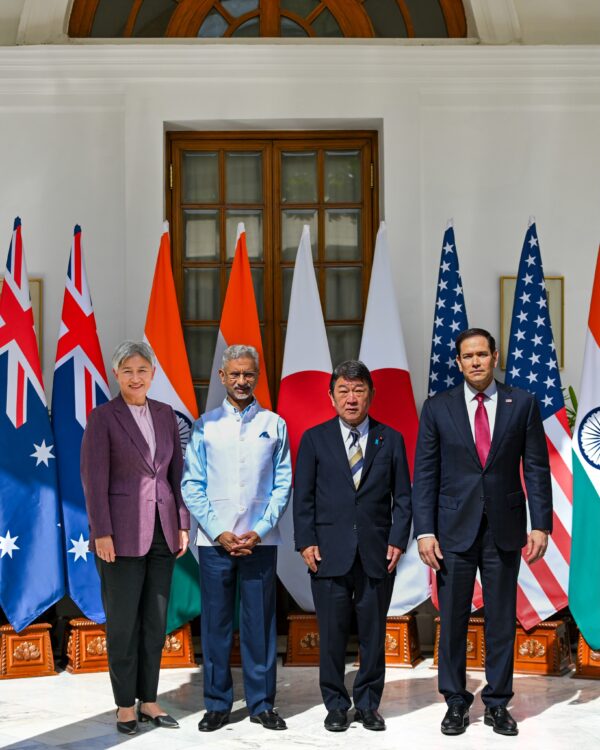
The Quad is not dead. Some are declaring its demise, but this week’s meeting of the foreign ministers of Australia, India, Japan, and the United States in New Delhi is uplifting proof of life amid the world’s state of crisis.
As China gathers strength, the Quad is indeed becoming ever more valuable, including to the United States.
Doubts about the group’s survival have grown because the Quad’s national leaders haven’t met since 2024. Politico cited analysts pointing to U.S. President Donald Trump’s lack of interest in the grouping. Writing in Foreign Policy, Sarang Shidore of the Quincy Institute described “a perceptible sense that the Quad is fading away.” The Times of India said the Quad “is quietly losing steam.”
Last year’s planned meeting of Quad leaders was reportedly canceled due to tension between Washington and New Delhi. But even the lack of a leaders’ meeting for a second year should cause no alarm.
Daily Quad work directed and checked by annual leader meetings would be ideal, but for the time being the foreign ministers meeting is what’s needed. Continuity of contact and action is necessary at all levels in the Quad, and foreign ministers are the ones who drive it forward.
People are talking about the Quad’s demise only because its meetings did reach leader level in 2021. But the Five Eyes intelligence grouping doesn’t meet at the leader level, and no one doubts its vital importance. And while leaders established the AUKUS security partnership, to succeed it must be an ingrained part of the three nations’ defense systems.
Significantly, the focus of all these groups is the challenge from China. This was the reason for the Quad’s reestablishment in 2017 and its elevation to the level of foreign ministers’ meetings in 2019. Back then, there wasn’t even a joint statement, yet this didn’t make the group insignificant. Public-facing work, such as leaders’ meetings, is necessary, but even without it the Quad provides a vital mechanism for its members’ foreign policy and security communities to collectively counter China’s behavior.
Other international issues sometimes appear and draw members’ attention away from the Quad. Bilateral tensions within the Quad appear, too, as they did last year. But these are temporary, whereas the animating force behind the Quad, the challenge from China, is as permanent as anything gets in international relations.
The Quad should be seen as a permanent institution for Indo-Pacific stability and tomorrow’s meeting should answer, again, any questions about U.S. commitment.
Trump’s approach to international affairs does heavily stress personal relationships and bilateral agreements. He knows that the United States, like all major powers, can influence other nations’ policies directly, not necessarily through groups.
But the China challenge is too much to handle with bilateralism alone. It makes the U.S. alliance network and minilateral groups, such as the Quad, much more important for Washington.
China is increasingly confident. President Xi Jinping hosted Trump this month for their summit of rivals, and, as soon as Trump departed, Russian leader Vladimir Putin landed – not as a rival but as a partner in a public plan for global authoritarian domination. The Iranian foreign minister was in Beijing just before Trump’s summit, and Xi reportedly plans to visit North Korea soon.
The answer to the tests Beijing is setting is collective democratic action. This Quad meeting is just that.
For while closure of the Strait of Hormuz will be on the meeting agenda and probably dominate any public component, the top priority will be China. U.S. Secretary of State Marco Rubio will likely take his counterparts through the Trump-Xi summit. The Delhi meeting will be further reassurance that the U.S. has not abandoned the Indo-Pacific. As part of the summit debrief, the potential sale of U.S. weapons to Taiwan should feature and Rubio is likely to receive private support from his Quad colleagues.
For Australia, Japan, and India, the task is to continue investing in their national security as the most effective way to ensure Washington is confident that they’re not taking economic benefits from China while leaving the security burden to the United States.
India and Japan still grapple with border and territorial disputes with China. The Chinese navy circumnavigated Australia in the middle of an election campaign last year. For all Quad nations, Beijing’s objectives of technological supremacy, taking over Taiwan, ruling the South and East China Seas and dominating the Indian Ocean and Pacific island nations represent a threat to security and sovereignty. While much of this will be discussed privately, it would be positive to hear Quad nations express support for the Philippines.
There is now increased transparency on China’s foreign policy objectives, including its penetration into the Pacific through bribery and elite capture. Australian Foreign Minister Penny Wong will likely lead this topic and take her counterparts through unreported background. Given the significance of the Pacific to the Quad, it would be good to bring New Zealand into such discussions from time to time.
Reports of the Quad’s death are greatly exaggerated. The Quad should be a powerful part of a minilateral framework – also including the Five Eyes, AUKUS and the Squad, an informal arrangement that includes the Philippines – that gives the US and its allied network its greatest advantage over Beijing’s toolset of bilateral coercion.
The foreign ministers meeting reinforces the ongoing importance of the group. That is progress, as would expansion to defense and tech-focused ministers. In a world full of Quad ingredients, leaders’ meetings would just be the icing on the cake.
This article was originally published in ASPI’s The Strategist.
