

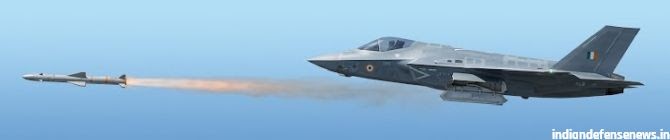
India has formally invited three private consortia to lead the prototype development of the Advanced Medium Combat Aircraft (AMCA), a ₹15,000 crore fifth-generation stealth fighter program.
This marks the first time Hindustan Aeronautics Limited (HAL) has been excluded from the prototype stage, signalling a historic policy shift towards private sector-led defence manufacturing.
Historic Private Push
For the first time in India’s defence aviation history, private firms will spearhead prototype development of a frontline fighter jet. The Ministry of Defence has issued a ₹15,000 crore Request for Proposal (RFP) for the AMCA program, fully funding the prototype phase. This decision reflects a deliberate policy to accelerate timelines, diversify manufacturing capacity, and reduce reliance on state monopolies.
HAL Left Out
Hindustan Aeronautics Limited (HAL), which has dominated India’s fighter jet production for decades, has been excluded from the prototype stage. Officials emphasise that this move is intended to foster competitive private sector participation, introduce advanced engineering capabilities, and break HAL’s monopoly in strategic aerospace projects.
HAL may still compete in the larger production tender once prototypes are validated, but its absence from early development marks a turning point in India’s defence manufacturing model.
Three In The Race
The shortlisted bidders are:
TATA Advanced Systems Limited (TASL)
L&T–BEL–Dynamatic Consortium (Larsen & Toubro, Bharat Electronics Limited, Dynamatic Technologies)
Bharat Forge–BEML–Data Patterns Consortium (Bharat Forge, BEML Limited, Data Patterns India)
Each consortium brings complementary strengths in precision manufacturing, electronics, systems integration, and advanced materials, critical to meeting the AMCA’s demanding stealth, avionics, and weapons integration requirements. Collaboration with the Aeronautical Development Agency (ADA) under DRDO will be central to delivering five flying prototypes and one structural test airframe.
Private Sector Takes The Lead
The prototype development will be centred at a new greenfield aerospace facility in Puttaparthi, Andhra Pradesh, designed to host advanced stealth aircraft assembly, systems integration, and flight testing. This facility, valued at around ₹2,000 crore, will be India’s first private-sector hub for next-generation fighter jet manufacturing. Defence Minister Rajnath Singh and Andhra Pradesh Chief Minister N. Chandrababu Naidu laid its foundation stone earlier this year, underscoring its strategic importance.
From Concept To Competition: The AMCA Journey
The AMCA is envisioned as a twin-engine, fifth-generation stealth fighter featuring:
Supercruise capability
Internal weapons bays
Advanced AI-driven avionics
Next-generation sensor fusion
Initial prototypes will be powered by the GE-414 engine, with later versions expected to incorporate indigenously produced Safran engines. The first prototype is targeted for 2027, with flight testing between 2028 and 2032, and operational induction expected after 2035. The Indian Air Force plans to induct seven squadrons of AMCA, placing India alongside the US, China, and Russia in the elite club of stealth fighter developers.
Defined Milestones
The bid opening for the AMCA stealth fighter is tentatively scheduled for 28 July 2026, with some vendors expected to raise issues in the RFP that will be resolved during the pre-bid meeting; price bids for those whose techno‑commercial bids are accepted will then be opened and a comparative statement prepared, with the successful bidder determined by the lowest price quoted — the ultimate cost to ADA being the deciding factor for bid ranking — and ADA reserving the right to call the lowest acceptable bidder (L1) for techno‑commercial negotiations if the indicated cost exceeds the budgeted estimate, evaluation of price bids being on a lot‑wise basis.
ADA also reserves the right to impose liquidated damages at 0.25% per week or part thereof (including taxes) for supplier‑attributable delays in delivery, up to a maximum of 10% of the total order/contract value, and in certain procurement categories LD may be levied on the basic cost of partially supplied stores that cannot be used due to late delivery of the remainder.

Strategic Significance
The AMCA program is not only a technological leap but also a structural transformation in India’s defence ecosystem. It is expected to:
Strengthen Atmanirbhar Bharat by reducing dependence on foreign suppliers.
Generate thousands of high-skill jobs in aerospace engineering, avionics, metallurgy, and composites.
Create spill over growth across metals, electronics, software, and advanced manufacturing sectors.
Enhance India’s combat preparedness against regional rivals, particularly as Pakistan eyes Chinese J-35 stealth fighters.
IDN (With Agency Inputs)
