

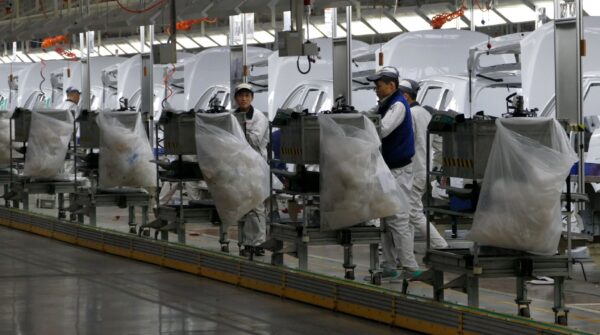
Beyond embodied intelligence and fusion energy, China’s 15th Five-Year-Plan contains a segment which may get overlooked: the so-called traditional industries. This code-name represents the low-tech industries which helped China industrialize in the past, including the emblematic Made-in-China textile industry. The fact that traditional industries remain high in the new priorities suggests that China intends to keep making low-tech goods alongside its push into advanced technology.
The question this raises is whether there is still room for other countries. If China competes simultaneously with both advanced and developing economies, is there room left for the rest of the world?
Why China Keeps Making Everything
As countries move up the value chain, they typically move on from relying on labor-intensive industries to more capital-intensive industries. For instance, Britain does not export large quantities of textiles as it once did in the 19th century, having shifted its economy toward knowledge-intensive and consumer-focused service industries, such as finance.
Anyone expecting this transition in China is still waiting. As articulated by Xi Jinping himself, China’s strategy is not to downgrade these industries into the “low-end” bracket or abandon them, but transform and upgrade them so they remain relevant on the global stage. This reflects Beijing’s broader desire to avoid deindustrialization.
Moreover, China aims to upgrade rather than merely retain these industries. Two ministries and three state institutions recently published an action plan to help enterprises accelerate the transformation to the higher end of the value chain, from “Made in China” to “Chinese Brands.”
Although China now has the capital and expertise necessary to grow capital-intensive industries, Beijing is simultaneously continuing labor-intensive manufacturing. A likely explanation is that the scale of China’s economy and uneven development among its provinces allow Beijing to move these industries inland rather than abroad – something no previous industrializing nation could do at comparable scale.
Staying with textiles, China continues to globally dominate in both overall production and exports, accounting for over 35 percent of the global market share, the largest share held among China’s manufacturing sectors. There are not many signs of Beijing’s loss of interest, as the National Bureau of Statistics (NBS) recorded a 4.3 percent year-on-year increase in investment in the textile industry, 5.2 percent in the apparel industry, and 12.3 percent in the chemical fibers. This growth outperformed all other manufacturing sectors.
The End of the Virtuous Cycle
As countries move up the economic ladder, wages increase and labor-intensive manufacturing becomes uncompetitive. The industries eventually migrate to lower-wage countries, where the same process repeats. Over time, as those countries grow wealthier and their costs rise, they move on to more advanced production. In East Asia, this cycle has defined development since the 20th century and has been termed the “flying geese” paradigm. The region’s industrialization has long been led by Japan as the lead goose. As Japan grew rich, its labor-intensive industries migrated first to the Asian Tigers, and later to China and Southeast Asia.
This virtuous cascade of industrialization and development now appears to be over, as China’s light industry overall has been expanding in recent years, and the migration is not happening at the predicted scale. The light industry in China still accounts for a quarter of all exports, remaining the largest export sector. Thus, China’s continued competitiveness in low-tech manufacturing exports is harming established manufacturers in Southeast Asia, not supporting industrialization.
The Financial Times reported that Malaysian and Indonesian labor-intensive manufacturing companies are going out of business because of the strong competition from Chinese exports. In Indonesia’s textile industry, this has led to 250,000 lost jobs since 2021. In the case of the Malaysian plastic industry, even protective trade measures of the Malaysian government did not help the sector from getting into trouble. Southeast Asia is also increasingly dependent on China for both industrial inputs and finished goods like EVs and green tech.
The Two Shocks
It appears that the “first” China shock, which describes the low-cost, low-tech Chinese exports destroying manufacturing in advanced economies (mainly the United States) during the 2000s, continues to shock economies – and just not the advanced ones.
On top of that, both industrializing and advanced economies are now going through the second China shock, which is impacting medium and high-tech manufacturing through China’s advantage and scale of manufacturing. This prevents industrializing economies from upgrading their industrial base and displaces established industries in advanced economies. The result is a Double China Shock – hitting developing and advanced economies alike, from opposite ends of the value chain.
The European Union and ASEAN have been most affected. For Europe, which was less devastated by the first China shock than the U.S. and managed to keep its industrial base, the second one became a “life-or-death moment,” according to French President Emmanuel Macron. The second China shock is impacting mainly Europe’s car industry, but also green industries such as solar and wind energy. EY reported that Germany, Europe’s largest economy and industrial core, has lost 1 in 20 industrial jobs since 2019 – a consequence felt beyond Germany’s borders, as Central and Eastern European economies deeply integrated into German supply chains absorb the knock-on effects.
The first issue of this shock lies in China becoming more self-sufficient, meaning it imports less from advanced economies. In Germany’s case, exports to China have dropped by 23 percent since 2022, caused mainly by the 66 percent decrease in car exports in the same period.The second problem is the increasing Chinese competition in third markets, such as Southeast Asia. The final issue is Chinese competition arriving in the home market, where Europe is facing an unprecedented surge in Chinese EV imports. Together, these three pressures leave European industry with few safe markets remaining.
Could Change Come From China?
The pressure could ease if China were to invest in manufacturing abroad and support localization, effectively migrating some of its industries. Chinese outbound foreign direct investment (FDI) has doubled since 2020, and greenfield investment in Europe reached a record in 2025. However, Rhodium Group research showed that counterintuitively, China’s recent FDI expansion does not support industrialization in the countries receiving its investment. Rather than bringing the benefit of localization, the FDI reinforces their dependency on Chinese inputs, technologies, and other high-value activities that Chinese multinationals retain at home.
China’s domestic trajectory could also shift the outlook. Last week, Beijing announced it was relaxing the hukou system, which has long hampered the labor force in less developed provinces. Making it easier for Chinese workers to migrate to higher-wage areas could, over time, push up wages in low-tech industries and erode their competitiveness. Whether this materializes, however, is uncertain, as Beijing is already investing heavily in automation, which could offset rising labor costs and keep low-tech manufacturing competitive regardless.
Shared Problem, Shared Solution: The Case for a Europe-ASEAN Partnership
The very fact that the Double China Shock impacts almost everyone creates unexpected common ground. Europe and Southeast Asia find themselves facing a version of the same problem, and that shared pressure opens space for cooperation neither side has previously prioritized.
First, Europe should understand what the China shock means for Southeast Asian countries. The region has long been a low priority for the EU, which is evident from the low number of free trade agreements between the bloc countries. The Double China Shock creates a political window to accelerate free trade negotiations with impacted ASEAN countries such as Thailand and Malaysia, and open new ones with other potential partners.
But trade agreements alone are not enough. Through direct investment in local manufacturing capacity using European technology, Europe can support a genuinely mutual diversification strategy: ASEAN gains an alternative to Chinese goods and a more stable export destination, while Europe gains diversified supply chains and a new market.
The timing matters. Southeast Asia’s long reliance on the United States as an export destination is becoming increasingly uncertain under the Trump administration’s tariffs – and those same tariffs are redirecting Chinese exports toward ASEAN, compounding the pressure the region already faces. The window will not stay open indefinitely. Recognizing that Europe and Southeast Asia are facing different expressions of the same shock is the first step toward turning a shared problem into a shared strategy.
