

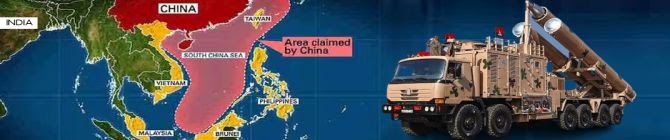
India’s expanding export of BrahMos supersonic cruise missiles is steadily transforming the strategic landscape of the Indo-Pacific, with the system poised to encircle the entire South China Sea.
This development signals a decisive shift in regional deterrence strategies, as Southeast Asian nations increasingly adopt land-based missile systems to counterbalance China’s growing naval power projection.
The BrahMos, jointly developed by India and Russia, is renowned for its speed of nearly Mach 2.8, precision strike capability, and versatility across land, sea, air, and submarine platforms. Its extended-range variants now offer strike envelopes exceeding 400 kilometres, making them a formidable tool for coastal defence and maritime denial.
The Philippines was the first foreign customer, signing a $375 million deal in 2022 for three shore-based batteries. Deliveries began in 2024, with operational deployment expanding across Luzon and the Luzon Strait.
These locations are critical choke points for monitoring Chinese naval movements. India has since offered Manila extended-range versions, enhancing its ability to deter hostile fleets across wider maritime corridors. Indonesia is now nearing a similar agreement, with Defence Secretary Rajnath Singh confirming that negotiations are in their final stages.
Reports suggest Jakarta will acquire coastal defence batteries akin to those supplied to the Philippines, with deliveries expected after contract signing. Vietnam too has expressed strong interest, seeking BrahMos to complement its Russian Bastion-P systems and bolster its layered coastal defence network.
Vietnam’s acquisition would be particularly significant, as it already operates Kilo-class submarines, Su-30 fighter jets, and has invested heavily in fortifying its island outposts in the South China Sea. Integrating BrahMos into this arsenal would raise the costs of coercion against Hanoi and entrench its territorial claims.
Together, the Philippines, Indonesia, and Vietnam form a triangle of missile-armed states capable of complicating Chinese naval operations across the South China Sea. Analysts describe this as a loose but increasingly coordinated deterrence arc of middle powers, cooperating without formal alliances yet united by shared security concerns.
India’s export diplomacy is closely tied to its Act East policy, which seeks to deepen strategic partnerships in ASEAN. By supplying BrahMos, India not only strengthens partners’ deterrence but also enhances its own conventional strike credibility.
The missile’s success has already boosted BrahMos Aerospace’s revenues, with FY26 figures crossing ₹5,200 crore, underscoring India’s rise as a global defence supplier.
Beyond exports, India continues to develop indigenous systems such as Agni and Pralay, which could be integrated with its export diplomacy to create a networked deterrence framework spanning the Indo-Pacific.
The strategic implications are profound. One scenario envisions India and its partners establishing a layered missile shield across Southeast Asia, effectively denying China uncontested access to critical sea lanes.
This would force Beijing to reconsider its naval deployments and increase the risks of escalation. Another scenario warns of an accelerated arms race, as China responds with expanded missile deployments and naval modernisation, compelling India and ASEAN states to balance deterrence with escalation management.
Exercises such as Balikatan 2026, where Philippine BrahMos units operated alongside US Typhon and NMESIS systems, highlight the growing interoperability between regional partners and external allies, further complicating China’s strategic calculus.
The encirclement of the South China Sea with BrahMos batteries represents a turning point in regional security. It reflects a broader trend of cost-effective, land-based deterrence strategies replacing expensive blue-water naval investments.
For China, this development is a cautionary signal: its naval dominance will increasingly be challenged not by rival fleets, but by dispersed missile networks capable of striking with speed and precision. For India, it marks the consolidation of its role as a trusted defence partner and a rising power shaping the Indo-Pacific’s security architecture.
IDN (With Agency Inputs)
