

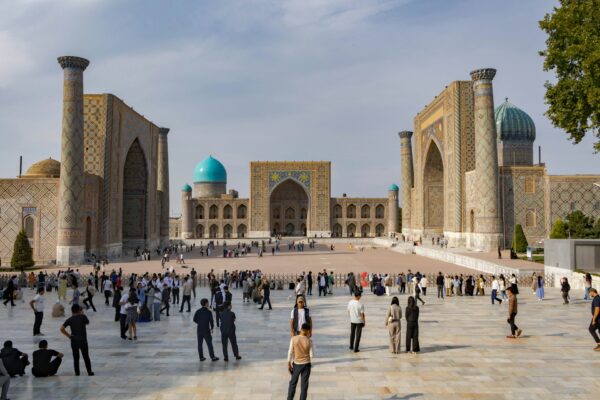
In late May, the National Statistics Committee of Uzbekistan announced that the country’s tourist intake within the first four months of 2026 increased 29 percent compared to the same period last year, with the overall number of tourists exceeding 4 million.
The latest figures are part of a broader trend that has transformed Uzbekistan into one of Central Asia’s fastest-growing tourism destinations. Last year reportedly 11.7 million people visited the country, a 46.8 percent increase, or 3.7 million more, than in 2024.
Although the statistics indicate that tourists come from over 200 countries across the globe, the majority come from Uzbekistan’s immediate neighbors. Kyrgyz citizens account for the largest share, with 3.3 million visits in 2025 alone, followed by visitors from Tajikistan (2.7 million) and Kazakhstan (2.7 million). Even Turkmenistan, one of the region’s least accessible countries, accounted for 370,000 arrivals in 2025.
The scale of growth is particularly striking when viewed over a longer time period. Uzbekistan’s 11.7 million visitor arrivals in 2025 were 333.3 percent higher than in 2017 (2.7 million), amounting to a 4.3 fold increase over the country’s pre-pandemic tourism figures.
The Statistic’s Committee, an “authorized state body,” labels these visits as “for tourist purposes.” But is this a genuine tourism boom? The statistics hide a great many nuances.
The “boom” is politically enabled, but is socially rooted. Since the change of government in 2016, Tashkent has taken drastic measures to transform Uzbekistan into a prime tourism destination with a particular focus on historic places such as Samarkand, Bukhara, and Khiva. Uzbekistan has liberalized its visa regime, allowing citizens of more than 90 countries to enter visa-free, while nationals of dozens of other states can obtain electronic visas through a simplified online application system.
Under Shavkat Mirziyoyev’s regime, Uzbekistan pursued regional policies focusing on integration. In particular, relations with Kyrgyzstan and Tajikistan were normalized, borders reopened and border disputes were resolved. Uzbekistan sought to frame the country as a “safe destination.” Tashkent’s tourism-oriented policy went to such lengths that “tourist police” were introduced, tasked with ensuring the safety of tourists.
These efforts re-branded Uzbekistan. It was named the country of the year by the Economist in 2019 and named the safest country in the world according to the “Safety Perception Index 2023.” This “boom” has also fueled the country’s economy. Tourism revenues increased from $1.3 billion in 2019 to $3.5 billion in 2024, providing hundreds of thousands of people with jobs locally.
However, politics are not the only reason for the “boom” in numbers.
Post 2016 government-change, Tashkent’s policies enabled the renewed flourishing of phenomena that have always been present in the region but were restricted due to cross-border disputes in independent Central Asia, especially in the densely populated Ferghana Valley: family ties, bazaars, shuttle trade, labor, services, and the integrated geography of the region.
That’s why the majority of Uzbekistan’s visitors come from Kyrgyzstan, Tajikistan, and Kazakhstan – people visit their families and do small-scale cross-border commerce (shuttle-trade and petty trade) where they cross borders regularly or are involved in short-term income-seeking mobility. Statistics flatten these differences when everything is labeled as a “touristic visit.”
Almost half a million tourists from Afghanistan also show Uzbekistan’s wider connectivity agenda. By normalizing relations with Kabul, Tashkent does not necessarily expect a major tourist influx from Afghanistan. But Afghanistan remains central to Uzbekistan’s South Asia strategy, trade corridors, Termez logistics, and the Trans-Afghan railway vision. The statistics also do not clarify if the half a million Afghan tourists traveled throughout Uzbekistan or just visited the AIRITOM Free Economic Zone – International Trade Hub in Termez, which allows Afghan citizens visa-free entry for 15 days. The majority of those who visit the hub seek business or medical services, not leisure or historic sight-seeing.
Regardless of these flattened nuances, this boom gives Uzbekistan leverage. Mobility does not give Tashkent political control, but provides it with regional influence. Increased regional mobility with Uzbekistan at the center creates regional dependency on open borders, shared markets, transport routes, and Uzbek infrastructure.
Uzbekistan’s mobility boom is not a conventional tourism success story. It is the marketization of historical connectivity where old social and geographic ties are being reactivated through new infrastructure, trade, services, and state-led connectivity strategies.
