

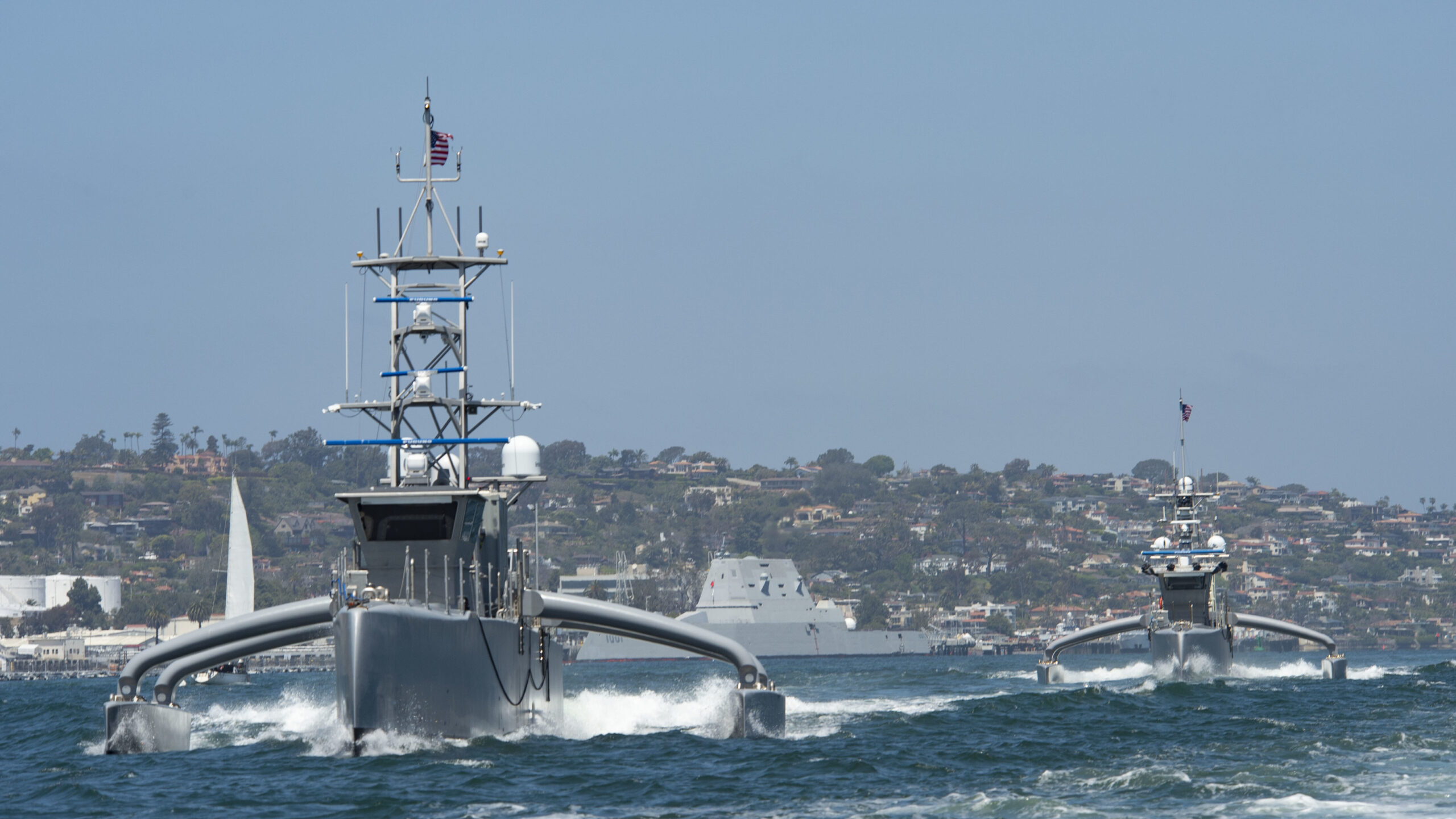
WASHINGTON — The Navy has named the seven defense firms who submitted their designs for the new medium unmanned surface vessel (MUSV) marketplace in April that will advance to the prototype testing phase.
The following companies will complete at-sea testing starting next month:
- Leidos
- Huntington Ingalls Industries (HII)
- Sea Machines
- Saronic Technologies
- Galliano Marine Services
- PacMar Technologies
- Birdon
Companies who successfully complete the at-sea testing, which is expected to wrap up in October, will receive $15 million and qualify for follow-on production, the Navy said in a news release on Friday.
Leidos has several MUSV designs, including the Seahawk that is scheduled to accompany the aircraft carrier Theodore Roosevelt on its upcoming deployment. Meanwhile, HII has its Romulus family of USVs, powered by the company’s AI-driven control suite known as Odyssey, which the company credits as a “key differentiator of our solution.”
“Demonstrated across programs supporting the U.S. Navy, U.S. Marine Corps, U.S. Coast Guard, and allied partners, Odyssey enables intuitive command and control of autonomous platforms and swarms across domains, enhancing fleet lethality, survivability, and operational effectiveness,” Andy Green, executive vice president of HII and president of HII’s Mission Technologies division, said in a statement today.
Sea Machines previously announced in February that its STEAMRACER MUSV design was competing in the Navy’s Modular Attack Surface Craft (MASC) program that preceded the MUSV marketplace. Saronic announced Friday that its Marauder MUSV was kicking off on-water trials.
PacMar and Birdon did not immediately respond to a request for comment from Breaking Defense. Galliano Marine Services could not be reached by Breaking Defense.
The Navy confirmed to Breaking Defense on May 22 that seven MUSV marketplace submissions had been selected to advance to the prototype evaluation phase. USNI News first reported that seven designs were chosen.
The Navy revealed the marketplace as part of a new acquisition model designed to replace MASC, and provide a blueprint for obtaining other autonomous systems, Rebecca Gassler, the portfolio acquisition executive (PAE) for robotic and autonomous systems (RAS), told reporters in March.
Gassler didn’t disclose then the mission set these vessels will fulfill, but said there’s several operational needs they could complete, supporting tailored force packages detailed in Chief of Naval Operations Adm. Daryl Caudle’s Fighting Instructions guidance, released in February.
Designs submitted were required to carry at least two 40-ft shipping containers, and travel 2,500 nautical miles at 25 knots in sea state 4 conditions while outfitted with a 25-metric-ton load on the payload deck, the solicitation document for the marketplace said.
Marketplace funding originated from President Donald Trump’s “One Big Beautiful Bill” that passed in July 2025, and included roughly $2.1 billion for MUSVs.
