

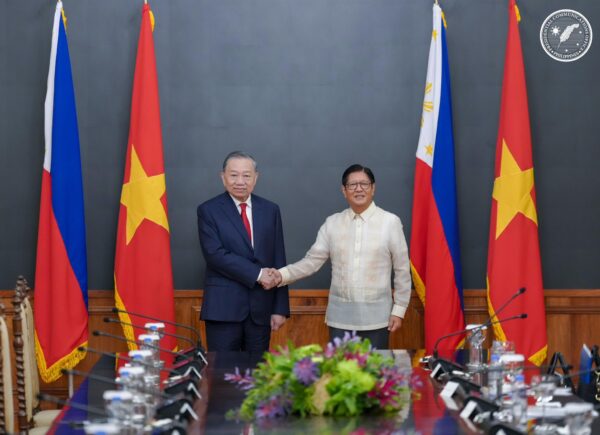
The Philippines and Vietnam have agreed to elevate their relationship to an enhanced strategic partnership, President Ferdinand Marcos said today in Manila, while hosting Hanoi’s top leader To Lam.
Lam arrived in the Philippines yesterday for a two-day state visit aimed at deepening bilateral cooperation between the two nations, the first ever by a leader of the Communist Party of Vietnam (CPV).
During a joint press conference following his meeting with Lam, Marcos said that the Philippines and Vietnam shared a common interest in “maintaining peace, stability and a rules-based order in our region” at a time of growing global instability.
Marcos said that the elevation of the partnership “reaffirms Vietnam’s unique and enduring position as the sole strategic partner of the Philippines in Southeast Asia.” The future of the relationship, he added, will be “defined by wider pathways for cooperation, stronger political and defense cooperation, and closer linkages between the Filipino and Vietnamese people.”
In response, Lam described the Philippines as an “important regional partner of Vietnam,” stating that the two nations were united by their commitment to peace and stability. “We always wish to work closely with the Philippines to further elevate our strategic partnership to a greater height with ever increasing substance, comprehensiveness and effectiveness,” he added.
Lam also laid a wreath at the Rizal Monument in Manila, and was set to visit the Philippine Senate. However, the latter was reportedly canceled, presumably due to the cloud of political controversy that is currently engulfing the chamber.
Lam’s visit comes ahead of the 50th anniversary of the establishment of diplomatic relations between Hanoi and Manila, which falls on July 12. It also comes 10 years after the two nations upgraded their ties to a strategic partnership, in large part due to their shared concern about China’s increasingly assertive behavior in the South China Sea.
At the time, China had recently begun the reclamation of reefs in the Spratly Islands and their construction into island fortresses, in order to assert its maximalist claims in the South China Sea. In 2024, Marcos stated that “maritime cooperation is the foundation” of the strategic partnership.
Speaking today, he said that he and Lam reaffirmed that “maintaining peace, stability, and the freedom of navigation and overflight in the South China Sea remains non-negotiable.” He added that both nations “remain resolute in their commitment to the peaceful resolution of disputes grounded firmly in international law,” including the United Nations Convention on the Law of the Sea (UNCLOS) and the 2016 arbitral ruling that found that most of China’s South China Sea claims were invalid under UNCLOS.
Since its establishment, Manila and Hanoi have agreed to increase high-level contacts between their militaries through joint naval patrols, training, and exercises. In 2024, they held their first joint coast guard exercises in the South China Sea. The two nations have also worked to resolve their own overlapping claims in the South China Sea, agreed to boost cooperation between their coast guards and work to prevent incidents in contested waters.
Among the four agreements that were signed by the Philippines and Vietnam today was a renewal of the Memorandum of Understanding (MOU) on Defense Cooperation between the two nations’ defense ministries, first signed in 2010, which Marcos said would lead to increased collaborations in joint exercises and military education.
Lam arrived in Manila after giving the keynote speech at the Shangri-La Dialogue in Singapore, during which he said that there were three primary crises facing the world, including the erosion of international rules and law, a crisis of development models characterized by slowing growth and climate change, and a crisis of trust among nations.
“The three crises confronting our world today are not inevitable realities that we are bound to accept,” Lam said, calling for a reinforcement of international law, the creation of inclusive and sustainable drivers of growth, and greater dialogue and transparency.
