

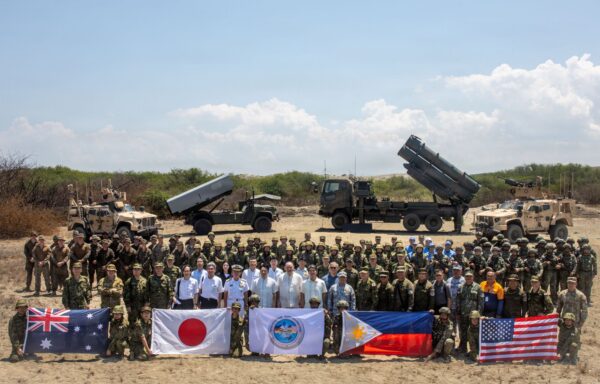
For 18 days in late April and early May, a force of 17,000 personnel, primarily from the Philippines, Japan, and the United States, gathered across an increasingly strategically relevant Southeast Asian archipelago for Balikatan 2026. Despite the insistence of exercise public affairs officers, there was only one adversary that these drills could be preparing to confront.
U.S. Indo-Pacific Command (INDOPACOM) chief Adm. Samuel Paparo proclaimed this Balikatan as a “rehearsal” for the defense of the Philippines. This was a significant step-up from past iterations, which focused on generic internal security issues and humanitarian operations.
The shift began in earnest in Balikatan 2022, a year in which Washington and Manila started to revitalize a relationship that had become strained under President Rodrigo Duterte. Their focus was to put up a signal to deter escalatory actions from Beijing’s maritime forces in the South China Sea. Balikatan’s gaze shifted west, with a milestone ship-sinking demonstration within 250 kilometers of Scarborough Shoal that was attended by Philippine President Ferdinand Marcos Jr. in 2023.
In 2024 and 2025, the focus of the drills slowly but surely oriented toward the northern edges of Luzon, in close proximity to Taiwan. The Batanes Island Group, Ilocos Norte, and Cagayan received an influx of Philippine and American troops. They were then reinforced by new basing agreements, missile deployments, and military construction projects in key areas.
2026 not only continued this pattern, but significantly expanded the drills’ intensity, focus, and complexity across multiple realms crucial in a potential contingency involving Manila, Washington and Beijing – whether one in the South China Sea or the Luzon Strait.
Balikatan’s evolution has always reflected the deepest concerns and priorities of the U.S.-Philippine alliance. In 2026, the exercise now reflects the focal point of Indo-Pacific priorities from the U.S. and its allies in the northern reaches of the Philippines.
Balikatan 2026’s Circumstances and Challenges
Historically, those who are on the defensive in the Philippine archipelago have a poor track record of success. Between 1898 and 1944, all invasions of the Philippines succeeded despite the best efforts of the defender.
Today’s circumstances are perhaps some of the most challenging for the defender since the Japanese and American invasions during the Pacific War.
Aside from solidifying Beijing’s territorial claims, the People’s Liberation Army Southern Theater Command has a plethora of warships, fighters, bombers, reconnaissance assets, and amphibious-capable contingents that can be rapidly mobilized against the Philippines. These advanced and multi-mission assets could be staged and sustained up to 230 kilometers from Philippine shores at a collection of artificial island military bases in the Spratly Islands. Chinese forces can also call upon a vast arsenal of cruise, ballistic, and hypersonic missiles.
They are further supported by hundreds of paramilitary vessels from the Chinese Maritime Militia and China Coast Guard, which expand maritime domain awareness and sensor coverage for Chinese commanders. This force has demonstrated its flexibility against the Philippines over the last decade through China’s hybrid approach toward asserting its territorial claims in the South China Sea. With an overmatch this severe in peacetime, it is hard to emphasize how drastic the situation could be in wartime.
Philippine Marines with the 68th Marine Company, Force Reconnaissance Group, prepare to insert into the Batanes island chain for maritime key terrain security operations during Exercise Balikatan 2026 at Cagayan North International Airport, Lal-lo, Philippines, Apr. 26, 2026. (U.S. Marine Corps photo by Sgt. Iyer Ramakrishna)
To further complicate matters, the infiltration of Philippine society by what the Armed Forces of the Philippines (AFP) calls “United Front Works” (UFW) has the potential to inflict serious damage on the country’s infrastructure and response capabilities in the event of a conflict. In recent years, suspected Chinese spies have been detained collecting sensitive information near government and military facilities in Manila, Subic Bay, and Palawan. A mayor of a town in Luzon was also revealed to be a Chinese national in 2024. Meanwhile, nearly half of the Philippine national power grid is controlled by China.
It is not difficult to see how an adversary like China might exploit these gaps in the event of a conflict.
It is these challenges that U.S. and Philippine planners must contend with, and are attempting to counter through the recent Balikatan drills. They face an enormous challenge from an adversary with numerous capabilities that can be quickly mobilized within the region and potential avenues for disruption from within the Philippines itself. 2026’s iteration of the exercises showcased some of the most intensive efforts to defend against these threats.
Luzon’s Importance in a Taiwan Contingency
For many, Philippine national security begins and ends with the South China Sea – or at least that might have been the case in the 2010s. A new focus for Manila is on the country’s northern territories and how a Chinese invasion of Taiwan might impact them.
Within the last two years, the Philippine political and military leadership, from AFP Chief of Staff Gen. Romeo Brawner to President Marcos, have repeatedly stated that whatever happens in Taiwan will also affect the Philippines. Alongside the large number of Overseas Filipino Workers residing in Taiwan, Luzon’s geographical proximity has been frequently cited. Located only 320 kilometers away from Taiwan, Luzon is the closest landmass to Taiwan aside from mainland China.
From the deployment of mobile missile launchers and dispersed combat aircraft, the devastating potential of U.S. forces from Luzon to take part in offensive operations against China or defensive operations in support of Taiwan cannot be understated. Strikes from Luzon can easily reach the waters around Kaohsiung, Taipei’s largest port and likely site of a Chinese landing in the event of an invasion.
A string of Philippine islands dot the strait between Luzon and Taiwan. If missiles and sensors were stationed on these islands, they could play an important role in the event of an attack or defense of Taiwan. From the Batanes and Babuyan Islands, a country could potentially control, or at least hinder, another’s ability to transit the first island chain.
These geographical realities have resulted in a security dilemma for all parties involved. The Philippines wants to deter China from eyeing the islands for its own military use. While supporting these efforts, the U.S. wants to deter China but may also view the strategic northern areas as a support base for Taiwan contingency operations. Beijing’s options during an invasion of Taiwan would be constrained if these strategic areas are not dealt with in a manner that keeps interventionist forces out.
Influencing all of these perspectives are recent territorial tensions, Chinese coercive actions in disputed waters, and ongoing great power competition.
These conditions mirror how Japan viewed the Philippines during the Pacific War. In order to access the resources of Southeast Asia, Tokyo needed to deal with the Philippines due to its strategic location next to the sea lines of communication necessary for the seizure and extraction of resources from the rest of the region. Neither the Philippine Commonwealth nor the U.S. was explicit military objectives. But their geographic position adjacent to the primary goals of Imperial Japan’s Southeast Asian conquests meant that they were too important to leave untouched.
Regardless of the motivations, the preparations, deployments, and posturing of Manila and its allies in northern Luzon for Balikatan have identified what the Philippines would need to defend should a conflict over Taiwan take place.
Dispersed Logistics, Coastal Defense Forces, and Area Denial Demonstrations
Balikatan 2026 immediately set itself apart from previous iterations of the exercise thanks to the logistical actions its planners carried out weeks before the official beginning of the drills.
In past exercises, American forces funneled vessels through the established facilities at Subic Bay – a major port and former U.S. naval station that is well equipped to accommodate such inflows of containers, vehicles, and personnel. However, with China’s arsenal of long-range missiles and virtual supremacy in the South China Sea, the utility of Subic’s facilities in wartime may be limited.
U.S. Marine Corps equipment was first offloaded at a port in Northern Mindanao, a southern island, before being placed onto contracted civilian vessels for further transport to exercise areas in northern Luzon. The mass use of host-nation civilian assets, as well as the deployment of supplies and vehicles from a less exposed area to the South China Sea, is a significant step for logistics in the Balikatan series.
During 2026’s iteration, an extraordinary number of missile deployments from the U.S. and Japan dotted the islands and coasts of the Philippines. Of 10 highly-publicized deployments and live-fires, six occurred in northern Luzon.
In the Luzon Strait, American Green Beret special forces troops controlled a Ukrainian-derived kamikaze unmanned surface vessel to sink a ship off Batanes. This was the first time American forces demonstrated this capability, which has proved pivotal in Kyiv’s mission to box in Russia’s larger conventional Black Sea fleet, in the Indo-Pacific.
The U.S. Army showed off its newly procured equipment, formations, and tactics designed for a fight against China at Balikatan 2026. Notable efforts included the dropping of buoys from its helicopters, maritime patrols and amphibious invasion interdiction with AH-64 Apaches, the maneuvering of missile launchers onto remote islands with watercraft, and the use of a recently established logistics hub at Subic Bay.
Supporting these strike capabilities were a network of drones and sensors created by the Philippines, Japan and the U.S. Command and control of the multi-national force was enabled by a recently developed mission network sponsored by INDOPACOM. The command structure itself was managed through U.S.-Philippine combined coordination centers, also funded by Washington’s increasing military construction efforts, located across the country.

A Japan Ground Self-Defense Force Type 88 Surface-to-Ship Missile System assigned to the 1st Artillery Brigade, fires while positioned next to a Navy-Marine Expeditionary Ship Interdiction System and Marine Air-Defense Integrated System during Exercise Balikatan 2026 at Paoay Sand Dunes, Philippines, May 6, 2026. (U.S. Marine Corps photo by Sgt. Jonathan Beauchamp)
When combined, these forces fired salvos of Japanese anti-ship missiles, U.S. M142 High Mobility Rocket Artillery System munitions, and a Tomahawk cruise missile over the course of a few days during Balikatan’s concluding drills.
The combined joint force also trained for a contingency in which enemy forces attempted to storm a beach, during a massive counter-landing drill involving Philippine, Japanese, Canadian and American ground troops. Swarm and one-way attack drones buzzed through the skies, striking mock targets replicating Chinese ZBD-05 amphibious assault vehicles.
Among the clutter of logistical maneuvers, missile deployments, and mass troop movements, one activity of note occurred at Cagayan North International Airport. This Philippine facility was designated for U.S. access under a 2023 provision to the Enhanced Defense Cooperation Agreement (EDCA).
U.S. Marines practiced riot control at the northern Luzon EDCA site, although the objective for the training at this location was not specified by exercise planners. However, the activity does indicate a consideration by exercise planners to deploy units capable of dealing with certain situations that could arise during the use of these bases by American forces in a Taiwan contingency.
What Lies Ahead for Balikatan 2027?
Balikatan 2026 established that Manila and Washington, alongside a coalition of other partners, could create a network of capabilities sufficient enough to defend the Philippine archipelago from external threats, specifically those in the vicinity of northern Luzon.
As more facilities funded by Washington through efforts such as the Pacific Deterrence Initiative come online in the Philippines, so do more options open up for American and Philippine commanders in a future contingency. Improvements to air bases, the creation of prepositioning facilities in Luzon, and a planned fuel depot in Mindanao have increased the capabilities of American forces deployed for Balikatan.
While the AFP is set to acquire new missiles, warships, aircraft, and drones under its modernization program, the real benefit for Philippine forces is the exposure to the command and control structure of their American partners. Picking up these aspects will go a long way in developing the AFP from its current counter-insurgency oriented posture.
Meanwhile, Japan wants to bolster ties with the Philippines under a broader plan of strengthening friendly states through its Free and Open Indo-Pacific vision. Luzon’s large expanses also offer the Japan Self-Defense Force a relatively close training area, something that Japanese officers expressed great interest in during this year’s Balikatan. These combined training activities would not have been possible without the recent Reciprocal Access Agreement between the Philippines and Japan.
In its mission to solidify a defensive posture against forces attempting to seize northern Luzon, the exercises have the potential to expand into a general wartime posture drill aimed at guaranteeing reliable sea lines of communication and access to the Philippine archipelago to support forces focused on the Luzon Strait. This was the reason Balikatan 2026 expanded its logistical activities in Mindanao to enable the access and sustainment of forces planned to defend the north.
While this year’s iteration debuted numerous milestone achievements – it involved the most participants of any previous exercise, featured Japan’s debut, and the first-ever launches of cruise and anti-ship missiles – it has also set the stage for more complex Balikatan exercises going forward. These exercises are set to focus further on the territorial defense needs of the Philippines amid an increasingly uncertain security situation to its north.
