

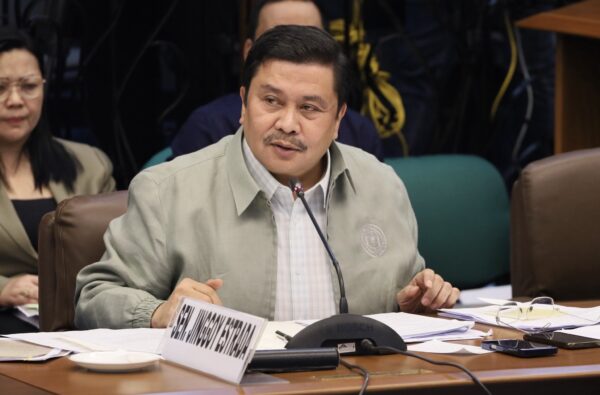
A Philippine senator surrendered to police yesterday after a court ordered his arrest over a charge that he received kickbacks as part of an infrastructure corruption scandal that erupted into large public protests last year.
The anti-graft court Sandiganbayan ordered the arrest of Senator Jose “Jinggoy” Estrada for plunder, a non-bailable offense under Philippine law. This came after the Office of the Ombudsman last week charged Estrada with violating anti-corruption laws for taking “kickbacks” amounting to 573 million pesos ($9.3 million) in connection with government-funded flood control projects.
Estrada also faces two counts of graft related to the scandal, for which he posted bail after an arrest warrant was issued on May 29. A charge of plunder can only be pursued if the amount of misappropriated funds in question total at least 50 million pesos ($808,000).
Estrada has denied the allegations, which are based on the testimony of a former government public works engineer, but said that he would surrender to police rather than seek the protective custody of the Senate, Rappler reported.
“I will defend myself till the end,” Estrada told a press conference yesterday. “I am ready to defend myself before the court and I will not hide behind the institution to evade the process,” he added.
Senate President Alan Peter Cayetano then accompanied Estrada to the Philippine National Police headquarters at Camp Crame, where police took his mugshot and fingerprints.
Estrada, 63, is the son of former President Joseph Estrada, who was impeached in late 2000 and was subsequently forced to resign amid mass protests early the following year. Estrada served as a senator between 2004 and 2016, before being re-elected to the upper chamber in 2022. According to Rappler, this is the third time that Estrada has been accused of plunder, although he was acquitted on both previous cases.
With his arrest, Estrada becomes the seniormost official to be detained during the course of the flood control scandal, which erupted last year after President Ferdinand Marcos Jr. blamed corruption for weeks of severe flooding and promised to investigate the issue thoroughly.
An internal government audit later revealed that “thousands” of flood control projects “were either substandard, poorly documented, or non-existent,” prompting a series of massive anti-corruption protests in Manila and other cities. Several government officials, politicians, and owners of construction firms have been accused of taking kickbacks from the projects, but this is the first time a sitting lawmaker has been arrested in connection with the scandal.
However, Estrada claimed yesterday that his arrest was part of the complicated and extremely bitter political feud that has raged between President Ferdinand Marcos Jr. and the family of former President Rodrigo Duterte over the past two years.
The locus of the feud is currently the Senate, which will soon begin the impeachment trial of Vice President Sara Duterte, Rodrigo’s daughter. On May 11, Duterte was impeached by the House of Representatives for a range of crimes, including corruption, misuse of government funds, and an alleged plot to assassinate Marcos. If convicted by the Senate, which requires the vote of at least 18 of the 24 senators, she would be removed from office and banned from elected office for life.
Estrada is a member of the pro-Duterte Senate majority, which last month launched a leadership coup and installed Cayetano in the chamber’s presidency, in order to influence the course of the impeachment trial and ensure Duterte’s acquittal.
Before leaving the Senate to surrender, Estrada suggested that he was being targeted for being aligned with the Dutertes and claimed that the charges were an attempt to get him to switch sides.
“There were many offers to drop the charges against me, but I did not entertain them,” he said, as per the AFP news agency. “What is at stake here is the independence of the Senate.”
Another subplot to the Senate drama is the ongoing manhunt for another pro-Duterte senator, Ronald “Bato” Dela Rosa, who is wanted by the International Criminal Court (ICC) for his prominent role in the anti-drug campaign waged by Former President Rodrigo Duterte, Sara Duterte’s father. Duterte is currently awaiting trial at The Hague-backed court, after his arrest and extradition in March 2025.
Dela Rosa, who served as Philippine National Police chief for the first two years of Duterte’s presidential term, is wanted for his role in leading the drug war, which killed as many as 30,000 people during Duterte’s 2016-2022 presidential term.
On May 11, Dela Rosa emerged from six months of hiding in order to cast the deciding vote for the Senate leadership coup that installed Cayetano as president. But after being confronted by officials from the National Bureau of Investigation, who were attempting to arrest him on the ICC warrant, he fled into hiding – but not before locking himself inside his Senate office for several days amid chaotic scenes.
While the Dutertes still appear to have enough Senate votes to stave off impeachment – their majority numbers 13 senators, and only nine are needed to acquit Duterte – it is possible that public pressure and maneuvering by the Marcos camp could sway enough members to secure a conviction.
Senator Joel Villanueva, another member of the pro-Duterte majority, is also being investigated by the Department of Justice for his role in alleged corruption related to flood control projects.
Estrada may still be able to participate in the impeachment trial by requesting and obtaining a leave of court to attend in person. Dela Rosa’s situation remains less clear. One current goal of the pro-Duterte majority is to change the Senate’s rules to ensure that he is able to dial in remotely during the impeachment vote, but it is unclear when and how this might take place.
With the Marcos-Duterte feud continuing to combust, these legal and procedural questions are likely to be a hot issue of contestation in the weeks to come.
