

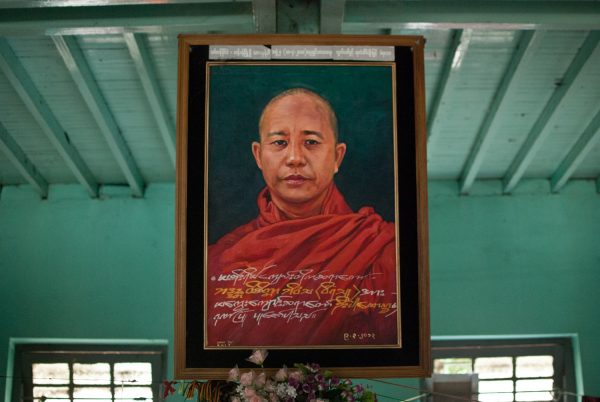
In February 2026, Myanmar’s widely condemned “sham” general elections received a public endorsement from Ashin Wirathu, the founder of religious fundamentalist movements 969 and Ma Ba Tha and a figure long associated with incitement against defenders of gender rights seeking to advocate against a patriarchal Bamar-Buddhist vision of Myanmar.
The endorsement was not incidental. By lending the junta a claim to religious legitimacy, Wirathu illustrated what Asia Centre’s new report, “Religious Fundamentalism in Myanmar: Post-Coup Repression of Gender Rights,” documents at length: that Buddhist fundamentalism functions in post-coup Myanmar not as a parallel force to military authoritarianism, but as an integral component of it.
This alliance predates the 2021 coup. Since the 1960s, successive military regimes have drawn on Burmanization and Buddhization policies to consolidate a centralized, patriarchal Bamar-Buddhist national identity. What has changed since the coup is their re-emergence and coordination in deploying this ideological framework.
Among the targets are advocates for women’s, gender and sexual minority (WGSM) rights, who are systematically framed as threats to national culture, religious tradition and social stability – and, therefore, national security. However, to date, this intersection between religious fundamentalism, authoritarian control and gender rights activism has received little attention.
Aiming to highlight this intersection, the Asia Centre report identifies three interlocking mechanisms through which this repression operates.
First, the junta weaponizes legislation – both existing statutes and laws introduced since 2021 – to criminalize WGSM advocacy and expand surveillance. Religious language is incorporated into this legal architecture to reframe state repression as the defense of moral and cultural order.
Second, physical violence against WGSM defenders is carried out by a range of actors, from the security apparatus to militias and civilian mobs, often encouraged or publicly legitimized by fundamentalist monks. These attacks are routinely framed as acts of religious duty.
Third, online spaces have become primary sites of organized harassment: pro-military and Buddhist fundamentalist actors use social media platforms to spread hate speech, conduct doxing campaigns and coordinate incitement against activists; while the junta have been deploying AI-enabled surveillance to monitor and suppress digital dissent.
In response, WGSM organizations have developed protective strategies across several dimensions: encrypted communications, emergency relocation mechanisms and digital security training, peer networks for resource-sharing and psychosocial support, cross-border partnerships with international donors, engagement with the National Unity Government (NUG) for political legitimacy, and sustaining advocacy toward the incorporation of gender-sensitive policies in a possible democratic Myanmar.
These strategies represent real and necessary adaptations among WGSM rights advocates. But they are insufficient. Security protocols developed primarily for urban, majority-context organizations translate poorly to the conditions faced by WGSM activists operating in rural, ethnic minority areas, or in displacement or conflict zones. Meanwhile, civil society support networks remain fragmented along organizational and identity lines, reducing the collective resilience of a movement that faces coordinated repression. International funding, already under pressure for a period, has contracted further following the 2025 withdrawal of U.S. foreign aid, removing a significant source of long-term support for grassroots actors. And while the NUG offers symbolic alignment and some limited funding and support, it lacks territorial control, sustainable funding and the enforcement capacity needed to provide material protection.
The February 2026 elections introduced a further risk. The junta’s move to institutionalize itself through the electoral process – however illegitimate that process is – has already encouraged international actors to resume engagement with junta-linked structures or to reduce pressure on the basis that a political transition is underway. However, Wirathu’s endorsement of this so-called transition points to a critical point: the religious fundamentalist logic that enabled the repression of WGSM defenders will continue to be enlisted.
In this context, therefore, the protection of WGSM rights defenders is not a secondary concern within Myanmar’s democratic recovery. It is a direct measure of whether that recovery produces a genuinely pluralistic political order or reconstitutes hierarchy under different institutional forms.
Buddhist fundamentalism will not recede from Myanmar’s political landscape with just the surface-level removal of military rule; its networks are too deeply embedded in the legitimation of governance, and its function too useful to those who benefit from excluding women, LGBTQI+ people, and religious minorities from political life. Addressing it requires the pro-democracy movement to treat pluralism, gender justice, and religious freedom not as aspirational additions to a democratic platform, but as structural conditions for one.
This op-ed is based on Asia Centre’s new report, “Religious Fundamentalism in Myanmar: Post-Coup Repression of Gender Rights.” Download the full report here. For more information about Asia Centre, visit asiacentre.org.
