

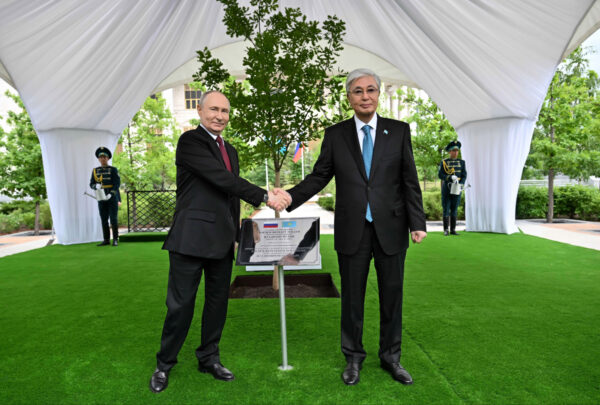
Fresh off a warm welcome in Beijing, last week Russian President Vladimir Putin touched down in Kazakhstan’s capital, Astana, for a state visit and a Eurasian Economic Union summit. While the EAEU meeting was rife with tension, not least because of the growing divide between Europe-curious Armenia and Russia, Putin’s engagements with his Kazakh counterpart, Kassym-Jomart Tokayev, were steeped with bonhomie.
The two presidents planted an oak tree in the “Alley of Eternal Friendship between Kazakhstan and Russia.,” which opened in Astana last year, and oversaw the signing of a dozen agreements, the most important of which focused on Russia’s building of Kazakhstan’s first modern nuclear power plant.
These included an agreement on “the basic principles and conditions of cooperation on the project to build a nuclear power plant on the territory of the Republic of Kazakhstan,” another on the “provision of a state export loan” from Russia to Kazakhstan to finance the project, and an action plan for “interdepartmental cooperation in the field of regulation of nuclear and radiation safety for 2026-2030.” There was also a currency swap agreement, arguably tied to the export loan.
Last summer, Russia’s Rosatom was selected to take the lead in building Kazakhstan’s first modern nuclear power plant. The exact specifications have evolved since the initial announcements, settling on an envisioned pair of VVER-1200 III+ reactors with a combined capacity of 2.4 GWe.
Last August, Kazakh officials marked the ceremonial launch of construction (in reality, the launch of engineering survey work) in Ulken. At that time, Almasadam Satkaliyev, the head of Kazakhstan’s atomic energy agency, told reporters, “The total investment in the project will be approximately $14-15 billion…An additional $1 billion will be allocated to the construction of social facilities and modern infrastructure.”
Last week, Satkaliyev cited a slightly larger figure: $16.4 billion, to include about $2 billion for security and infrastructure, according to official state news agency Kazinform. While the exact details of Russia’s export loan to Kazakhstan have not been revealed, it has been reported that Moscow is furnishing as much as 85 percent of the project’s financing.
Given Russia’s current geopolitical and financial stresses, courtesy of its full-scale and ongoing invasion of Ukraine, this sparked considerable interest. Putin felt the need to explain.
“… We don’t just sink this money or give it away; we lend it out. This is money that will be returned to the Russian treasury. We lend it with interest, as is customary in all such cases,” he said.
Putin argued that the project was advantageous for Russia given Moscow’s long-standing cooperation with Astana regarding uranium. Kazakhstan is the world’s top producer of uranium.
Officials have pegged 2027 for the genuine start of construction and are targeting early 2034 to commission the first reactor.
In their joint statement at the conclusion of Putin’s state visit, Kazakhstan and Russia laid out the foundations of their relationship, starting with history — highlighting “the importance of a responsible attitude towards historical memory.” Additional foundations include “common efforts to develop Eurasian integration, “a common border” and “economic partnership.”
The two states are “equal partners, strategic allies, and good neighbors.”
