

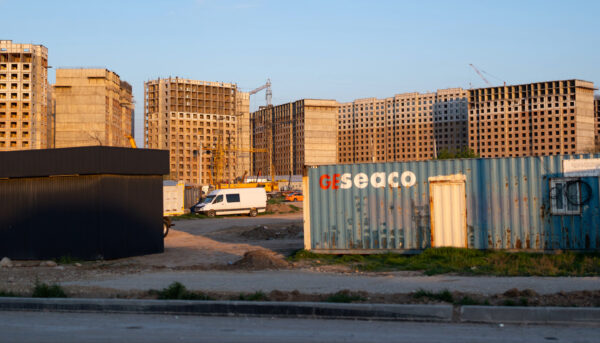
In Central Asia, Soviet brutalist architecture survives amidst the region’s rapidly developing cities, standing alongside newly constructed buildings, roads, and other projects. Meanwhile, the tremendous scale of Central Asia’s urban reconstruction exacerbates the impacts of climate change. The urbanization of Central Asia has unfolded alongside the a reckless cutting of urban trees, which has transformed vast areas into heat islands.
In 2025, for various reasons, more than 4,000 trees were cut down in Bishkek, the capital of Kyrgyzstan, alone – a 197.7 percent increase compared to the carnage of 2024.
In Bishkek, we noticed vines growing on buildings and cascading out of balconies and wondered what these plants, clinging onto bare concrete, might have to tell us about a broader impact the city could be having on the climate. We noticed dry canals and deforestation and recalled how Bishkek was once considered a green city, but is now, like so many other places, struggling to maintain that status within the context of rapid development.
Eco-brutalism, an architectural and design movement blending the aesthetic of mid-20th-century Brutalism – a style characterized by bare concrete and geometric forms – with modern ecological principles and design, is on accidental display throughout Bishkek.
The buildings sometimes feel permanent, unshakeable. While they offer safety to those inside, they stand as a reminder of civilization’s power to those on the outside. Bishkek’s buildings, whether Soviet-era apartment blocks or newer constructions, stand as an ode to society and progress. They are also sometimes hugged by nature in the way cities are surrounded by mountains and forests.
Discussing images from Olivia Broome’s book, “Brutalist Plants,” Wallpaper staff writer Tianna Williams described some of Broome’s selected buildings as having “deliberately considered their green context, while others show greenery reclaiming its built environment.”
This is an important distinction because it gives two excellent choices to residents and developers: design new buildings to support green infrastructure, and preserve existing green spaces. Eco-brutalism is an aesthetic appeal to a healthier, greener future and one that can be built atop existing realities.
The functionalist Soviet housing blocks and smaller aesthetically adjacent examples in this series of images may not be examples of true, artistic brutalism; but while these selections are not strictly brutalist, they each speak to the eco-brutalist relationship between architecture and nature.
One tenet of eco-brutalism could even be realized when gray concrete takes on the color of the nature around it. Aesthetically, it can be that simple – or as profound as to remind us of nature’s ability to engulf and sweep away, without warning, our most powerful institutions, our most solid constructions. It can remind us to participate instead of succumbing to climate anxiety, despair, and ecological fatalism, which could serve as an appealing example of grassroots initiatives to address climate change challenges.
Some of these examples, concrete and foliage, are created with large potted plants. While science shows that the air-purifying effects of indoor plants are negligible in real-world settings, it remains a primary motivation for urban gardeners. Even for house plants like the sansevieria, which have been shown to be very efficient at reducing airborne toxins, it would take an unrealistic number of plants in one’s home to make a positive impact on indoor air pollution.
And yet, such plants serve a purpose all the same. There is evidence to support the relationship between gardening and positive health and psychological outcomes. Therefore to promote green cities is to promote healthier lives in many ways. Green cities can resist desertification, and have been shown to reduce the urban heat island effect.
Engineering firm Burro Happold noted, “While urbanization is inevitable, and a significant driver of desertification, it can be mitigated through planning of growth and comprehensive afforestation initiatives.”
