

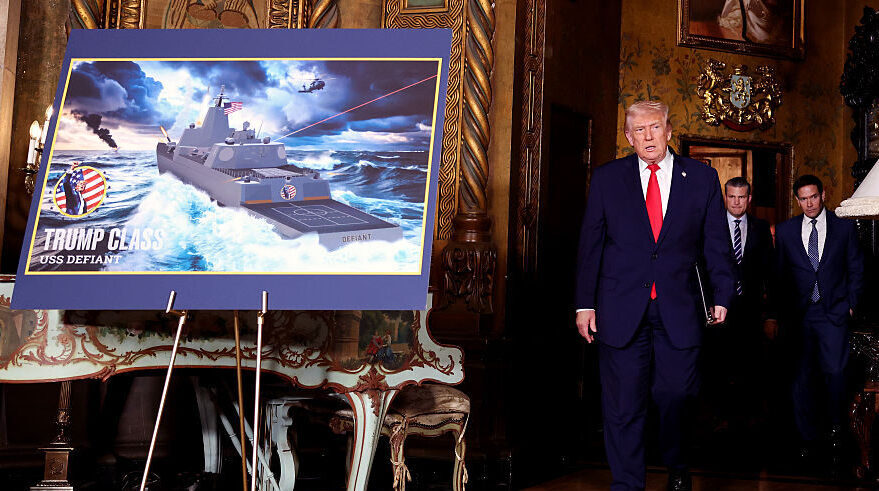
WASHINGTON — Republicans defeated an amendment to the fiscal 2027 defense policy bill that would have stripped $1 billion in funds for the Trump-class battleship during a House Armed Services Committee mark up of the bill today.
The amendment, offered by HASC’s top Democrat Rep. Adam Smith of Washington state, would have zeroed out advanced procurement funds for the BBG(X) but was defeated in a 26–30 vote. Democratic Rep. Don Davis of North Carolina voted with Republicans.
Citing the Congressional Budget Office’s projection that the lead Trump-class battleship could cost about $20 billion, Smith argued that the Navy should put that funding toward autonomous drone ships.
“Whatever the number is [for the BBG(X) program], I’m going to give you right one of the surest fire Kalshi bets you will ever have: Take the over,” he said. “Whatever they come up with the number, it’s going to wind up higher.”
HASC Chairman Mike Rogers, R-Ala., spoke against the amendment, stating that the battleship’s requirements were spawned out of the studies for a next-generation destroyer done by the Biden administration.
“There has been a requirement for a large surface combatant for decades,” he said. “We currently lack a ship with enough space or power to support the combat systems we need for future conflicts like hypersonics and high being high energy lasers.”
While Rogers was the only Republican to speak on behalf of the battleship, several Democrats took swipes at the program.
Connecticut Rep. Joe Courtney, the top Democrat on the seapower and projection forces committee, said it doesn’t make sense to begin ordering parts and materials for a ship that does not have a design finalized.
“The concept of the battleship was announced last December down at Mar-a-Lago, where, again, we didn’t have any designs. We didn’t have any studies in terms of analysis that normally go into starting a new class of any ship. What we did have was an AI-generated picture on a poster board,” he said.
Rep. Seth Moulton, D-Mass., called it a “boondoggle” and “the most expensive sitting duck in world history,” while Rep. Eugene Vindman, D-Va., said that the program would not be receiving the same support from Republicans if the ship was named the Obama-class.
The battleship amendment was defeated as HASC took its first series of recorded votes on NDAA amendments. Debate on the bill is still ongoing, with a vote on final passage slated for late tonight or early Friday morning.
During those votes, Republicans also toppled the only amendments so far that address the size of the defense budget and the war with Iran, both offered by Moulton. One would have lowered the NDAA topline by $150 billion, but was defeated in a 25-31 vote that saw Democrats Davis and Jared Golden of Maine vote with Republicans. The other would require the Defense Department to submit a breakdown of costs associated with the war in Iran, and was defeated in a 27-30 party line vote.
Earlier in the hearing, HASC members passed multiple large packages of noncontroversial amendments, including several that impact the BBG(X) and other major Navy programs.
The Arleigh Burke-class destroyer was the biggest beneficiary, receiving a $500 million boost to help pay for a second ship in FY27. The amendment, from Golden, would zap funds from submarine tenders, littoral combat ship modernization, and KC-46 tanker development in order to increase DDG-51 funds.
However, that move is largely symbolic of congressional support for the destroyer program, as the NDAA only authorizes funding and it is unknown whether appropriators will follow suit.
Another amendment passed in the so-called “en bloc” packages would require the Navy to provide a report on its strategy to design and construct the BBG(X) battleship without interfering with existing nuclear-powered shipbuilding plans, specifically that of the Ford-class carrier.
“The committee is aware that the timelines for completion of the three Ford-class aircraft carriers currently under construction have experienced significant delays due to a variety of reasons including supply chain and workforce challenges,” the provision states. “The committee is concerned that these factors, coupled with a lack of physical shipbuilding capacity, could be further exacerbated by a new nuclear-powered surface vessel program and without careful planning could jeopardize Ford-class delivery.”
A separate amendment would require a briefing on Golden Fleet, including the business case for BBG(X), the novel systems needed to build the battleship and their projected costs, and the impact of BBG(X) and other Golden Fleet vessels on legacy shipbuilding programs.
