

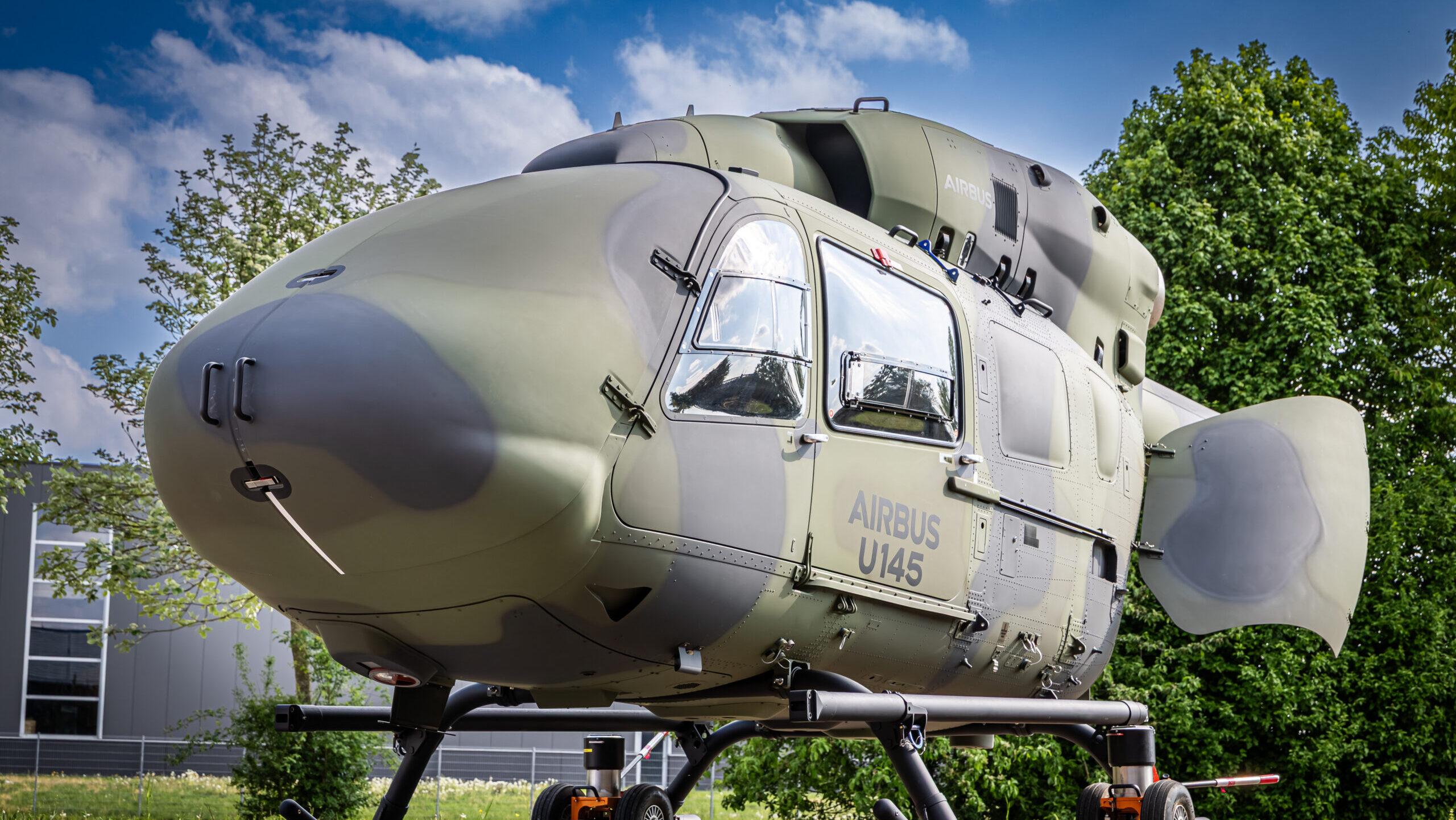
BELFAST — Airbus has launched a new autonomous drone dubbed U145, based on the company’s H145 civil and military helicopter.
A full scale mock up of the uncrewed aircraft, designed primarily for cargo supply missions, will be on display at this week’s Berlin Air Show, said the manufacturer in a statement today.
The manufacturer added that a first flight with a safety pilot onboard is slated for the end of this year, with entry into service expected at the start of 2030.
Fitted with a “specialized” sensor suite and AI, the fully autonomous platform is the second crewed rotorcraft from the Airbus product line to be converted into a drone, behind the VSR700, evolved from the Cabri G2 light helicopter.
Matthieu Louvot, CEO of Airbus Helicopters, said in the statement, that the firm will partner with “leading autonomous mission partners,” to develop U145 multi-mission capabilities.
An Airbus spokesperson told Breaking Defense today that the autonomous drone has not been specifically developed for any single, outstanding national or European acquisition.
The aircraft will feature a number of changes from the H145 to support cargo missions, such as a nose door, complete with a foldable loading table and a dedicated cargo floor.
Other military roles for the drone include armed scouting, surveillance, crewed-uncrewed teaming as well as acting as a “mothership” for air launched effects, according to the European prime.
As noted, as part of an offer to the US Marine Corp, the US division of Airbus Defence and Space is currently collaborating on the development of the MQ-72C fully autonomous drone with Shield AI, L3 Harris and Parry Lab.
Specifically, Airbus is two years into the service’s Aerial Logistics Connector Middle Tier of Acquisition (MTA) Rapid Prototyping Program, designed to showcase how aircraft prototypes can demonstrate new capabilities through a range of experimental activities.
Company figures indicate that over 1,800 H145 family helicopters are in service covering military, parapublic and civil missions, collectively logging more than 8.5 million flight hours.
