

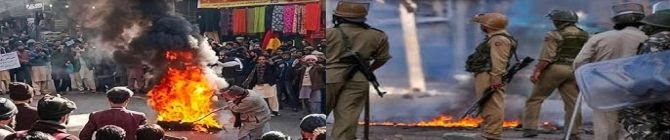
Over thirty people have been massacred and around two hundred injured in Pakistan-occupied Kashmir after violent clashes erupted between protesters and security forces.
The unrest followed the banning of the Joint Awami Action Committee (JAAC), a civil society alliance that has long spearheaded demonstrations over economic and political grievances in the region.
Authorities outlawed the group on Friday, citing concerns over public order and security, a move that immediately heightened tensions.
The violence broke out in Rawalakot after the death of a trader, allegedly shot during a confrontation with law enforcers late on Friday night. His body was taken to a hospital morgue, where supporters gathered in anger.
Commissioner Sardar Waheed Khan, the top civilian official in Rawalakot, confirmed the incident and said that when security forces attempted to disperse the crowd, JAAC activists retaliated with automatic rifles, petrol bombs and other weapons.
According to Khan, six protesters were killed in the ensuing clashes, and multiple arrests were made. However, local residents and JAAC supporters disputed the official account, insisting that civilian casualties were far higher than acknowledged. Witnesses described scenes of chaos as paramilitary forces opened fire, while protesters hurled projectiles and petrol bombs in return.
The confrontation occurred just a day before JAAC’s planned region-wide protests. The alliance had called for demonstrations against the reservation of twelve seats for refugees in the upcoming legislative elections scheduled for 27 July.
Out of forty-five seats in the assembly, these reserved positions are seen by JAAC as undermining local representation. The group was also protesting against earlier incidents of violence, internet restrictions, the banning of their organisation, and broader issues such as electricity shortages, inflation, unemployment, alleged resource exploitation, and political marginalisation.
JAAC members have denounced their listing as a “terror” group, describing it as an act of oppression. They argue that their campaign is for legitimate economic and political rights, though authorities point to the group’s history of violent demonstrations in recent years.
The Human Rights Commission of Pakistan has previously expressed alarm at the use of anti-terror legislation against civil society organisations, warning that such measures risk deepening political disenfranchisement.
The clashes in Rawalakot mark one of the deadliest episodes of unrest in the region in recent years. The scale of casualties has drawn international concern, with observers noting that the situation could deteriorate further as elections approach.
Security has already been tightened across POK, with restrictions on large gatherings, communication blackouts in several districts, and heightened deployments of police and paramilitary forces.
The JAAC leadership has vowed to continue its campaign despite the ban, framing the confrontation as evidence of state repression.
The group’s supporters insist that their struggle is rooted in everyday hardships faced by the people of POK, including rising costs of flour and electricity, chronic unemployment, and poor governance. With tensions escalating and both sides unwilling to back down, the region faces a volatile and uncertain period in the run-up to the July elections.
Agencies
