

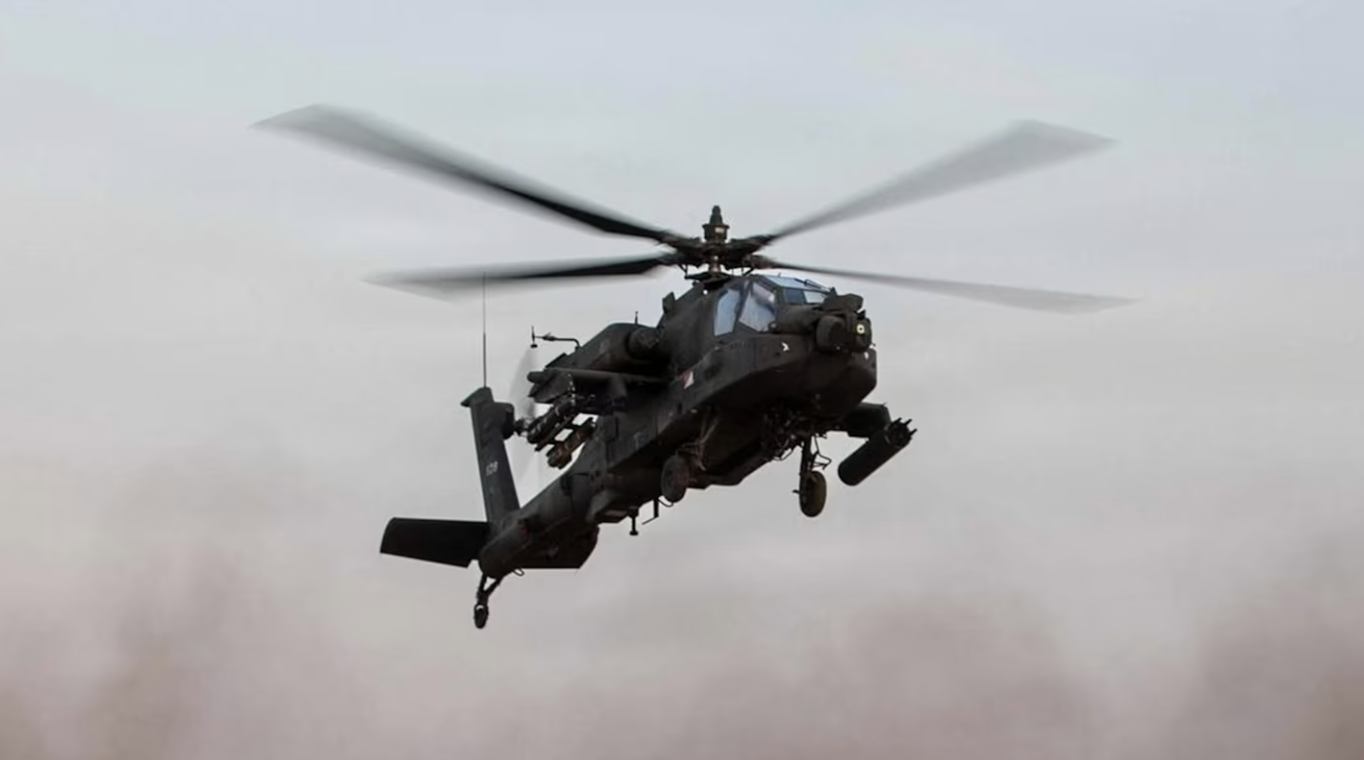
The United States has launched a series of military strikes against Iranian targets after President Donald Trump accused Tehran of shooting down a US Army Apache helicopter near the Strait of Hormuz.
The move has rapidly escalated tensions across the Middle East casting fresh doubt over fragile peace negotiations.
The latest crisis erupted after an AH-64 Apache helicopter was brought down during a patrol mission near the strategically vital shipping route.
Both crew members survived and were rescued and US officials blamed Iran for the attack.
“The United States must, of necessity, respond to this attack,” President Trump said, adding later that American forces were carrying out retaliatory operations. “They shot down a helicopter, and we are responding as we speak. It will be very strong and very powerful.”
Within hours, US Central Command announced strikes against Iranian radar installations, air-defence systems and command facilities along Iran’s southern coast.
American military officials described the attacks as a “proportional response” designed to deter further aggression while avoiding a broader conflict.
The strikes mark the most serious direct confrontation between Washington and Tehran since a ceasefire was established earlier this year.
Before the helicopter incident, Trump had suggested peace talks were nearing a successful conclusion.
“We are in the final throes of what will be a very, very good deal,” the president told reporters earlier this week, expressing optimism that a diplomatic agreement could stabilise the region and reduce the risk of further conflict.
Iranian Foreign Minister Abbas Araghchi condemned the strikes and warned that Tehran would retaliate if further attacks occurred.
“Iran’s armed forces will leave no attack or threat unanswered,” Araghchi said. He also issued a warning to foreign militaries operating in the Gulf region, declaring: “Leave our region if you want to be safe.”
Iran has disputed US claims that the helicopter was deliberately targeted and accused Washington of using the incident as a pretext for military action.
Iranian state media described the American strikes as a violation of international law and a threat to regional stability.
The situation deteriorated further as reports emerged of Iranian missile and drone attacks against US military facilities in Bahrain, Kuwait and Jordan.
Although many of the projectiles were intercepted, the exchanges heightened fears that months of diplomatic progress could quickly unravel.
Complicating matters further are Israel’s continuing military operations in Lebanon despite repeated calls from Washington for restraint.
In recent days, Israeli aircraft have struck targets in southern Beirut and around the coastal city of Tyre, with Israeli officials saying the operations are aimed at Hezbollah weapons depots and command centres.
The Trump administration has privately and publicly urged Israel to avoid actions that could inflame tensions at a time when American diplomats are attempting to preserve negotiations with Tehran.
President Trump recently called on all parties to reduce hostilities, warning that further military escalation could jeopardise peace efforts.
But Israeli leaders have maintained that operations against Hezbollah will continue as long as threats remain along Israel’s northern border.
Iran has accused Israel of deliberately undermining diplomatic efforts. Senior Iranian officials argue that the attacks in Lebanon risk opening another front in an already volatile conflict and could make a negotiated settlement significantly harder to achieve.
Lebanese officials have also expressed alarm, warning that continued Israeli strikes threaten civilian areas and could trigger a wider regional confrontation involving Hezbollah and other Iranian-backed groups.
Analysts say the combined impact of the helicopter incident, US retaliation and Israeli operations in Lebanon has created the most dangerous moment for Middle East diplomacy in months.
Oil markets reacted nervously to renewed fighting near the Strait of Hormuz, a waterway through which a significant share of global energy supplies passes. Traders fear that prolonged instability could disrupt shipping and drive energy prices higher.
Despite the increasingly hostile rhetoric, neither Washington nor Tehran has formally withdrawn from negotiations. Both governments continue to insist they do not seek a wider war.
