

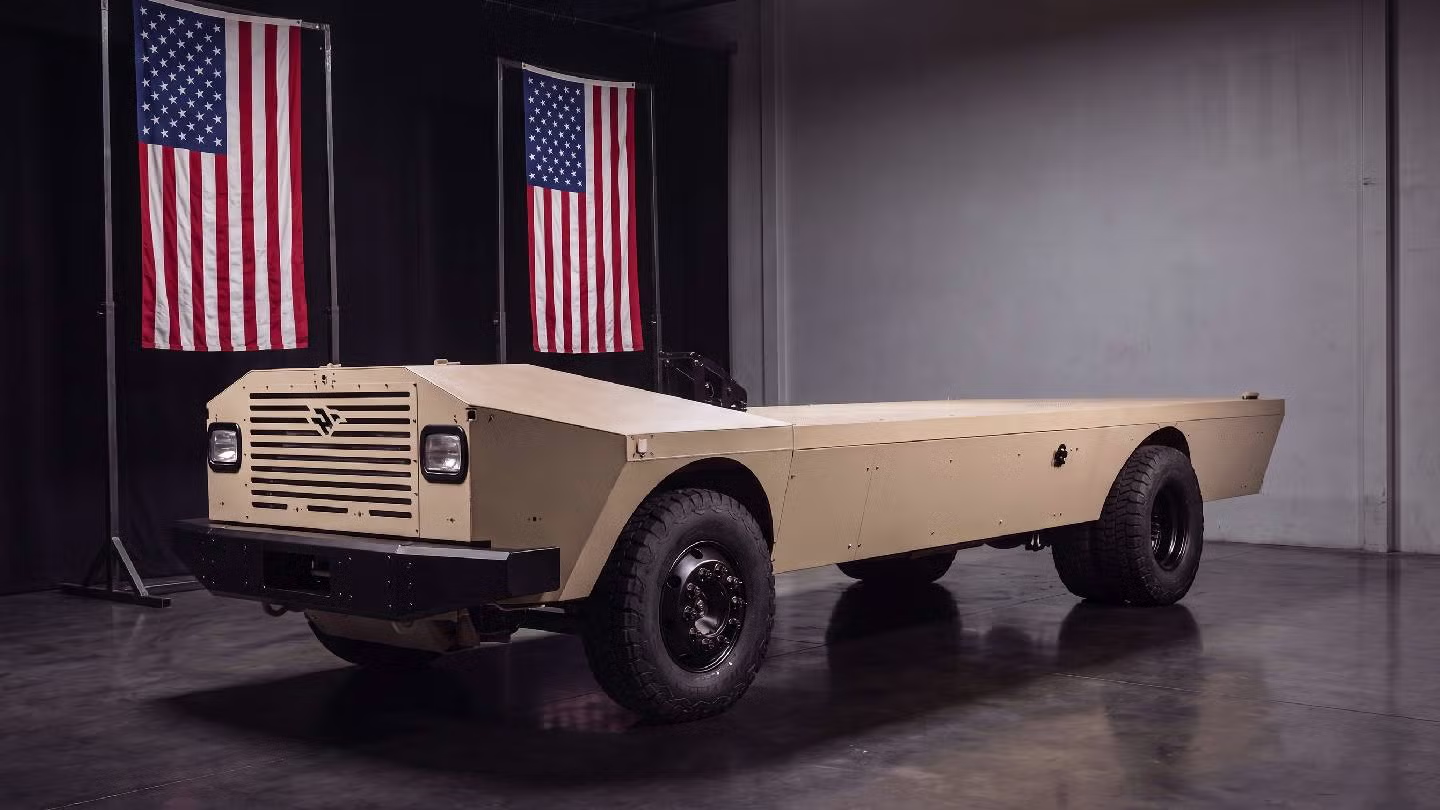
US-based Harbinger has introduced a new uncrewed hybrid-electric vehicle platform designed for defence and military use.
The platform, developed under its newly formed defence unit Harbinger Praesidia, is being configured for a range of mission-specific applications in collaboration with government clients and defence contractors.

Discover B2B Marketing That Performs
Combine business intelligence and editorial excellence to reach engaged professionals across 36 leading media platforms.
According to the company, the platform is intended to support operations such as flat-deck logistics, field communications, troop transport, perimeter security, and counter-uncrewed aerial system activities.
Available in 158-inch, 178-inch, and 208-inch wheelbases, the vehicles support gross vehicle weight ratings between 16,000 and 26,000 pounds, with payload capacities up to 18,000 pounds.
The hybrid system pairs an electric motor for high torque with a compact petrol engine and generator, enabling both recharging of batteries and the supply of external power.
The standard configuration delivers over 500 miles of combined range in hybrid mode, around 105 miles of fully electric range, and can be powered by petrol, electric vehicle charging or both.
Performance specifications include a maximum speed of 65mph, the ability to handle gradients exceeding 30% and side slopes over 20%, and operation at temperatures from -30°C to 55°C and up to 12,000 feet in altitude.
The platform is also equipped for remote operation in hazardous or contested environments, featuring Stealth Mode to muffle sound and reduce thermal signatures, as well as dual-network communications through radio and satellite connectivity.
Harbinger says that advanced mesh radios support teleoperation at up to five kilometres line-of-sight, and satellite systems allow operation beyond that distance.
Built on a clean-sheet, medium-duty plug-in hybrid chassis, the vehicles are also equipped for full teleoperation using Harbinger’s proprietary, in-house application programming interface.
The Praesidia vehicles incorporate drive-by-wire, brake-by-wire and steer-by-wire systems, with redundancy in key areas to support remote and autonomous control.
They also incorporate a six-camera system designed to provide 360-degree situational awareness.
Harbinger co-founder and CEO John Harris said: “The government needs robust vehicles that can support a wide range of use cases without forcing operators to compromise on payload, range, exportable power or durability.
“Our American designed, engineered and assembled vehicles fulfil this need while supporting domestic manufacturing capacity, which is itself a national security asset. At the same time, these unmanned vehicles are engineered to help keep soldiers out of harm’s way without compromising on performance.”
In addition to the new platform, Harbinger announced that In-Q-Tel (IQT), the not-for-profit strategic investor for the US national security community and its allies, has become a strategic investor in the company.
IQT’s involvement is intended to support Harbinger’s expansion in government and defence markets.
Recently, Harbinger also formalised a partnership with American Rheinmetall to develop next-generation robotic and uncrewed ground vehicles for military modernisation projects.
Aimed at supporting the US Department of War’s (DoW) modernisation priorities, the collaboration pairs American Rheinmetall’s vehicle integration and mission-systems expertise with Harbinger’s commercial, autonomy-ready hybrid platform.
Together, the companies intend to pursue existing and emerging programmes centred on commercial-derived hybrid-electric and drive-by-wire architectures.
Early focus areas include autonomous wheeled vehicles, contested-logistics resupply, and next-generation robotic platforms aligned with US Army autonomy and manned–unmanned teaming priorities.

