

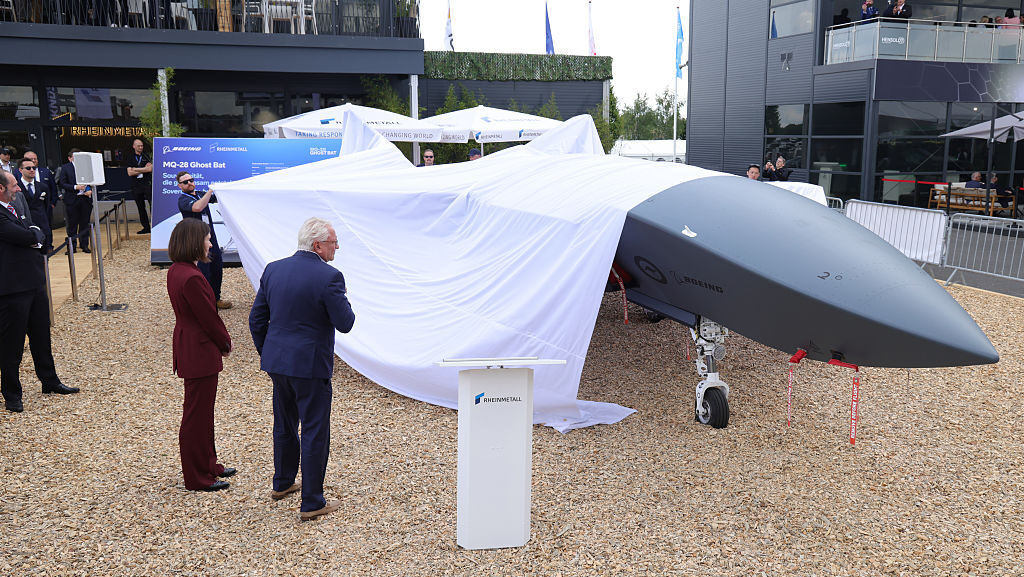
BERLIN — Company officials with Boeing Australia and Germany’s Rheinmetall dramatically pulled back a white sheet here at the Berlin Air Show today to reveal a MQ-28 Ghost Bat, a collaborative combat aircraft (CCA) that’s already taken to the skies in Australia and hopes to do so for the German air force.
The drone was specially flown in from its home Down Under, less than three months after Boeing Australia and Rheinmetall announced their team up to offer up the unmanned craft in Germany’s quest for its own CCA, envisioned as flying alongside manned aircraft.
“At the moment, we are still in negotiations with the German government, but if they want to have the plane by 2029, my expectation is that by at least next year, we have to go into the final stage of negotiating the contract,” Rheinmetall CEO Armin Papperger told Breaking Defense at the air show.
As for that timeline, a spokesperson for the German Ministry of Defense said they could not comment on possible procurement projects prior to pending parliamentary deliberations.
But that hasn’t stopped major defense firms from lining up their offerings here, where at least four real aircraft or full-sized models are on display.
All Eyes On CCA
During the unveiling today the Boeing-Rheinmetall team said new features have been integrated on the bird, including a 25 percent increase in wingspan, allowing it to carry an additional 2,000 pounds of fuel, stores and mission payloads. According to the company’s MQ-28 global program director, Glen Ferguson, the Ghost Bat can be equipped with two AMRAAM missiles or four small-diameter bombs internally and has flown for over 200 hours.
But competitors were quick to publicize their own updates. German firm Helsing revealed today a new variant of its under-development CA-1 Europa dedicated to electronic attack, the CA-1EA.
“It is an expansion of the CA-1 Europa platform, on the basis of which Helsing is already building an autonomous combat aircraft, now to be designated as the CA-1KA (kinetic attack),” the company said in a press release. The CA-1KA is scheduled for maiden flights in early 2027.
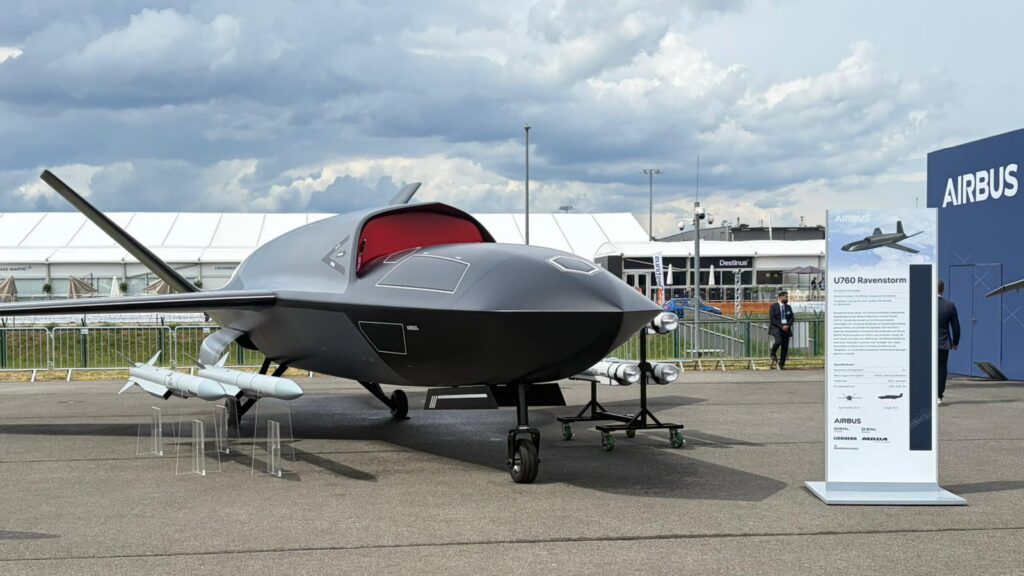
Airbus, meanwhile, showcased a full-scale 1:1 model of its new U760 Ravenstorm CCA concept for the first time here, in what appears to be a follow-on to its ongoing work with US-based Kratos. The two companies agreed last year to purchase two XQ-58A Valkyrie CCAs and planned to modify them for the European market.
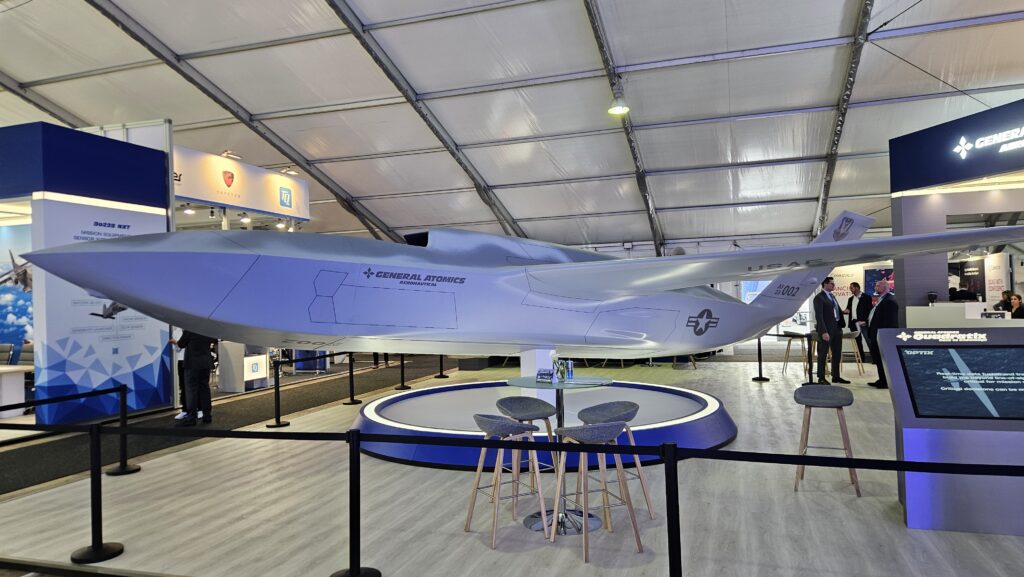
General Atomics Aeronautical Systems is here as well, with a full-sized version of a drone from its Gambit family, one of two unmanned aircraft selected through the first increment of the US Air Force’s own CCA program.
“We have certainly spoken to Germany many, many times about our CCA and what there is to offer,” GA spokesperson C. Mark Brinkely told Breaking Defense today. “It’s the most advanced CCA in the world. We don’t need to go to block whatever to add a weapons bay and all the rest, we’re ready today.”
Whether that argument will prevail with German leadership remains to be seen, but Berlin certainly appears to be on the clock. Pistorius has said that by 2029, the same year referenced by Papperger today, Russia could be ready to attack NATO.
