

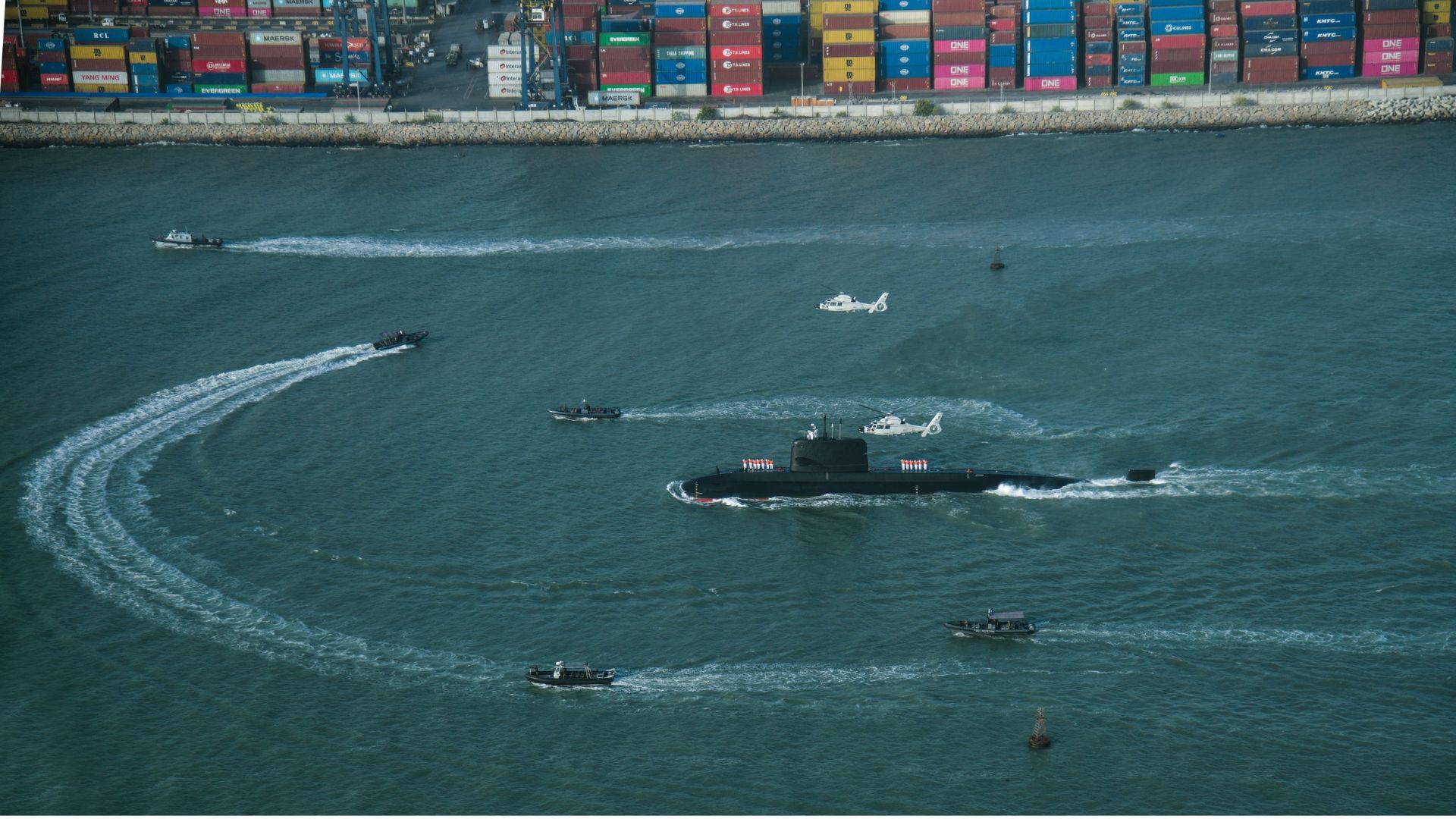
The Pakistan Navy’s (PN) first Hangor-class submarine, PNS/M Hangor, arrived at Karachi on 11 June 2026, where it was received at the PN Dockyard in a ceremony led by Commander Pakistan Fleet, Vice Admiral Abdul Munib (Dawn). The arrival came six weeks after the boat’s commissioning at Sanya, China, on 30 April, an event attended by President Asif Ali Zardari as chief guest alongside the Chief of the Naval Staff (CNS), Admiral Naveed Ashraf (Naval News).
PNS/M Hangor is the first of eight boats the PN ordered from China in 2015, and in many respects, its arrival closes a procurement arc that had started two decades earlier with an entirely different submarine, from an entirely different supplier.
However, while the commissioning resolves the long wait for the lead boat, it also opens a series of new questions about how the PN intends to employ its largest-ever submarine, how the rest of its subsurface fleet will be organized around it, and where the Hangor-class sits in the wider — and at times contested — debate over Pakistan’s sea-based deterrence posture.
This deep-dive analysis is entirely free to read, but this level of rigorous, national security analysis is only possible because of our community. For just $30 USD a year, you can unlock Quwa Plus.
As a Plus member, you don’t just help Quwa continue its vital work in delivering high-quality, insightful Pakistani defence journalism—you also gain instant, unrestricted access to our deep premium corpus of strategic research, specialized defence market data, and exclusive industry interviews via Pulse Check.
Finish the story. Get the full picture.
Unlock independent journalism and deeper analysis on Pakistan’s key defence and policy developments
The Road Not Taken: Pakistan’s Pursuit of the Type 214
To understand why the PN ended up in Wuhan, one must first look at why it did not end up in Kiel. The PN’s requirement for a next-generation submarine dates back to a Naval Service Requirement drawn up in 2004, which, following a technical evaluation, settled on the German Type 214 from Howaldtswerke-Deutsche Werft (HDW).[^1]
The selection made sense at the time. The Type 214 paired a proven Type 209 lineage with the fuel-cell air-independent propulsion (AIP) technology of the German Navy’s own Type 212A, and by the late 2000s it had already drawn orders from Greece, South Korea, and Turkey, which meant the PN would have joined a wide user base with a correspondingly healthy supply of spares and support.
By November 2008, the deal had progressed to the point where HDW’s chief executive, Walter Freitag, told Pakistani media at IDEAS 2008 that the commercial contract was “95 per cent” finalized, with the three boats to be built at Karachi and the first delivered 64 months from signing.^2
In other words, the PN was within reach of a fuel-cell AIP submarine — the quietest of the major AIP architectures — built domestically under a transfer-of-technology (ToT) arrangement, which would have extended the industrial gains Karachi Shipyard & Engineering Works (KSEW) had made through the Agosta 90B program.
Why the HDW Type 214 Deal Collapsed
However, the program — valued at roughly €1.2 to €1.3 billion, per Quwa’s Hangor-class profile — unravelled between 2009 and 2011, and the reasons had less to do with the submarine than with the environment around it. Pakistan’s fiscal position had deteriorated sharply after 2008, and with the government entering an International Monetary Fund (IMF) program, the financing required for the acquisition fell away.[^3]
On the German side, Berlin had tied any export approval to a National Security Council review weighing “political and regional aspects,” and political opposition to arming Pakistan persisted throughout the negotiation.[^4] Thus, the deal sat at the intersection of a buyer that could not pay upfront and a seller that would not finance, and in that respect, the Type 214’s collapse fit a wider pattern that played out across multiple Pakistani procurement efforts with Western suppliers in that period.
The collapse mattered beyond the immediate loss of three hulls. It took fuel-cell AIP off the table for the PN, and it pushed Naval Headquarters (NHQ) towards the one supplier that could marry a credible AIP submarine with the financing to make it attainable.
From Talks to Contract: Building the Deal with China
With the German track closed, the PN opened discussions with China Shipbuilding & Offshore International Co. Ltd (CSOC) around 2011 for six AIP-equipped boats, as detailed in Quwa’s Hangor program coverage.
The talks matured over several years, and in April 2015 — coinciding with Chinese President Xi Jinping’s visit to Islamabad and the launch of the China-Pakistan Economic Corridor framework — the Pakistani government approved the purchase, though notably of eight submarines rather than the six originally discussed, with the Ministry of Defence Production (MoDP) initially designating the program as the ‘S20.'[^5]
Financing the Eight-Submarine Purchase from China
The contrast with the German experience could not have been sharper, and it is worth dwelling on, because financing — rather than technology — was the variable that decided where Pakistan’s submarine future would be built. Where Berlin declined to extend credit for three boats, Beijing structured a long-term loan that carried eight, and in 2016 Pakistan finalized both the deal and the financing behind it.[^6]
Reports at the time, led by the Financial Times, pegged the package at $4 to $5 billion, making it the largest arms export contract in Chinese history, though Quwa has long noted that this figure may have bundled the four Tughril-class (Type 054A/P) frigates the PN ordered in 2017 and 2018, which would make the submarines’ standalone cost difficult to isolate.
The program’s structure took shape quickly from there. In August 2016, the program’s Chief Project Director told the National Assembly’s Standing Committee on Defence that the first four boats — to be built at Wuchang Shipbuilding’s Shuangliu Base in Wuhan — were due in 2022-2023, with the remaining four to follow from KSEW by 2028 under a ToT arrangement.
In October 2016, China Shipbuilding Industry Corporation (CSIC) publicly confirmed the eight-boat export project,[^7] and in January 2017, then-CNS Admiral Muhammad Zakaullah announced that the class would carry the name Hangor — honouring the Daphné-class boat that sank INS Khukri in 1971, the first submarine kill of a warship since the Second World War.
Technology Transfer and KSEW’s Role
The ToT element deserves emphasis here because it ties the program back to the institutional thread running from the Agosta 90B era. KSEW had assembled PNS/M Hamza in the 2000s under the French program, and the Hangor arrangement was designed to deepen that base — a goal then-CNS Admiral Zafar Mahmood Abbasi would later articulate in 2020 as transforming the PN from a “submarine-operating navy into a submarine-building navy,” as recounted in Quwa’s coverage of KSEW’s build progress.
In that sense, the 2015 contract was never solely about the eight hulls; it was also the PN’s second sustained attempt — after the Agosta 90B — at building a domestic submarine construction industry, and the success of that effort will arguably matter more over the long run than the boats themselves.
Unpacking the Hangor-Class Design
The Hangor-class is based on CSOC’s S26, an export design derived from the People’s Liberation Army Navy’s (PLAN) Type 039A/B Yuan-class. Imagery released by the Royal Malaysian Navy during PNS/M Hangor’s replenishment stop at Kota Kinabalu from 8 to 11 May — a rare external view of the boat, given the limited imagery the PN itself has released — indicates that the design inherited nearly all of the Type 039’s features (Janes).
Hangor-Class Specifications from KSEW and CSOC Data
The PN has never formally disclosed the Hangor’s specifications, which means most of what is verifiable comes from two sources: the scale mock-up and specifications sheet KSEW displayed at IDEAS 2018 in Karachi, and CSOC’s own S26 export marketing data.
Per the KSEW sheet, the Hangor displaces 2,800 tons at a length of 76 m, with a draught of 6.2 m and a surfaced speed of 10 knots — figures that make it heavier than the 2,550-ton S26 baseline yet slightly shorter than the reference design’s 77.7 m. It is, by a comfortable margin, the largest submarine the PN has ever operated, a point this article will return to, because the size itself is one of the more revealing aspects of the acquisition.
Stirling AIP and Submerged Endurance
Like the S26, the Hangor is understood to use a Stirling-cycle AIP system, though here too the PN has not offered confirmation.[^8] The value of the AIP system lies in endurance: where a conventional diesel-electric boat must snorkel every few days to recharge its batteries — exposing itself each time — an AIP-equipped submarine (SSP) can hold a patrol station submerged for potentially weeks at a time.
The PN is familiar with this capability through the French MESMA system on its Khalid-class (Agosta 90B) boats, but the Stirling system, paired with the Hangor’s larger hull and fuel capacity, would extend that endurance further, and it is this quality — more than speed or armament — that changes the character of the threat an adversary’s anti-submarine warfare (ASW) forces must plan against.
The MTU Engine Ban and the CHD620 Switch
The program’s path to this point was far from smooth, and the disruption is worth recounting because of where it came from. The boats were originally specified with MTU 12V 396 diesel engines from Germany, but Berlin refused to issue export licences after MTU engines were found to have been supplied for Chinese warships in violation of the European Union arms embargo — a restriction that applied to China as the manufacturing partner rather than to Pakistan directly.
CSOC substituted the CHD620, a licensed derivative of the MTU 396 design,[^9] and the same substitution played out in Thailand’s parallel S26T program, where the Royal Thai Navy declined to accept the Chinese engine until over 6,000 hours of bench testing had been completed.
There is a certain irony in the fact that German export controls shaped this program twice — first by closing the Type 214 route, and then, a decade later, by forcing an engine switch on the Chinese boats Pakistan bought instead — and the episode reinforced a lesson NHQ had already internalized about the supply-side risks of Western-sourced subsystems, even when embedded in a non-Western platform.
In terms of armament, the Hangor carries six torpedo tubes, likely of 533 mm diameter, configured for heavyweight torpedoes and anti-ship cruise missiles (ASCM). The PN has confirmed neither the torpedo nor the missile, but the PLAN Yuan-class loadout would point to the Yu-6 or an export derivative for the former, while the structure of Thailand’s S26T contract — which included the CM-708 missile — suggests a similar arrangement could accompany the PN’s boats.
The tubes would also, in all likelihood, support submarine-launched cruise missiles (SLCM), which is where the Hangor intersects with Pakistan’s strategic weapons programs, a subject taken up later in this article.
As for the rest of the fleet, the remaining three Chinese-built boats — PNS/M Shushuk, PNS/M Mangro, and PNS/M Ghazi — were in the final stages of handover at the time of the lead boat’s commissioning, while the four KSEW-built units are tracking behind the original 2028 target.
KSEW cut steel on the fifth boat in December 2021 and laid the keel of the sixth in February 2025, and given the pace so far, the domestic units may not be completed until the early 2030s, as covered in Quwa’s analysis of the commissioning.
The Hangor in Pakistan’s A2/AD Strategy
To appreciate what the Hangor-class adds, one has to start from the structural problem the PN has always faced: it cannot match the Indian Navy (IN) hull-for-hull, and any attempt to do so on the surface would simply expand the set of targets the IN’s far larger strike complex could service.
Surface warships are sought-out targets, and defending them against threats such as the BrahMos supersonic cruise missile requires a heavy — and ultimately losing — investment in anti-air warfare, since the defending missiles cost more than the threats they intercept and will run out first in a saturation attack.
Why Submarines Anchor Pakistan’s Sea Denial
Submarines invert that cost equation, which is why they have always sat at the centre of the PN’s anti-access and area-denial (A2/AD) thinking. A submarine whose location is unknown converts the surrounding water into a high-risk zone, and clearing that zone requires the adversary to mount a full ASW effort involving maritime patrol aircraft, helicopters, and surface escorts — an effort that consumes assets, time, and attention disproportionate to the single boat that prompted it.
The longer the submarine can remain submerged, the larger and more persistent that contested zone becomes, which is precisely where the AIP endurance discussed above feeds back into the strategic picture.
In this vein, the fleet the PN is building is best understood as a layered architecture rather than a simple expansion. The Khalid-class and the older Agosta 70 boats would continue to operate closer to home, defending the littoral and the exclusive economic zone (EEZ), while the Hangor-class — with its greater displacement, range, and endurance — becomes the asset for operations farther afield.
Adm. Ashraf’s commissioning remarks pointed in the same direction, framing the induction around the security of sea lines of communication (SLOC) across the Arabian Sea and the wider Indian Ocean, and around the threat that disruptions at maritime choke points pose to trade and energy security.[^10]
An 11-Boat AIP Submarine Fleet
Once all eight boats are inducted, the PN will field at least 11 SSPs — the eight Hangors plus the three upgraded Khalid-class boats — which would rank among the largest AIP-equipped fleets in Asia. That number is the point.
A fleet of that size allows the PN to sustain a continuous underwater presence across multiple zones simultaneously, forcing the IN to spread its ASW assets — its P-8I Poseidons, its MH-60R helicopters, its escort screens — across a far wider area than three Agosta 90Bs ever could, and pulling those assets away from offensive tasking in the process.
The Hangor, in other words, pushes the PN’s defensive line outward, from a posture organized around coastal defence to one capable of sea denial at reach — a doctrinal shift Quwa explored at length in a recent Defence Uncut episode.
Finish the story. Get the full picture.
Unlock independent journalism and deeper analysis on Pakistan’s key defence and policy developments
A Bigger Boat: What the S26’s Size and SWATS Reveal
It is worth pausing on the design choice itself, because in some ways the most intriguing aspect of the Hangor acquisition was never the supplier — it was the size of the boat the PN selected. The Yuan-class lineage produced a platform built for long-range, long-endurance, open-water operations, and at 2,800 tons, the Hangor displaces roughly half again as much as the Khalid-class.
A submarine of that size is not the natural choice for the shallow, cluttered waters of the Makran littoral or the approaches to Karachi and Gwadar; those environments favour smaller, more manoeuvrable boats, which is exactly the role the PN’s aging Cosmos MG110 mini-submarines — acquired in the late 1980s and early 1990s — have historically filled.
SWATS and the Littoral Layer
The PN’s answer to that gap is itself revealing. In early 2021, then-CNS Admiral Muhammad Amjad Khan Niazi disclosed that the PN was seeking a new shallow-water attack submarine (SWATS), and subsequent coverage has pointed to candidate designs such as STM’s STM500 and Fincantieri’s S800.
Read together, the two programs form a coherent signal. The PN did not buy a large submarine and then discover it needed a small one; rather, it appears to have deliberately split the subsurface fleet into a blue-water tier and a littoral tier, with the SWATS program existing precisely so that the Hangor fleet can be freed from coastal duties and committed to operations farther out at sea — towards the central Arabian Sea, the Gulf approaches, and the wider Indian Ocean.
Procurement choices, in this sense, are doctrine made visible. One does not need NHQ to publish its concept of operations to see where the Hangors are meant to go; the displacement figures and the parallel SWATS requirement say it plainly enough.
This is also where the SWATS partner selection — still unresolved — becomes one of the more consequential open decisions in the PN’s pipeline, since the program doubles as the PN’s most plausible route to an original domestic submarine design, a thread Quwa will continue tracking.
Reading the S26 Through the Agosta 90B Upgrade
Given that the PN has disclosed essentially nothing about the Hangor’s combat systems, the question becomes how one can reason about the boat’s probable capabilities at all.
The most useful instrument available is the PN’s own recent behaviour — specifically, the mid-life upgrade (MLU) it commissioned for the Khalid-class, because that program is a documented statement of what NHQ considers the baseline for a modern combat suite, written at almost exactly the same time it was specifying the Hangor.
Inside the STM-Led Agosta 90B Upgrade
In June 2016 — the same year the Hangor financing was finalized — the MoDP signed a $350 million contract with Türkiye’s STM to modernize the three Agosta 90Bs. The scope was close to a full combat-system replacement: the sonar suite, attack and search periscopes, command and control, fire control, radar, electronic support measures (ESM), data distribution, converters, steering, and chilled-water systems were all replaced.[^11]
Within that package, the subsystems most worth noting are Aselsan’s ARES-2SC ESM suite, Havelsan’s SEDA sonar-integrated command and control system — designed to fuse the boat’s radar, sonar, and ESM picture into a single situational awareness layer[^12] — and Aselsan’s ZARGANA torpedo countermeasures system, which provides up to 24 launch cells with single or salvo launch modes, and for which Pakistan became only the second export customer after Indonesia (Naval News).
The upgraded boats have since proven out operationally; PNS/M Hamza, delivered in April 2021, sank a decommissioned Tariq-class (Type 21) frigate with a single DM2A4 torpedo during the SEASPARK-2022 exercise (STM).
What the MLU reveals, when read as a planning document rather than a parts list, is a set of priorities. The PN paid to give 25-year-old hulls fused multi-sensor situational awareness, a low-probability-of-intercept radar picture, modern optronics, and — tellingly — a layered self-protection capability built on a dedicated ESM suite working alongside salvo-capable acoustic countermeasures.
The emphasis on ESM and countermeasures is the part most worth carrying over to the Hangor question, because for a submarine whose entire survivability doctrine rests on remaining undetected in waters patrolled by P-8Is and increasingly capable IN escorts, the ability to sense the adversary’s emissions first — and to defeat a torpedo once detected — matters at least as much as the sonar that finds targets.
Thus, the reasonable inference is that the PN would not field its newest, largest, and most expensive boats below the standard it just paid to retrofit onto the Khalid-class. The S26’s probable fit would include Chinese ESM and acoustic countermeasure systems of equivalent or greater capability, alongside the sensor-fusion-centred combat management approach the PN has now operated for several years.
The open question — and it is genuinely open — is whether the PN will eventually standardize subsystems across both classes to streamline training and interoperability, a path that could run through Turkish systems or, increasingly plausibly, through domestic ones.
Global Industrial & Defence Solutions (GIDS) already lists a submarine ESM suite (RIBAT) and an automated deployment and retrieval system (ADRS) under development, and one can see the PN configuring these locally produced systems across its submarine platforms over time, both for fleet commonality and as another rung in the indigenization ladder the Hangor ToT is meant to climb.
The Strategic Role Debate: Hybrid Option or Clean Demarcation
No discussion of the Hangor-class is complete without addressing the question that has followed the program from the start — namely, whether these boats are meant to carry a piece of Pakistan’s nuclear deterrent to sea.
The Babur-3 SLCM Question
The technical basis for the question is real. Pakistan first tested the Babur-3 SLCM in January 2017 from a submerged platform, with the Inter-Services Public Relations (ISPR) stating a range of 450 km and describing the missile as providing a “credible second strike capability.”[^13] A second test in 2018 released footage confirming horizontal ejection — the launch mode compatible with standard torpedo tubes rather than a vertical launch system (Arms Control Association).
The implication follows naturally: any PN submarine with compatible tubes is, in principle, a latent nuclear delivery platform, and the Hangor — with six tubes and the fleet’s longest submerged endurance — would be the most capable host available.
PN voices have engaged the question directly. In 2024, retired Vice Admiral Ahmed Saeed described the Hangor as a “hybrid” piece in Pakistan’s deterrence posture — a compromise between a purely conventional attack submarine and a nuclear-powered boat. He cautioned that such an arrangement would still fall short of an “assured” second-strike capability, and argued that the PN should work towards a nuclear-powered submarine (SSN) or nuclear-powered ballistic missile submarine (SSBN) over time — remarks Quwa examined in its analysis of the PN’s case for a dedicated nuclear asset.
The Case Against the Hybrid Model
The hybrid option, then, exists more or less by default, and it costs Pakistan nothing to retain it as a fallback. However, there is a strong case that leaning on it as the actual posture would be a mistake, and the reasoning is worth laying out in full.
First, the ambiguity cuts both ways: if any Hangor might be carrying nuclear-tipped Babur-3s, then an adversary must treat every Hangor as a strategic asset, which raises the escalation stakes around boats that are, in most scenarios, performing entirely conventional anti-ship warfare (AShW) or ASW missions. The same ambiguity that complicates the adversary’s planning also strips Pakistan of the ability to signal restraint, and in a crisis, that is a liability rather than an asset.
Second, the hybrid model degrades the conventional fleet it borrows from, since boats held in reserve for deterrence patrols are boats unavailable for the A2/AD and sea-denial tasks for which the class was actually procured — and as discussed above, the entire logic of the 11-boat fleet rests on presence across multiple zones at once.
Third, there is the survivability problem Adm. Saeed himself implied: an SSP creeping at the low speeds its AIP system permits, needing to close within 450 km of its target, in some of the most intensively surveilled waters in the region, is a deterrent of a much weaker grade than the “assured” standard he set out.
Finally, the institutional cost may be the most underappreciated one — blending the conventional and non-conventional roles muddies both at precisely the moment the PN is trying to grow a conventional submarine enterprise through foreign partnerships and gradual indigenization, an effort whose partners, financing, and political cover all become more complicated if the platforms involved are read abroad as strategic systems.
Notably, the PN’s own trajectory appears to point away from the hybrid model. As Quwa examined in its recent analysis of Pakistan’s pursuit of a sea-based nuclear deterrent, there are indications that the PN has moved towards a clear demarcation, under which any genuine sea-based nuclear capability would reside with a future dedicated — and ideally nuclear-powered — platform, while the conventional fleet, the Hangors included, stays exclusively on the AShW and ASW missions.
That demarcation would be the cleaner read of the PN’s procurement behaviour, and it would leave the hybrid arrangement as what it arguably should be: a residual option held in the background, rather than the plan of record.
The Long Game: Towards the Arabian Sea’s Pre-Eminent Subsurface Force
The pursuit of a dedicated SSN or SSBN, for its part, remains alive but distant. The decision does not rest with the PN alone but with the national strategic leadership, and the cost, complexity, and industrial demands of a nuclear-powered boat make it a long-horizon prospect at best.
In the meantime, the conventional track is the one the PN can actually build on, and it is building deliberately: the KSEW boats as the test of the “submarine-building navy” goal, the SWATS program as the likely bridge to an original design, and the GIDS subsystem roadmap as the start of a domestic supply chain beneath both.
Seen from that vantage point, the Hangor-class is best understood as a step — by far the largest the PN has taken beneath the surface, but a step nonetheless — within a longer institutional project. What the step delivers in the near term, however, should not be undersold.
The Hangor anchors the A2/AD architecture the PN has been assembling for a decade, and it gives the service something it has never possessed: the means to project a persistent subsurface presence at reach, along the SLOCs Adm. Ashraf invoked, towards the Gulf approaches, and into the wider Indian Ocean.
With 11 SSPs in prospect — alongside the Agosta 70s, the Cosmos boats, and an eventual SWATS class — the PN is positioned to field the largest force of full-size submarines of any navy operating in the Arabian Sea and the broader Middle East, with Iran’s numerically larger but midget-dominated flotilla being the only nearby force that exceeds it in raw hull count.
That power-projection dimension may, over time, prove more consequential than the India-centric denial mission that justified the program, because it places the PN — for the first time — among the region’s shapers of the underwater domain rather than its bystanders.
How far that goes will depend on the threads still unresolved: whether KSEW can deliver its four boats on a credible timeline, which partner the PN selects for SWATS, whether subsystem standardization consolidates around domestic systems, and whether the dedicated nuclear platform ever moves from aspiration to program. Each of these will shape the PN’s next decade beneath the waves, and each is a story Quwa will continue to follow.
Quwa Plus
Make Sense of Pakistan’s Defence and Policy Shifts
Independent Pakistan-led analysis, Pulse Check audio briefings, and a decade of reporting to help you understand what changed, why it matters, and how the story fits together.
Featured & Trusted By
Notes
[^1]: “Type 214,” GlobalSecurity.org, accessed June 12, 2026, https://www.globalsecurity.org/military/world/pakistan/type-214.htm.
[^3]: Usman Ansari, “Pakistan To Buy 8 Submarines From China,” Defense News, April 3, 2015, https://www.defensenews.com/naval/2015/04/03/pakistan-to-buy-8-submarines-from-china/.
[^4]: “Berlin Denies Report on Imminent Sale of Three Submarines to Pakistan,” Islamic Republic News Agency, October 31, 2008, via GlobalSecurity.org, https://www.globalsecurity.org/military/library/news/2008/10/mil-081031-irna01.htm.
[^5]: “The Submarine Pakistan Has Been Waiting a Decade For,” Eurasia Review, April 29, 2026, https://www.eurasiareview.com/29042026-the-submarine-pakistan-has-been-waiting-a-decade-for-oped/.
[^6]: “Pakistan Submarine Capabilities,” Nuclear Threat Initiative, September 4, 2024, https://www.nti.org/analysis/articles/pakistan-submarine-capabilities/.
[^7]: “India Not Concerned About China-Pak Submarine Deal,” Sputnik, October 18, 2016, via GlobalSecurity.org, https://www.globalsecurity.org/wmd/library/news/pakistan/2016/pakistan-161018-sputnik01.htm.
[^8]: “Pakistan Navy Commissions First Hangor-class Submarine in China,” Naval News, April 30, 2026, https://www.navalnews.com/naval-news/2026/04/pakistan-navy-commissions-first-hangor-class-submarine-in-china/.
[^9]: “Pakistan Commissions First Chinese-Built Hangor-Class Submarine,” Asian Military Review, May 2026, https://www.asianmilitaryreview.com/2026/05/pakistan-commissions-first-chinese-built-hangor-class-submarine-foc/.
[^10]: Naval News, “Pakistan Navy Commissions First Hangor-class Submarine.”
[^11]: “Turkiye’s STM Delivers 2nd Upgraded Agosta 90B-class Submarine to Pakistan Navy,” Naval News, January 25, 2023, https://www.navalnews.com/naval-news/2023/01/turkiyes-stm-delivers-2nd-upgraded-agosta-90b-class-submarine-to-pakistan-navy/.
[^12]: “Turkish Modernization of Pakistan’s Agosta 90B Submarines Continues,” The Diplomat, October 15, 2019, https://thediplomat.com/2019/10/turkish-modernization-of-pakistans-agosta-90b-submarines-continues/.
[^13]: “Pakistan Test-Fires Submarine Cruise Missile for First Time,” Press TV, January 9, 2017, via GlobalSecurity.org, https://www.globalsecurity.org/wmd/library/news/pakistan/2017/pakistan-170109-presstv01.htm.
