

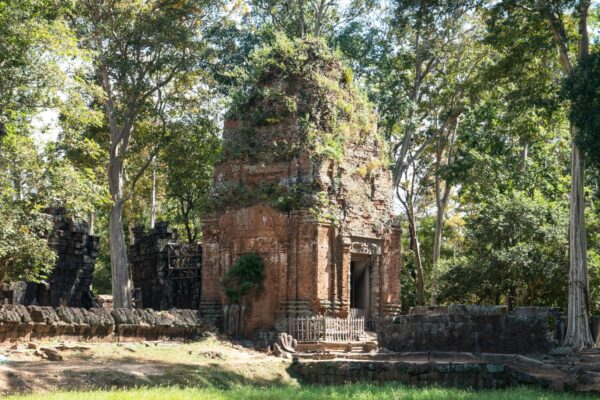
Throughout Cambodia’s long years of civil war, the country’s cultural patrimony was systematically looted. In remote areas of the country, centuries-old Angkorian temples were ransacked; hundreds of sacred sculptures were stolen, cut from sandstone pedestals and chiseled from bas-reliefs. They were then funneled secretly into the demimonde of the international art world.
The person most responsible for this plunder was Douglas Latchford, a British expatriate whose decades-long obsession with the Angkorian Empire led him to assemble one of the largest collections of Khmer antiquities in the world. “Dynamite Doug,” as he was known prior to his death in 2020, laundered the origin of these stolen items and helped to channel them into Western museums and the private collections of the rich – all while being feted across the globe as a leading expert on the art of the Angkorian Empire.
Latchford’s life is the subject of a new book by Matthew Campbell, a journalist at Bloomberg Businessweek, which examines in detail his role in the Cambodian antiquities trade, as well as the supportive role played by international art dealers and prominent Western museums.
Campbell spoke to The Diplomat’s Sebastian Strangio about how Latchford facilitated the theft of Cambodia’s cultural patrimony, the complicity of the international art world, and how some of these precious relics are now starting to return home.
First off, who was Douglas Latchford? When did he first arrive in Southeast Asia, and how did he get involved in the trafficking of stolen Khmer antiquities?
Latchford was a figure who, in some ways, lived in the wrong century. He was born in Bombay, as it was known, in the dying days of the Raj, and moved in the mid-1950s to Bangkok. There, he fell in with what you could call a community of expatriate aesthetes, dominated by Jim Thompson – the namesake of the silk company and the famous house – and Thompson’s friend Connie Mangskau. It could be a shadowy place; Thompson and Mangskau were both former (or not-so-former) intelligence operatives, and Latchford also crossed paths with spies.
All these people were interested in art and antiquities, and especially in the magnificent stone and bronze sculptures that came from Cambodia. Latchford started as a collector, but by the late 1960s, he was more of a dealer, moving works fresh from Cambodian temples onto the international market. And as he became a major player in that business, Cambodia was about to explode, with the Khmer Rouge emerging as a meaningful force around 1968 and full-blown civil war beginning in 1970. This transformed Latchford’s business, because violence and chaos created new supply.
By what means did these artifacts move from remote temples to the international art market?
Virtually everything Latchford sold was looted and smuggled, by any reasonable understanding of those terms. In the mid-1960s, this would have been sort of artisanal – small-scale, opportunistic thefts from temples in a poor country. But as the Cambodian civil war got going, it reached industrial scale. Wars run on money, and the combatants in the war – the Khmer Rouge, the North Vietnamese Army, and non-communist factions – looted temples to fund themselves. Other thefts were by people who just took advantage of the breakdown in public order. It’s important to remember that by 1970, the front line ran right through the center of Siem Reap, with Communist forces dug into positions inside the Angkor temples.
Looting crews would hit ancient sites, whether around Angkor or further afield in places like Koh Ker, using everything from chisels to construction equipment and even dynamite to rip artworks out. They would then carry the pieces to the Thai border, where brokers would move them across and onward to Bangkok, where Latchford was waiting. His role was to serve as the interface between upstream supply and downstream demand. He had impeccable relationships with auction houses, dealers and museums in Europe and the U.S., and especially with the Metropolitan Museum in New York. He was also connected to the looting crews on the Cambodian side, closely enough that he sometimes sent instructions up the chain, specifying the kind of pieces he wanted, which looters would then try to find.
What’s really shocking about this business model is that it didn’t come to an end in the 1970s. The Cambodian civil war only ended in 1998 with the death of Pol Pot, and major looting continued all the way through, with some of the very largest raids in 1995-1997. This was long after everyone involved, and certainly the Western buyers who snapped up whatever came out of Cambodia were supposed to have known better.
What means did Latchford use to conceal the thefts, and how did he characterize his own “work”?
Even in the 1970s, you couldn’t just sell a huge Cambodian sculpture freshly ripped out of a temple without some paperwork. There was some awareness that looting was a problem, and buyers wanted certain assurances. In particular, they wanted to know, or be able to plausibly claim, that a piece had left the country before 1970. That year was important for two reasons: first, it was the beginning of the full-blown civil war in Cambodia, and second, it was the date of a key United Nations treaty on cultural heritage.
Latchford’s solution was to forge the documents. Over the years, he got very good at providing letters and statements purporting to show that artworks were legitimate. These often wouldn’t have passed the barest scrutiny had anyone bothered to investigate them, but buyers generally didn’t. Amazingly, he continued doing this – and was still having his fake documents accepted by major institutions – into the 2010s. He was able to sell works with wildly illicit origins just about any time he wanted.
I think it’s fair to say that Latchford didn’t really care how his pieces were obtained and wasn’t that interested in the details. What he was interested in was the art itself, which obsessed him. He was a toxic character, but I think his love for the objects was genuine. He did make some comments much later indicating that he felt he was saving pieces that would otherwise have been destroyed in the war, but that seems to me like rationalization after the fact.
What was Latchford’s relationship with the Cambodian government, and how did this change over the years?
In the 1980s and 1990s, his relationship with the Cambodian government was very limited. The war was still going on, and no one had effective control of Cambodia’s territory, nor much time for issues of cultural heritage. That changed after 1998, with the consolidation of Hun Sen’s rule. Latchford built a warm relationship with institutions like the Ministry of Culture, and he donated artworks to the National Museum in Phnom Penh. In return, he received some state honors, including the equivalent of a knighthood.
Part of this was simply a lack of knowledge. In the early 2000s, there wasn’t a lot of understanding of the scale of the looting, nor of Latchford’s role in it. There was also genuine gratitude for his donations, though they were tiny compared to his overall business. Museums and cultural heritage programs in Cambodia needed all the help they could get.
But over time, Cambodian officials changed their view, especially once the U.S. Department of Justice began investigating Latchford’s activities around 2011-2012. So, the government became much more skeptical of Latchford and ultimately came to see him as the malign force that he was.
Your book argues that Latchford would not have succeeded to such an extent were it not for the networks and institutions of the art world, and their willingness to turn a blind eye to the provenance of the artifacts in Latchford’s possession. What role did museums, dealers, collectors, and scholars play in the plundering of Cambodia’s cultural patrimony? What does it say about how these institutions operate?
Latchford was a hugely important figure in the looting of Cambodia, but he never could have been so important without a network. He was remarkably well-connected in both New York and London, and he served a purpose. Museums and private buyers wanted blockbuster Cambodian pieces, and Latchford could provide them in a way no one else could. His partners did turn a blind eye, and sometimes did much more than that, to ensure those pieces could enter the U.S. market. There was a degree of indifference toward the origins, in a way you would never have seen with works from, say, Italy.
I find this particularly shocking because none of these people could have claimed to be ignorant of the violence in Cambodia, which was front-page news. So you had these periods when page A1 of the newspaper would be reporting on the latest movements of the Khmer Rouge, while the arts section would be reviewing the latest show of sculptures from the same areas, many of which had never been previously displayed. You would have had to be totally ignorant, or indifferent, not to make the connection.
Of the major Western museums that had relationships with Latchford, none were as powerful or august as the Metropolitan Museum of Art in New York City. What was the nature of its relationship with Latchford, and how much did the Met know (or want to know) about what they were purchasing from him?
The Met is hugely important in my story, both because of the size of its own Southeast Asian collection and its broader influence. It’s not an exaggeration to say that where the Met goes, the rest of the American museum world follows.
In the late 1960s and early 1970s, the Met had a young and very energetic director, Thomas Hoving, who wanted to ensure the museum responded to the evolving interests of its public. And those included a strong interest in South and Southeast Asia, in Buddhism and Hinduism. Think about what was happening in pop culture: the Beatles going to India to study with the Maharishi Mahesh Yogi, the rise of transcendental meditation, of the Hare Krishna movement. So Hoving hired a new curator, Martin Lerner, and tasked him with building a world-class collection.
Lerner became one of Latchford’s most important partners, and they worked together for almost 50 years. Latchford was a major Met supplier, providing some of the most significant pieces in its Southeast Asian galleries, which in turn boosted his credibility with private buyers. For an art dealer, there’s no better advertisement than having a sculpture in the Met. Thanks to the DOJ’s eventual investigation of the Met’s relationship with Latchford, we know that he employed his usual M.O.: providing false or doctored paperwork that gave objects the bare minimum of a legitimate story. And these were largely accepted, because no one in a position of power at the Met had an incentive to look any further. But Lerner was an expert on Cambodian art and traveled to the region extensively. He knew what was going on.
In recent years, the Cambodian government has pushed hard for the return of Angkorian statues from foreign museums, including the Met, with the support of investigators in the United States. Do you think the restitution of looted artifacts is a sign that museums are beginning to confront their involvement in looting, or is there still resistance? What safeguards could be put in place to prevent this sort of thing from happening again?
There’s been huge progress, and that’s a credit to the efforts of the Cambodian government, the DOJ, and people like Bradley Gordon and Tess Davis, respectively the legal adviser to the Cambodians and the director of The Antiquities Coalition, an NGO that’s been very active on this issue. The Met and other institutions have had to reckon with at least some of their past behavior, though many of the investigators would say they haven’t gone far enough.
The good news is that large-scale looting isn’t going on in Cambodia anymore. It’s a country with many problems, but that isn’t one of them. The bad news is that we can see a similar pattern unfolding in other places experiencing war and civil strife – Sudan and Ukraine today, Iraq and Syria not long ago. When public order breaks down, one of the first things that happens is that looters hit museums and historic sites. There’s still a robust international market for stolen artifacts, and a supply chain capable of getting them whenever an opportunity arises.
In my opinion, and that of law-enforcement people I’ve interviewed over the years, the only way to durably stop this is by going after the demand side. Think of other illicit markets; how much money has the U.S. spent trying to stop fentanyl from entering the country, to very little effect? So long as buyers want a product, the product will be provided. And what we have largely not seen, when it comes to looted art, is prosecutions of buyers—who aren’t drug addicts but rational actors making a risk calculation. I think it wouldn’t take many such prosecutions to dramatically change their incentives, and to reduce the chances of other countries experiencing the destruction that Cambodia did beginning in the 1970s.
