

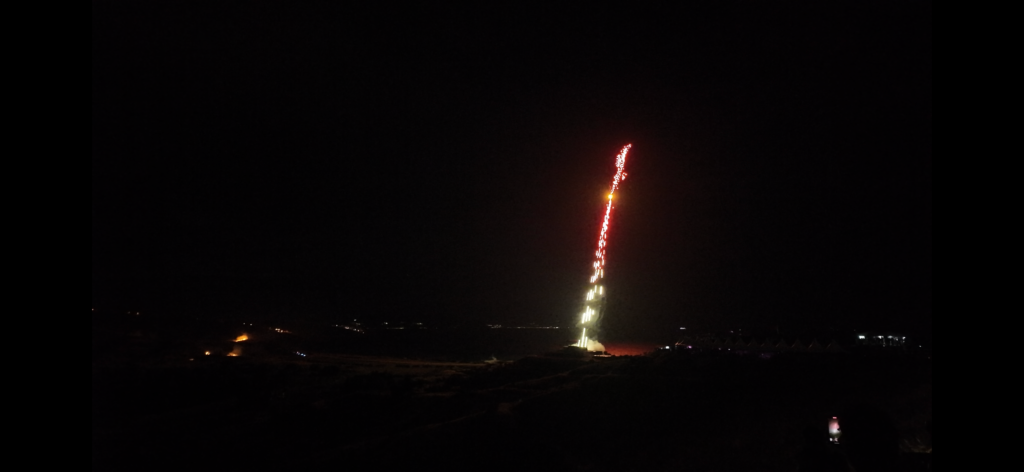
BEIRUT — Turkish electronics giant Aselsan has inked a €780 million ($900 million) deal to provide air defense technologies for Ankara’s Steel Dome project, the company announced in a statement.
Delivery of the components is expected to take place between 2028 and 2032, according to the announcement, released yesterday on social media platform X.
Steel Dome, or Celik Kubbe, is a Turkish layered air defense project akin to the US Golden Dome effort, or Israel’s various layered systems.
Aselsan, the lead of Steel Dome project, inked a $1.9 billion deal with the Turkish Secretariat of Defence Industries (SSB) in September 2025. The Turkish giant also received last year $1.5 billion government investment in a Steel Dome production hub, envisioned as the biggest air defense facility in Europe.
As envisioned, Steel Dome will feature counter drone technology and air defense systems against threats at short range, including the Korkut C-Ram anti aircraft gun, Ejderha directed energy weapon and Gokberk directed energy laser. The systems also integrates longer range air defense systems including the Gurz 140 hybrid air defense system, Hisar short- and medium-range launchers, and Siper long-range air defense system. It was not clear from the statement what Aselsan would be providing to the project.
In light of recent attacks by Iran on neighboring Gulf states, officials from Turkish firms told Breaking Defense in May that they are receiving increased interest from Gulf states in their short-range air defenses and counter-drone technologies.
“Drawing lessons from Ukraine-Russia and Israel-Iran wars, Turkey decided to accelerate modernizing of its aging legacy air defense systems and the Steel Dome forms the backbone of this effort. Perhaps the greatest lesson is that air and missile defense is now a matter of ‘existence or non-existence,’” Serhat Süha Çubukçuoğlu, an expert at TRENDS Research & Advisory in Abu Dhabi, told Breaking Defense.
He added that after the Gulf states’ response to the Iran war, “sovereignty and deterrence are now being redefined around resilience, continuity, and infrastructure protection, not only territorial defence. Applied to the Turkey’s neighborhood, especially the Eastern Mediterranean, this means Ankara increasingly views ports, sea lanes, energy routes, and commercial corridors as part of one integrated strategic picture.”
“On the geopolitical front, the growing Greek/European-Israeli alignment and the accumulation of military assets on Cyprus have significantly increased surveillance, air-defence, and intelligence density around the island. This heightens pressure on Turkey’s maritime and air posture in the Eastern Mediterranean. Ankara’s response has been to harden its position by deploying its latest air and missile defense systems (components of the Steel Dome) and armored units on Cyprus,” Çubukçuoğlu said.
