

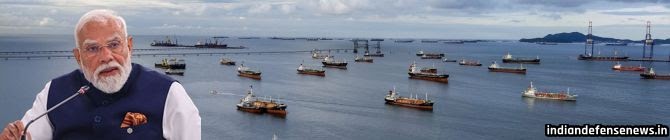
Prime Minister Narendra Modi used his address at the G7 Summit in Evian to warn of the grave economic and humanitarian consequences of disruptions in maritime trade through the Strait of Hormuz, stressing that several Indian civilians have lost their lives during the ongoing conflict in West Asia. He urged collective responsibility to safeguard seafarers and ensure secure global sea lanes.
Prime Minister Modi spoke during the Outreach Session on “Forging New Partnerships and Rebuilding International Solidarity” at the 52nd G7 Summit.
He welcomed the progress made in peace efforts in West Asia, particularly the Iran–US peace deal, while noting that the conflict has caused significant loss of life and property in friendly countries across the region.
He emphasised that disruptions to maritime trade through the Strait of Hormuz have harmed the global economy. India, heavily reliant on energy imports passing through this strategic chokepoint, has been directly affected. Modi underlined that several Indian civilians have lost their lives in the course of the conflict, highlighting the human cost of instability in the region.
The Prime Minister declared that international partnerships and global solidarity can only be meaningful if nations work together to address shared challenges. He reiterated India’s belief that lasting resolutions to tensions and conflicts are possible only through dialogue, diplomacy, and international cooperation.
This message was directed at both regional actors and global powers, underscoring India’s preference for peaceful solutions.
Modi stressed the importance of safeguarding maritime routes and ensuring the security of seafarers engaged in global trade. He described the safety of seafarers as a collective responsibility, noting that they connect nations through maritime commerce. He called for secure sea lanes where seafarers can perform their duties without fear, and affirmed that India stands fully prepared to work with all partners on these critical issues.
His remarks came against the backdrop of recent incidents in which Indian sailors lost their lives during US military strikes on commercial vessels in the Gulf of Oman. These events have heightened India’s concerns about the vulnerability of civilian maritime workers in conflict zones and the wider implications for global supply chains.
The Prime Minister’s intervention at the summit also reflected India’s broader strategic outlook. He pointed out that in today’s interconnected world, trust has become the most valuable strategic asset.
He warned that trade and technology are increasingly being misused for narrow interests, creating a trust deficit in international relations. He argued that mutual trust is essential for successful partnerships and for ensuring that supply chains and technology serve the global good rather than being used as instruments of coercion.
Modi’s remarks were delivered in the presence of US President Donald Trump and other G7 leaders, making them particularly significant in the context of India’s upcoming bilateral discussions with the United States. The deaths of Indian sailors and the disruption of maritime traffic through the Strait of Hormuz are expected to feature prominently in his meeting with President Trump.
India’s participation in the summit marked its 13th appearance as a partner nation and Modi’s seventh consecutive attendance. His arrival in Evian followed an official invitation from French President Emmanuel Macron, underscoring India’s growing role in global deliberations on security, trade, and development.
By linking maritime safety to broader themes of trust, solidarity, and partnership, Modi positioned India as a responsible stakeholder advocating for inclusive and cooperative solutions to global challenges. His call for protecting seafarers and securing maritime routes resonated strongly with the summit’s agenda of rebuilding international solidarity in an era of heightened geopolitical tensions.
ANI
