


For company leaders, detailed hiring and workforce data is an early warning system for performance. It shows where skills are strengthening or eroding and gives a forward-looking view that guides smarter investment, cost and competitiveness decisions. Hiring data shows where the real bets are being placed long before results show up in sales or earnings. By tracking which roles, skills and regions companies are investing in, leaders can see where competitors are pushing into new products, channels and markets – and spot gaps or overexposure.
However, the positioning window on such hiring signals is around one to three months: by the time consensus reacts, the data will have already moved on. GlobalData Jobs Analytics delivers point‑in‑time postings direct from company career pages, tagged by company, sector and theme. For leaders, this pattern highlights where investment and capability-building are still moving forward, which markets are slowing, and in which areas demand is growing.
Here we examine how the latest data for semiconductor job postings are shifting across themes, geographies and employers – and what those changes reveal about real investment priorities across all sectors.
Why have global semiconductor job postings eased?
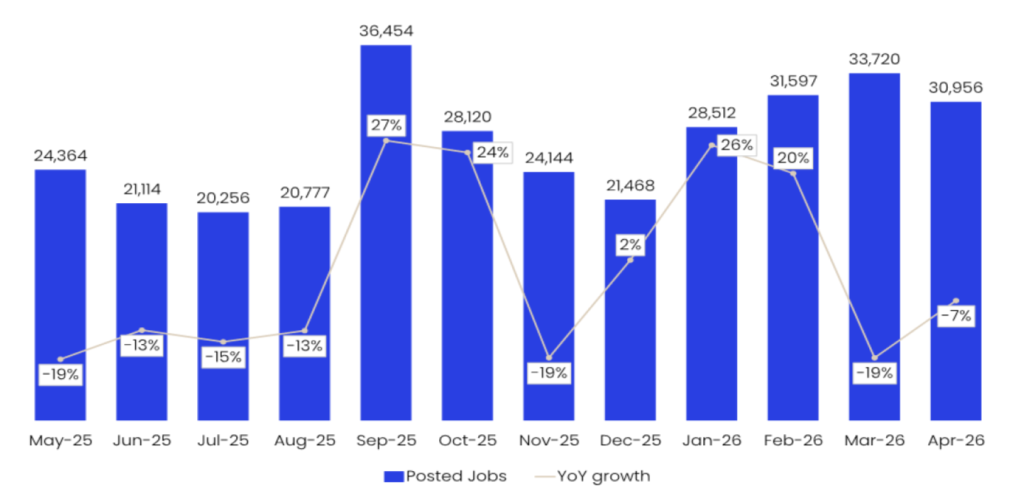
April 2026 postings show a decline of 6.58% month-on-month to 30,956, marking a second consecutive monthly decline following a January–February acceleration. Over the last 12 months, hiring shows a volatile pattern, with step-ups in September 2025 and again in January–February 2026 followed by retrenchment into March–April. Despite the April pullback, posting levels remain above the December 2025 baseline, indicating a higher run-rate than late-2025 lows. Overall, the latest month reflects cooling momentum rather than a return to mid-2025 trough levels.
Figure 1: Global Monthly Semiconductors sector job postings, May-25 to Apr-26
Source: GlobalData Jobs Analytics
AI- and cloud-linked themes dominate semiconductors hiring mix
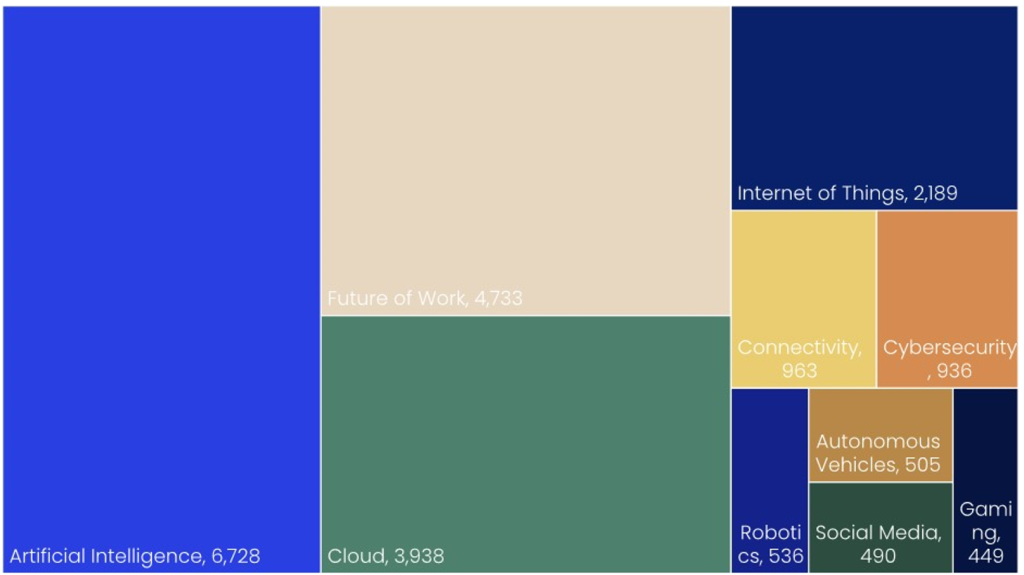
Theme-based hiring is concentrated in Artificial Intelligence (AI) (6,728) and Future of Work (FOW) (4,733), with Cloud (3,938) forming the next tier, indicating a clear skew toward software-adjacent and digital modernisation demand within semiconductors postings. Secondary themes such as Internet of Things (IoT) (2,189) and connectivity (963) are materially smaller, highlighting a steeper drop-off beyond the top three. The long tail (e.g., robotics, autonomous vehicles, gaming) remains comparatively limited in posting volume.
- AI leads all themes by count, separating clearly from the rest of the theme set.
- Cloud is a sizable third pillar, reinforcing the concentration of postings in platform and infrastructure-oriented work.
- Autonomous vehicles (505) and robotics (536) appear as smaller, specialist demand pockets relative to core digital themes.
Figure 2: Top hiring themes in the Semiconductors sector – April 2026
Source: GlobalData Jobs Analytics
US remains the largest hub for semiconductors hiring
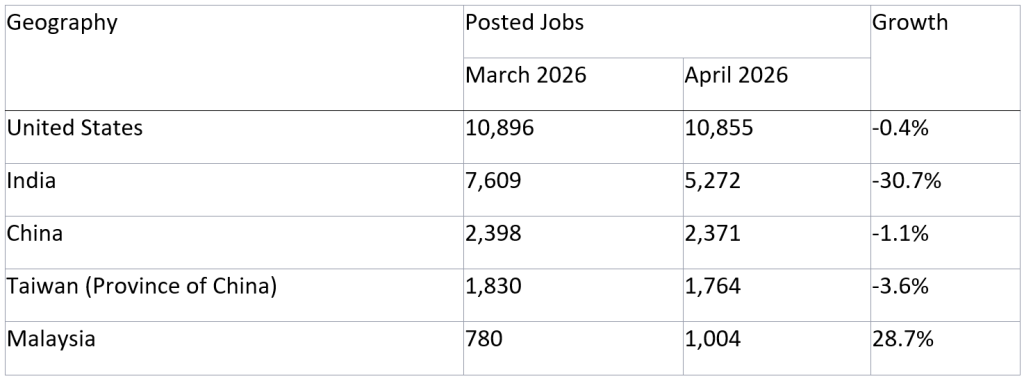
In April 2026, the US remained the largest hiring market among the listed countries, holding essentially flat versus March (-0.4%). India recorded the steepest month-on-month contraction (-30.7%), accounting for the most significant negative swing within the top geographies. China (-1.1%) and Taiwan (Province of China) (-3.6%) also edged lower, while Malaysia grew 28.7% to 1,004 postings, standing out as the main positive mover in the set. Overall, April’s geographic profile shows stability in the largest market alongside dispersion in growth rates elsewhere.
Figure 3: Hiring by country in the semiconductors sector– April 2026 vs March 2026
Source: GlobalData Jobs Analytics
Top semiconductors employers show mixed hiring momentum
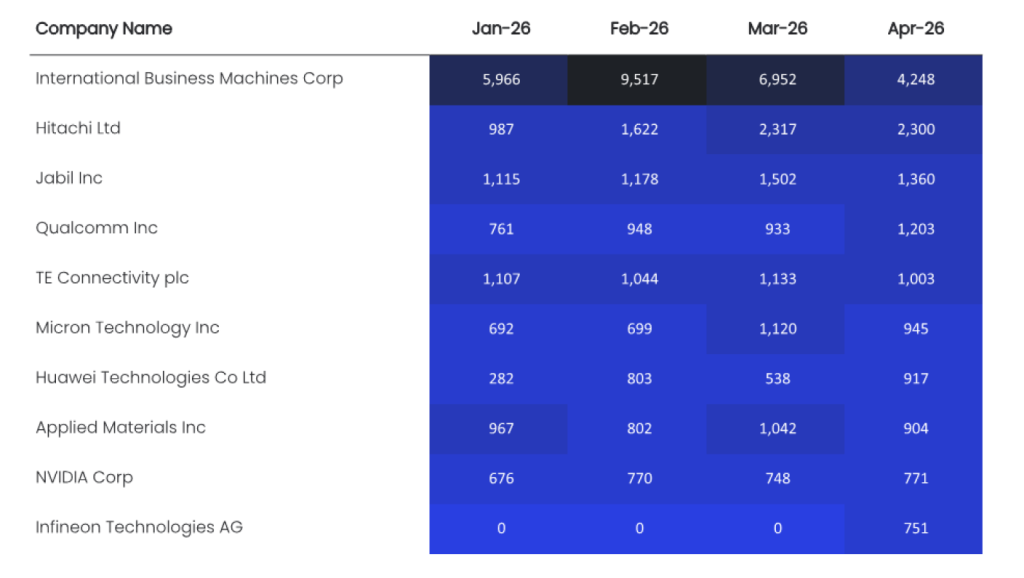
IBM remained the largest job poster in April 2026 (4,248) but fell materially from its February peak (9,517) and also declined versus March (6,952), contributing to softer top-employer momentum. Hitachi showed relative stability at elevated levels (2,300 in April versus 2,317 in March). Several others posted moderate April increases (e.g., Qualcomm to 1,203; Huawei to 917), while some declined (e.g., Jabil to 1,360; Applied Materials to 904). Infineon entered the top-employer list in April with 751 postings after zeros in January–March, indicating a notable month-specific shift in the employer mix.
Figure 4: Top semiconductors sector employers by jobs posted – Jan-26 to Apr-26
Source: GlobalData Jobs Analytics
Technical skills in semiconductors hiring
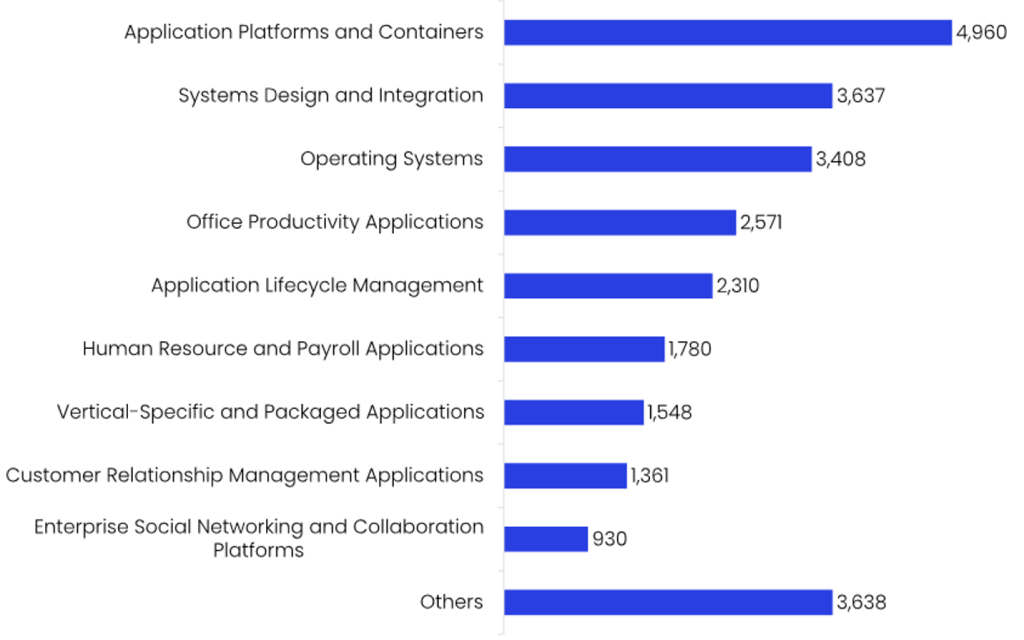
Technical demand is led by Application Platforms and Containers (4,960), followed by Systems Design and Integration (3,637), indicating hiring emphasis on platform engineering and integration-heavy delivery. Operating Systems (3,408) also ranks highly, reinforcing infrastructure- level capability needs across postings. The remainder of the top skills set includes enterprise application domains (e.g., application lifecycle management and HR/payroll applications), suggesting breadth across IT delivery and business systems support.
Figure 5: Top technical skills in demand in the semiconductors sector, April 2026
Source: GlobalData Jobs Analytics
What this all means for you as a leader
Across every sector, hiring and workforce data offers an early, forward-looking view of where investment, capacity and risk are really shifting. By tracking how roles, skills and locations are changing before they appear in financial results or consensus, leaders and investors can make sharper decisions on where to back growth, where to pull back, and how to stay ahead of competitors.
Job postings lead earnings revisions by at least one to three months, so by the time consensus reacts, the data has already moved. GlobalData Jobs Analytics delivers point‑in‑time postings direct from company career pages, tagged by company, sector and theme. Request a data sample today, by contacting hirendra.vikram@globaldata.com or download the white paper below to start translating complex hiring patterns into straightforward signals you can use in planning and investment decisions.

