

Bangladesh’s Home Minister Salahuddin Ahmed has announced plans to fence parts of the country’s 270-kilometer border with Myanmar. To understand why Dhaka has arrived at this point, one must look back to December 8, 2024, when the Arakan Army (AA) completed its capture of Maungdaw and assumed full control of northern Rakhine State’s border with Bangladesh.
For most international observers, the fall of Maungdaw marked a milestone in Myanmar’s civil war – another indication of the military junta’s shrinking territorial control.
For Dhaka, however, it meant the disappearance of effective Myanmar state authority along much of its southeastern frontier. Today, Bangladesh no longer faces a functioning state across large stretches of that border.
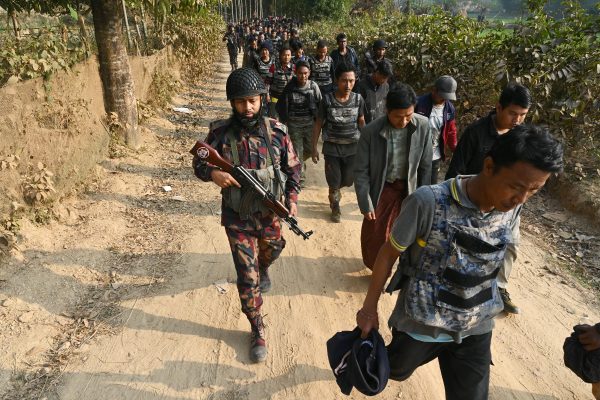
The Myanmar government retains little meaningful presence in northern Rakhine. In its place stands the AA, an ethnic armed organization that now exercises de facto control over much of Rakhine State, administers territory, collects taxes, regulates movement, and increasingly performs functions characteristic of a governing authority.
This transformation has upended Bangladesh’s border security environment — and exposed the fragility of the institutions that once managed it.
The core problem facing Dhaka is a profound structural asymmetry. Myanmar’s government, despite its historical shortcomings and systemic failures, remained formally bound by bilateral agreements, diplomatic protocols, and international commitments. The Arakan Army is not.
The AA behaves increasingly like a governing authority — enforcing regulations, administering local affairs, and asserting jurisdiction over border areas — yet it is not a sovereign state and falls outside the mechanisms through which states are ordinarily held accountable to one another.
For Bangladesh, this means that familiar instruments of statecraft have been rendered largely unreliable.
Communication with the AA is not impossible; Dhaka has already engaged through informal channels, local intermediaries, and international organizations to secure the release of detained civilians and manage urgent border incidents.
But these interactions occur without the predictability, institutional safeguards, and reciprocal obligations that normally accompany relations between recognized states. Diplomatic engagement between Bangladesh and the AA, when it happens, remains entirely reactive and ad hoc.
The consequences of this institutional void have become starkly visible. Over the past year and a half, hundreds of Bangladeshi fishermen and Rohingya residents have been detained by the AA in the Naf River and the waters adjoining it. These incidents reflect both the AA’s unilateral assertion of control over previously ambiguous waterways and the complete absence of formal protocols through which such disputes would normally be resolved.
Simultaneously, in Bandarban, Bangladeshi residents continue to encounter landmines and unexploded ordnance near agricultural land — deadly remnants of fighting taking place just across the border. The frontier has also hardened into a principal transit route for methamphetamine and other illicit narcotics, with law enforcement agencies reporting record seizures. Regional assessments indicate that trafficking networks have expanded despite enforcement pressure, shifting their routes with remarkable adaptability as Myanmar’s post-coup fragmentation continues to entrench the conflict economy along the border.
The proposed fence should be understood in this light. It is Bangladesh’s attempt to regain a measure of unilateral control over a frontier where traditional coordination mechanisms have broken down entirely.
The approach, admittedly, has substantial limitations. A fence cannot eliminate the economic incentives sustaining the narcotics trade, resolve complex maritime jurisdictional disputes in the Naf River, or address the underlying political conditions driving instability in Rakhine State. But assessing the fence purely on whether it can solve these problems misses part of its purpose. Governments facing intractable external pressures must demonstrate visible, tangible action to the public, even when no single measure can eliminate the underlying threat. In this sense, fencing serves a crucial domestic political function alongside its security role. It signals that the state is responding to growing public anxiety about cross-border crime and lawlessness.
More pointedly, the fence sends a message directed beyond Bangladesh’s own borders. It signals to the region and the international community that Dhaka does not intend to absorb indefinitely the costs of a crisis generated entirely outside its borders, and that responsibility for the consequences of Myanmar’s structural collapse cannot rest with Bangladesh alone.
Bangladesh is already managing approximately 1.2 million Rohingya refugees, many of whom have been in the country for nearly a decade. Bangladesh’s long-term plan for the Rohingya has always been repatriation, and Dhaka pursued formal agreements with the Myanmar state to that end. Yet much of the territory to which Rohingya refugees would eventually return is now controlled by the AA — an organization itself accused of genocidal violence against the Rohingya population. The AA’s hostility toward the Rohingya is well-documented.
Questions over the Rohingyas’ fundamental rights, security, and political status under any future AA-administered arrangement remain unresolved. The AA’s advance in Rakhine State may well push back the already interminable timeline on Rohingya repatriation. Meanwhile, the fighting in Rakhine State has driven new waves of refugees across the border – an additional burden Bangladesh is ill-equipped to bear.
The planned border fence might not deter future refugees, but it does symbolize Bangladesh’s sovereign position: that the refugee crisis remains a consequence of Myanmar’s internal instability demanding resolution from within Myanmar.
Bangladesh is not alone in navigating these pressures. Thailand, India, and China all share frontiers with Myanmar territories where ethnic armed organizations now exercise varying degrees of authority. None of these states has found a definitive answer to the governance problems created by Myanmar’s fragmentation, largely because the broader conflict remains unresolved.
Yet Bangladesh’s situation is unique. Hosting more than a million displaced people while managing a border where effective state authority has collapsed creates a dual humanitarian and security crisis that its regional neighbors do not face in comparable form.
Ultimately, Bangladesh’s move toward border fencing is a telling indication of the geopolitical transformation taking place across the frontier. It is a risk-management tool — one element of a broader effort to contain the spillover effects of a conflict Bangladesh neither created nor can easily influence. Without a comprehensive political settlement inside Myanmar, no barrier can substitute for the bilateral institutions that once managed this frontier. But in their effective absence, Bangladesh has little choice but to try.
