

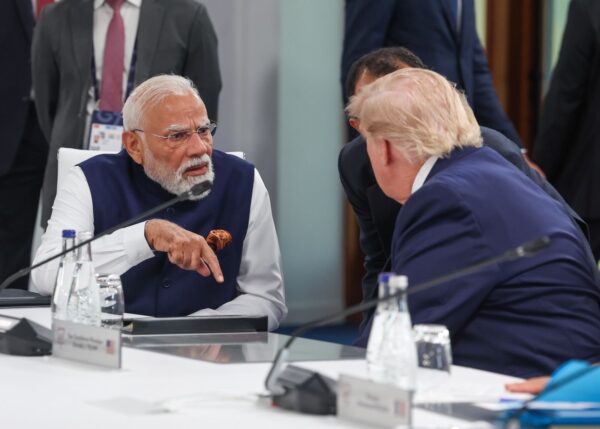
Prime Minister Narendra Modi’s meeting with U.S. President Donald Trump on the sidelines of the G-7 meeting in France on June 17 was supposed to stabilize relations that have been troubled over the past year.
Trump was effusive in his praise of Modi. He told reporters that the two leaders share “a great relationship” and that India had “a great friend in the White House” as long as he was president.
However, there is little reason for India to believe that India-U.S. relations will go back to the strong partnership that existed before Trump returned for his second term.
Trump did reassure India on defense support. “I can tell you this – without having a contract, we don’t have a contract – but if they (India) were attacked, we would be there to help them,” he said, adding, “If anybody attacks that man [Modi], we’re going to be there.”
It wasn’t immediately clear who Trump was referring to as India’s adversary.
India is not a treaty ally of the United States, although it has agreements in place since 2005 that have deepened defense cooperation. U.S. ships now make regular stops at Indian ports for repairs and supply replenishment.
India has strained relations with Pakistan and has an unresolved border with China, which it views as its strategic competitor. U.S. ties with Pakistan have warmed in Trump 2.0 and Washington is looking to reset ties with China. In the event of an armed conflict with Pakistan or China, will the U.S. “be there to help” India as Trump promised?
In his remarks to Trump, Modi said that since their previous meeting in Washington in February 2025, bilateral ties had been invigorated by a “new momentum” and “new energy.” Both countries were working toward achieving targets set at their February 2025 meeting, he said.
Modi also praised Trump’s efforts to bring “peace and stability in the region” in the wake of the Iran-U.S. conflict. He urged measures to ensure the security of seafarers while implementing the Iran-U.S. peace deal, noting that hundreds of thousands of Indian seafarers were deployed on ships, including at the Strait of Hormuz. He said that he hoped that Trump would give priority to the security of seafarers.
Modi’s remarks follow the deaths of three Indian sailors in an attack by a U.S. aircraft earlier this month off the Oman coast. The killings sparked anger in India, with many questioning India’s strategic partnership with the United States.
A statement from the U.S. Central Command said the firing took place “after the crew repeatedly failed to comply with directions from American forces” enforcing a blockade in the Gulf of Oman to prevent the oil sales by Iran during the conflict. News reports later said the company operating the vessel had denied it was transporting any illegal cargo.
In New Delhi, India summoned the U.S. charge d’affaires, Jason Meeks, twice, first to protest the firing on the Indian crew and later after the deaths of its seafarers. India’s External Affairs Minister S. Jaishankar also spoke to U.S. Secretary of State Marco Rubio, whose remarks that “violations of the U.S. blockade and the illicit transport of Iranian oil will not be tolerated” only added to the sense of outrage Indians felt.
When asked by reporters on June 17 if he shared his condolences on the deaths of the Indian sailors, Trump said: “It’s a rough profession, there’s no question about it, and we work together on it … We love all of those people, they’re great people.” However, there was no apology, not even an expression of regret.
It must be noted that throughout the crisis over the U.S. attack on the ship that carried the Indian crew, the Modi government refrained from naming the United States. Understandably, this evoked criticism from the opposition Congress Party.
Indian analysts are skeptical that the Trump-Modi meeting will lead to a steadying of the bilateral relationship. Its impact would be “very limited,” C. Uday Bhaskar, a former Indian Navy commodore and strategic affairs analyst, told The Diplomat.
Trump’s imposition of 50 percent tariffs on India last year was among the highest in the world. His repeated statements claiming credit for the ceasefire that ended the India-Pakistan hostilities in May 2025 annoyed India. Meanwhile, Trump was reportedly peeved with India not endorsing him for a Nobel Peace Prize after Pakistani leaders did so. Trump also repeatedly belittled India as a “dead economy” and a “hellhole.”
These contributed to a sharp downturn in bilateral relations over the past year.
A U.S. delegation is expected in New Delhi later this month to tie up a trade deal that has been under negotiation for months. A pact could help repair some of the damage done, but not entirely.
For one, there is a marked change in U.S. priorities, with the Trump administration focusing on “America First” and prioritizing the Western Hemisphere and the Pacific, as outlined in its National Security Strategy released in November 2025. This dilutes the importance of India within the U.S. security calculus and its role as a major partner in Asia, Bhaskar said.
Against this backdrop, the Trump administration’s announcement on June 16 that it would be restoring the name of its Hawai’i-based command as U.S. Pacific Command from U.S. Indo-Pacific Command isn’t surprising.
“The U.S. under President Trump has been explicit about putting America First. The implication is that Washington will be reluctant to commit resources or strategic attention to regions and issues where it does not perceive a clear national interest,” Abhijit Singh, a former Indian navy captain and currently an analyst with the New Delhi-based Observer Research Foundation, told The Diplomat.
The unstated implication of the name reversion is that the United States is deprioritizing the Indian Ocean, in contrast to former U.S. President Barack Obama’s Pivot to Asia strategy. In 2012, then-U.S. Defense Secretary Leon Panetta described India as the “linchpin” of the U.S. rebalance to Asia. India had welcomed the move as this aligned with its own view of a multipolar Asia, with the U.S. bolstering security in the wider Indo-Pacific region amid the rise of China.
Adding to India’s worries about the United States under Trump are its sudden policy changes. A U.S. government order of June 12, banning access of all foreign nationals to advanced AI models due to national security concerns, hit India hard. Although the move wasn’t particularly aimed at India, Indian technology businesses are worried, given their reliance on advanced U.S. technology.
“India’s IT services industry was built on the assumption of open access to the best global technology. That assumption has now developed a serious crack. This creates a competitive disadvantage, but the deeper risk is strategic dependency,” Nikhil Narendran, a tech policy thought leader, was quoted as saying by the Economic Times.
Interestingly, during a visit to India in March, U.S. Deputy Secretary of State Christopher Landau had framed India as a possible competitor to the United States. India “should understand that we are not going to make the same mistakes with India that we made with China 20 years ago in terms of saying, we are going to let you develop all these markets, and then, the next thing we know, you are beating us in a lot of commercial things,” he said.
Taken together, these developments point to the need for India to re-examine the extent of its dependencies on the U.S. and insulate itself from shocks.
Once viewed as India’s partner of choice in technology, innovation and investments as India looked to become a developed economy by 2047, the U.S. is now seen as a less-than-dependable partner. This may explain the reason for India’s growing closeness with Europe, with Modi and Jaishankar making multiple visits to countries in the continent to shore up ties.
