

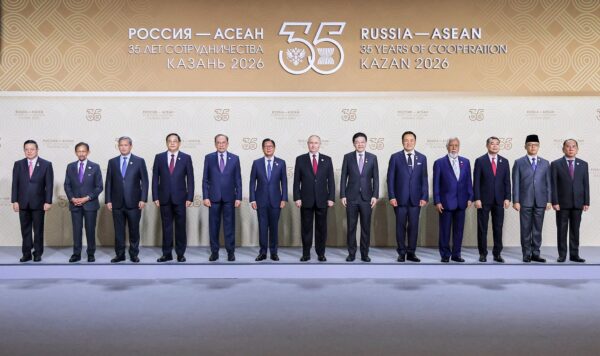
The Association of Southeast Asian Nations (ASEAN) and Russia yesterday pledged to expand trade, energy, and security cooperation, as they met for a special summit in Kazan.
Leaders from 10 of ASEAN’s 11 member states attended the ASEAN-Russia Commemorative Summit, which is intended to marks the 35th anniversary of relations between Russia and the Southeast Asian bloc. A number also held sideline meetings with President Vladimir Putin, who co-chaired the summit with Philippine President Ferdinand Marcos Jr., who currently holds the rotating chairmanship of ASEAN. Due to its exclusion from high-level ASEAN meetings, Myanmar was represented by an official from the Ministry of Foreign Affairs.
In his welcome remarks as co-chair of the summit, Marcos said that the two sides had much to gain from closer cooperation.
“In an era of deepening geopolitical uncertainty, the value of steady political and security engagement between ASEAN and Russia cannot be overstated,” Marcos said, as per the Philippine news outlet GMA News Online.
“We must be more deliberate and more ambitious in expanding economic opportunities, improving trade facilitation, deepening investment flows, and connecting our business communities,” Marcos added. “Food and energy security deserve, in particular, attention as these are the foundations on which broader stability rests.”
The Philippine leader also called for the two sides to expand cooperation to combat transnational threats “such as terrorism, illicit trafficking, cybercrime, and online scams” and to “strengthen practical cooperation on maritime security and counterterrorism.”
During the summit, the two sides adopted a number of outcome documents, including the Kazan Declaration 2026, which pledged to expand cooperation across a host of different fronts, based on a “common aspiration” for “a just multipolar world as guided by international law and the principles of the U.N. Charter.” The two sides also adopted the ASEAN-Russia Comprehensive Plan of Action 2026-2030, which will serve as a “guiding document” for future engagement between the regional bloc and Moscow.
Speaking at a joint press conference with Putin, Marcos said that the documents “provide a comprehensive roadmap for expanding practical cooperation and delivering tangible results and benefits to our peoples in the years to come.”
Putin said that Russia and ASEAN’s member states agreed on the need to deepen economic cooperation, diversify trade, and strengthen food and energy partnerships to address the vulnerabilities exposed by the closure of the Strait of Hormuz, which created global shortages of fuel and fertilizer.
“Naturally, we’ll continue to supply our Asian friends with food and energy, which are very high in demand,” Putin said.
He also highlighted Russia’s readiness to cooperate with Southeast Asian governments in developing peaceful nuclear energy programs through the state-owned nuclear corporation Rosatom.
Over the past decade, under Putin’s leadership, Russia has taken steps to expand its economic, political, and security relations with Southeast Asia. This has involved efforts both to build upon the historical influence of the Soviet Union in the region, particularly in Indochina, and to forge new partnerships with rising middle powers such as Malaysia and Indonesia.
As the comments made at yesterday’s summit suggest, the global energy supply crisis has only created further incentives for ASEAN member states to increase their cooperation with Russia. In the Comprehensive Plan of Action for 2026-2030, both sides pledged to “strengthen cooperation in the use and development of all energy sources” and to “strengthen cooperation to enhance energy security,” among many other things.
It also underscores the reality that despite their misgivings about the Russian invasion of Ukraine, ASEAN member states have been unwilling to internalize the Western view of Russia as a pariah state. In this sense it was notable that the ASEAN-Russia summit overlapped with a Group of Seven (G-7) meeting in France, where leaders reaffirmed their “unwavering support for Ukraine in defending its freedom, sovereignty, and territorial integrity” in its war with Russia.
Ian Storey, the author of a recent book on Russia’s relations with Southeast Asia in the Putin era, told The Diplomat last year that the invasion of Ukraine, and the resulting wall of Western sanctions, had significantly increased Southeast Asia’s importance to Moscow. At the same time, “Western attempts to portray Russia as an international pariah have clearly failed in Southeast Asia.” He added that most ASEAN member states simply “don’t want to get embroiled in the disputes of the major powers, especially over an issue in which they do not believe their own interests are directly at stake.”
All this suggests that, even if one takes the effusive summit statements with a degree of skepticism, most ASEAN member states see every reason to maintain and deepen their relationships with Russia in areas where it can benefit them.
This is true even in the case of Singapore, the only nation to condemn Russia by name for its invasion of Ukraine and impose financial sanctions. In a post on X yesterday relating to his sideline meeting with Putin, Prime Minister Lawrence Wong stated that his country had opposed the Russian invasion “not because of alignment with any side, but because we believe the sovereignty and territorial integrity of all countries must be respected.”
Wong added, “Singapore values its long-standing ties with Russia and its people, and we will continue to look for opportunities to cooperate in areas of mutual interest.”
