

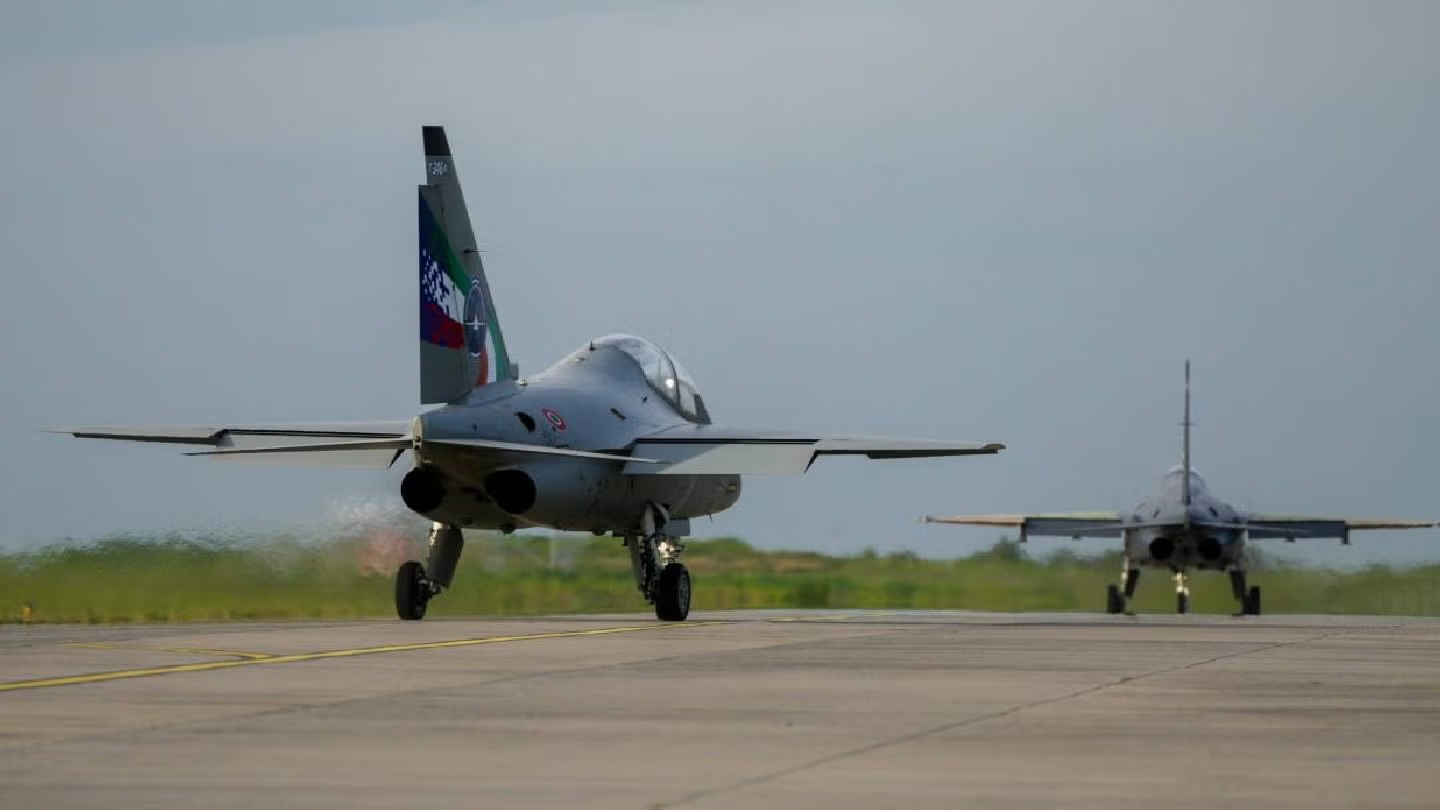
Leonardo and Baykar have completed the initial phase of live flight testing for the K-SWARM programme, aimed at enhancing coordination between crewed and uncrewed aircraft.
The tests, which took place in May at Baykar’s flight and test centre in Çorlu, Türkiye, were designed to evaluate interoperability for future combat air systems.

Discover B2B Marketing That Performs
Combine business intelligence and editorial excellence to reach engaged professionals across 36 leading media platforms.
The collaborative testing featured a Leonardo-owned M-346 Fighter Attack aircraft, accompanied by an Italian Air Force T-346A acting as a chase aircraft, and Baykar’s Bayraktar KIZILELMA uncrewed fighter.
The main objective was to validate new algorithms as well as operational tactics and procedures, with activities managed by Leonardo’s teams in Turin and supported by a full mission simulator in Venegono, Italy.
According to Leonardo, various formations and manoeuvres were tested, with the KIZILELMA aircraft autonomously responding to commands issued from the M-346 cockpit.
A specialist data exchange system, protected by Leonardo’s GCC Tactical Platform, was used to ensure synchronised data sharing between platforms. This system offers real-time cyber defence monitoring and coordination, supporting secure and effective command of flight formations.
The campaign also involved technical contributions from Baykar’s Hardware-in-the-Loop Laboratory, which developed the Smart Fleet Autonomy algorithms.
Following autonomous taxi and take-off, the KIZILELMA joined the M-346 and enabled the latter to assume control.
Equipped with a newly developed, fully integrated onboard avionic suite, M-346 pilots issued formation commands that KIZILELMA carried out autonomously via a specialised crewed/uncrewed computing system.
During the trials, various mission scenarios were implemented, including position changes, separations, and rejoins.
The KIZILELMA accurately followed the M-346’s instructions during these tasks, Leonardo stated.
Leonardo said: “The activities performed in Çorlu were the result of extensive and intense preparation work, including pilots and technicians, which were jointly carried out over several months by the Leonardo and Baykar teams.
“This extensive work resulted in the trials achieving the required level of technical integration of the systems, the development of testing scenarios, the algorithms validation and ensured the tests could be managed and completed safely and effectively.”
Data collected from the recent flights would inform the next stages of the K-SWARM programme, which will focus on more complex collaborative operations.
The aim is to expand the autonomy of uncrewed systems, gradually reducing pilot workload and increasing operational efficiency while maintaining pilot control over mission-critical decisions.
The companies will conduct further testing in the coming month, with plans to introduce additional capabilities and higher levels of complexity in upcoming trials.
In June last year, Leonardo and Baykar Technologies established a 50-50 joint venture focused on uncrewed technologies.

