

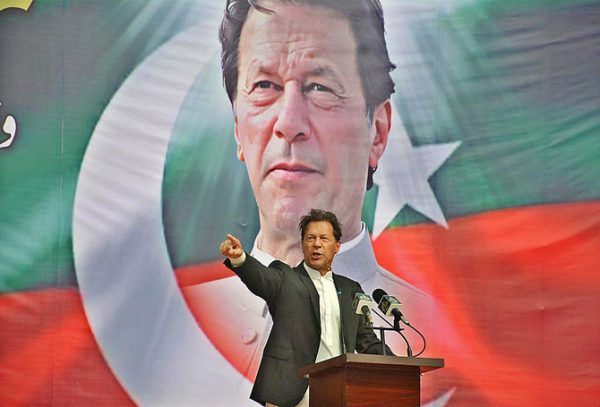
On June 19, the Election Commission Gilgit-Baltistan (ECGB) announced the final results of the June 7 polls, with the Pakistan People’s Party (PPP) bagging nine out of 21 seats to emerge victorious. The delay in finalizing the result of the elections in Gilgit-Baltistan, a territory that is a part of the Kashmir dispute between Pakistan and India, was largely due to widespread allegations of misappropriation leveled by Imran Khan’s Pakistan Tehreek-e-Insaf (PTI).
The PTI insisted that, like the 2024 general elections, the Gilgit-Baltistan polls too were rigged by the military establishment to sideline the party. Eyewitnesses confirmed discrepancies in voting patterns and final results across polling stations, in addition to the pre-poll alterations in constituency boundaries and voters lists. On top of that, the PTI is being forced to field independent candidates, with its leaders frequently barred from campaigning.
The state’s marginalization of the PTI from the electoral process is a continuation of the military establishment’s clampdown on the party following Imran Khan’s removal as the prime minister in April 2022. Since then the party leadership has faced incarceration. Khan has been in prison since August 2023, in addition to thousands of PTI workers being jailed over “anti-state” actions – most notably the riots of May 9, 2023, when Khan was first arrested. Last year, 75 PTI leaders were jailed in a mass conviction over the 2023 protests.
Khan’s health is deteriorating in jail, as both the PTI founder and his wife Bushra Bibi – also imprisoned over corruption allegations – suffer from a loss of vision. Meanwhile, the media blackout of the party – especially Khan, whose name was unofficially barred from being spoken on TV channels – has continued over the past four years, including in the lead up to the Gilgit-Baltistan polls.
While anti-army sentiments exploded in Pakistan in the immediate aftermath of Khan’s removal as the premier, and garnered global attention amid large-scale election manipulation in 2024, the military leadership has witnessed a stark turnaround over the past 12 months. The ceasefire following the May 2025 India-Pakistan clashes allowed Islamabad to claim victory, especially amid confirmation that multiple Indian jets were downed.
Since then, as Pakistan has continued to woo U.S. President Donald Trump, Islamabad has become the chief broker in the ongoing Iran-U.S. negotiations, even hosting the talks between the two sides in April. The all-powerful army chief, Asim Munir, who became the country’s second field marshal and the very first chief of defense forces (CDF), was described by U.S. Vice President J.D. Vance as “one of two most important people in my life” during the Lake Lucerne talks in Switzerland over the weekend. Trump has repeatedly called Munir “my favorite field marshal.”
Munir, who had been dubbed “hardline” within the military ranks even before his ascension to the army chief position, also has a bone to pick with Imran Khan. While prime minister, Khan had removed Munir as the head of the Inter-Services Intelligence (ISI) in 2019. Munir is now spearheading the crackdown on Khan and his party as not just the most powerful man in Pakistan, but now also one of the most influential figures in the region.
This turnaround has pushed a rethink in the PTI, The Diplomat has learned through conversations with the party leadership. Party leaders are now open to the Pakistan Muslim League-Nawaz (PML-N)-led government’s longstanding proposition of a “charter of democracy,” originally designed to strengthen parliamentary supremacy, but now largely considered the army leadership’s ploy to reaffirm its authority. Many in the PTI ranks believe that a compromise with the military leadership is the only way forward to maintain any political relevance in the country.
“The military establishment has now become so powerful that it has become impossible to uphold democracy in Pakistan,” a PTI leader told The Diplomat. “Politicians can now only function in the space allowed to them. The hybrid regime is permanent – so Pakistani politics is all about competing for the shrinking civilian space in the hybrid system.” The “hybrid” model of governance, popularized by the current leadership, signifies a civil-military accord, but critics believe it is euphemism for the army dictating all matters of importance.
Numerous PTI leaders express such sentiments and believe that the party needs to abandon its overt anti-establishment leaning and seek a return to the mainstream by agreeing to the proposed “charter of democracy.” Many also believe that any upheaval to undo the military-upheld status quo is unlikely, given the reluctance of the majority of the population to take to the streets in protest to demand justice for Imran Khan (even as he remains the most popular politician in Pakistan).
In this regard, there have been talks between PTI leaders and the government. Last month, the PTI’s Interim Chairman Gohar Ali Khan and Khyber Pakhtunkhwa Chief Minister Sohail Afridi met with Interior Minister Mohsin Naqvi. On June 19, PTI leaders Asad Qaiser and Junaid Akbar led a party delegation into a meeting with Finance Minister Muhammad Aurangzeb. Officially, these meetings have been described as discussions pertaining to “security” and “taxation” policies. However, insider accounts say that there have been conversations on bridging the differences between the PTI and the government vis-à-vis the “charter of democracy.” While the ruling parties are largely playing the role of intermediary, the conversation is actually being had with the military.
“We [the PTI] are always ready for talks in order to establish true democracy. For that there needs to be a level playing field [for all parties]. There should be no political vendetta. The country is ours, and so is the army,” said Qaiser.
The PTI leadership’s changing narrative on the army is already paying dividends. On June 19, the National Assembly lifted its ban on the airing of PTI leaders’ speeches. The day before that, senior PTI leader Shah Mahmood Qureshi, long considered aligned with the military establishment’s policies, was acquitted by an anti-terrorism court. Last week, the Supreme Court restored Imran Khan’s right to contest a defamation case filed by Prime Minister Shehbaz Sharif. The apex court is also set to hear Khan’s plea regarding access to his lawyers and family.
While any negotiations between the PTI and the military leadership via the ruling parties will inevitably include relief for Khan, many within the party believe that the PTI founder will not endorse the charter of democracy. “He would rather die than accept compromise with the parties. That will undo his entire political legacy,” said a longtime PTI loyalist, speaking on condition of anonymity owing to their stance of having bid farewell to formal politics.
The sentiments were also echoed by veteran politician and former PTI president Javed Hashmi. “Imran Khan might have compromised with the military to come to power [in 2018] but now he has nothing to gain from any compromise – neither with the PML-N and PPP nor the military establishment,” he told The Diplomat.
Given Khan’s popularity, any charter that doesn’t include him and the PTI would not amount to anything significant. “With Imran and PTI, the charter can set up basic rules of the game. Whether or not a charter materializes… an attempt should be made,” said Miftah Ismail, cofounder of the Awaam Pakistan party and a former PML-N leader. He added that the questions over the validity of the charter itself can only become relevant when all parties are on the negotiation table.
The endorsers of the “charter of democracy’ believe that once all major parties agree to have a conversation, they might eventually create a united front to reclaim the space ceded to the military. The detractors, meanwhile, insist that given the expansion of the powers of the army, spearheaded by Munir, the charter today is the formalization of the hybrid regime and sanctioning of the limited role carved out for the civilian leaders.
Given Imran Khan’s popularity, and indeed his own role in facilitating the military leadership’s relentless power grab, he remains critical to any hopes of salvaging democracy in Pakistan. But Khan and the PTI, with all the support they enjoy, might find it hard to undo the autocratic policies of a military leadership that is not only basking in totalitarian policies at home, but today is also hobnobbing with global powerbrokers.
