

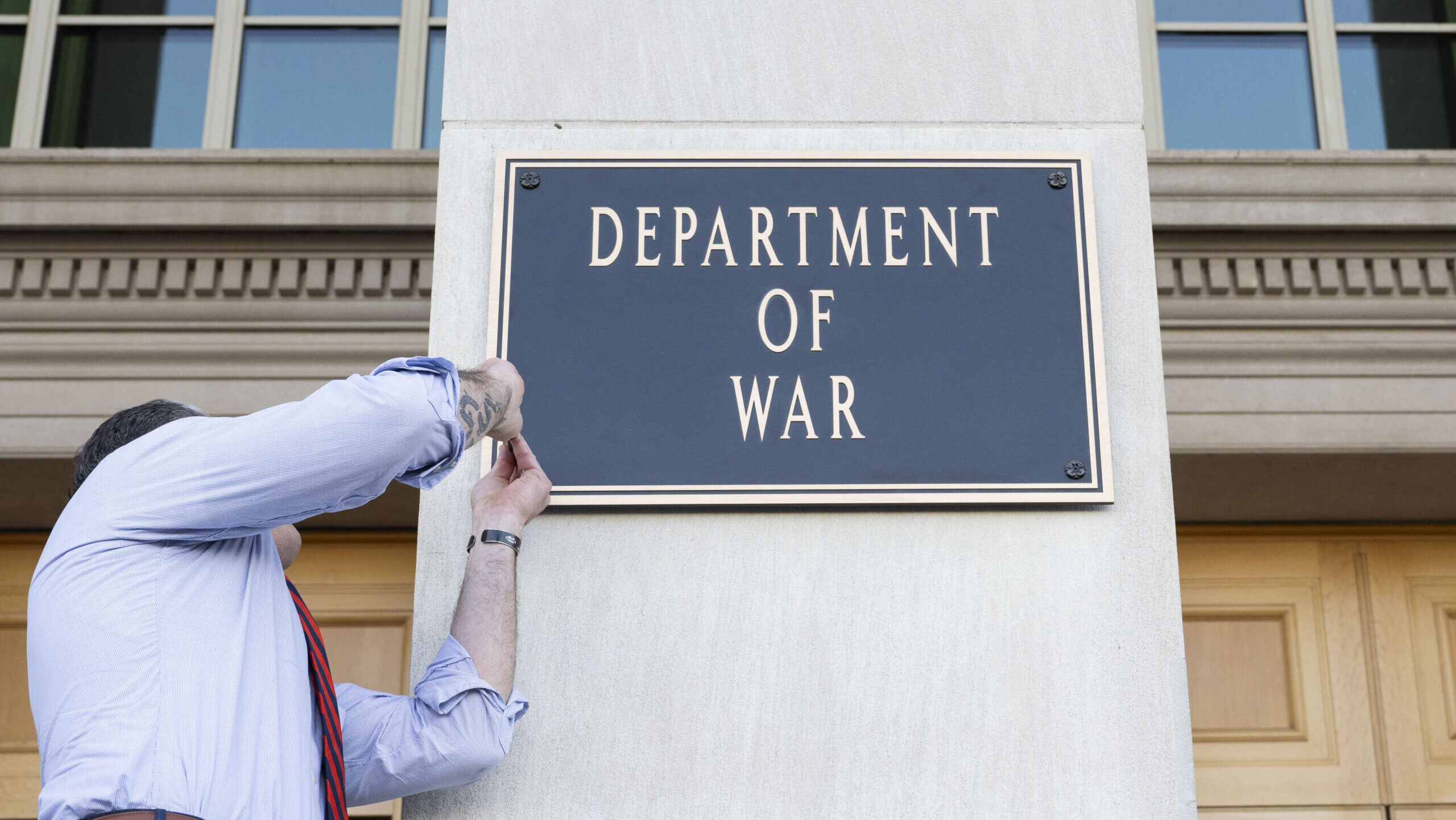
WASHINGTON — The House Appropriations Committee adopted its $1 trillion defense spending bill for fiscal 2027, after Republicans batted back every single Democrat-offered amendment and passed a measure to rename the Defense Department as the “Department of War.”
The bill passed in a 34-27 vote, on party lines.
In a turn of events that House Appropriations Committee Chairman Tom Cole joked was “brutal,” only two amendments were passed during the almost eight hour markup: A bipartisan manager’s package of uncontroversial measures and a GOP-backed collection of culture war amendments that included the name change. Both were offered by Rep. Ken Calvert, R-Calif., who chairs the defense subcommittee.
Democrats argued that renaming the Defense Department would be a needless expense that would send the wrong signal about the United States’ appetite for starting wars.
“[The Congressional Budget Office] did a study of the cost of this name change in January and advised that the cost of changing the name across the department would range up to $125 million,” said Minnesota Rep. Betty McCollum, the ranking Democrat on the committee’s defense subpanel. “Now we could be asking ourselves, what programs or activities did the secretary short circuit in order to cover the cost of this name change?”
Rep. Ben Cline, R-Va., who backed the measure’s inclusion in the package of amendments, said the current “Defense Department” designation only emphasizes one aspect of the Pentagon’s mission.
“The historic title, Department of War, more directly reflects the warrior ethos and the department’s responsibility to prepare for, deter, and when required, successfully wage war in the defense of the United States and its interests,” he said.
The GOP-backed amendment package was adopted in a 32 to 25 vote.
Early in the markup, Republicans batted back an amendment from McCollum which would have zeroed out $1 billion in advanced procurement funding for the Trump-class battleship.
“The administration has requested this funding, even though the Navy has not completed the ship’s concept design. I ask every member in this room, if you were going to build a house yourself, would you pay for it before it had even been designed?” she said. “I think the answer would be a resounding no. So why should we do that with a ship that reportedly could cost $17 billion apiece?”
The measure was defeated in a voice vote after comparably little debate.
Another failed amendment, offered by Rep. Rosa DeLauro of Connecticut, the full committee’s ranking Democrat, would have made the $152 billion in defense funds approved in last year’s reconciliation bill — known as the One Big Beautiful Bill — subject to the same oversight authorities and conditions as funding typically approved by lawmakers in the appropriations process. It was defeated in a 27-32 vote.
Republicans also defeated amendments that would have eliminated money for the National Guard’s deployment to DC, cut off funding if US force structure levels in Europe reach below 76,000 troops, and barred funding for being used to finance operations in Iran unless Congress authorized military force.
GOP members also blocked a measure that would have restricted Defense Secretary Pete Hegseth’s travel funds until the department provided justification for the removal of candidates under consideration for the rank of general officer amid reports that Hegseth interfered in the promotion of several female and minority officers.
Bill Slams ‘Risky and Uncoordinated’ Reconciliation Bid
Although the $1 trillion spending bill is equivalent to the level requested by the Pentagon earlier this year, the committee report made public earlier this week sheds light on major shifts in money for programs like the Air Force’s HH-60W combat rescue helicopter, while also highlighting concerns on munitions and the F-35 Joint Strike Fighter. (The spending level allocated by appropriators is in line with the Pentagon’s $1.15 trillion discretionary request, as funding for military construction, among other things, are spelled out in a separate bill.)
The committee’s bill would obligate $11.4 billion for critical munitions, one of the administration’s top priorities as it tries to ramp production in the wake of conflicts in Ukraine and Iran.
It also includes five-year multiyear procurement authorities for Standard Missile-6, Long Range Anti-Ship Missile (LRASM), Joint Air-to-Surface Standoff Missile Extended Range (JASSM-ER), Advanced Medium-Range Air-to-Air Missile (AMRAAM), Standard Missile-3 Block 1B and 2A, Joint Advanced Tactical Missile (JATM), Precision Strike Missile (PrSM), as well as with seven-year authority for PAC-3 interceptors, THAAD interceptors and the Tomahawk cruise missile.
Meanwhile newer weapons like the Family of Affordable Mass Missiles (FAMM), Low-Cost Hypersonic Strike systems (LCHS) and Ground Launched Low-Cost Cruise Missile system would receive three-year authorities.
However, the committee notes that the money needed to execute the multiyear framework deals announced this year with weapons makers like Lockheed Martin and RTX are requested as mandatory funds through a reconciliation bill, which is separate from the normal appropriations process.
“The two legislative vehicles are entirely separate tracks, with different timelines, committees of jurisdiction, and approval processes. This approach is risky and uncoordinated,” the committee report states.
And though the committee was broadly supportive of the Pentagon’s munitions request — with the FAMM program receiving a boost of $300 million for a FY27 total of $355 million and LCHS getting a $325 million plus up to begin buying the first 500 rounds — other programs were hit with minor reductions.
For instance, the Army’s PrSM account was decreased from $2 billion to about $1.5 billion due to various cuts associated with initial spares and repair parts and non recurring costs that were “excess to need.” Other Air Force munitions also got minor haircuts, with JASSM decreased by $10 million and AMRAAM decreased by $12 million.
Beyond munitions, House appropriators also slammed the Pentagon’s approach toward using reconciliation dollars for the F-35 program, noting that the request is split between $6.9 billion in the base budget for 32 jets and $9.8 billion in the reconciliation bill for 53 F-35s. Funding for modernization was also similarly split in half.
“The Committee has serious concerns regarding how the Office of Management and Budget (OMB) bifurcated the funding request and questions the rigor that was used to split the request between discretionary and mandatory funding,” the committee stated. “For example, radars and other critical components were either funded in full on one side of the ledger or the other, inconsistent with the total flyaway costs for discretionary and mandatory quantities.”
The committee report further notes that the procurement levels spelled out in the bill are based on financial assumptions associated with a multiyear contract — which has not yet been inked and could result in the Pentagon buying far fewer jets than planned in this budget request.
For example, using current financial assumptions, “the discretionary budget request actually procures a quantity of only six aircraft, rather than the 32 it purports to fund,” the report states.
One of the biggest winners in the bill was the E-7 Wedgetail program — a pet issue of appropriations chair Cole, whose home state of Oklahoma is the likely destination for the E-7 after the current E-3 AWACs planes are retired. The Air Force once again attempted to cancel the E-7 program in the budget request, but backtracked after ongoing operations in Iran highlighted capability gaps that the Wedgetail could fill.
According to the committee report, the Pentagon submitted a budget amendment to the Office of Management and Budget to restore $1.5 billion in funding to the E-7 program, taking funds from the Navy’s E-2D program. Ultimately, House appropriators decided to fully fund both the E-7 and E-2D programs.
Here are other highlights from the report:
- Army aviation assets saw big budget increases in the bill, including an added $493 million for the Black Hawk helicopter program, $456 million for the Chinook program and $240 million for MQ-1C Gray Eagle drones. However, procurement funding for the Future Vertical Lift family of systems was zeroed out.
- The XM30 mechanized infantry combat vehicle set to replace the Bradley was also reduced from about $547 million to only $33 million, with appropriators claiming that the money was “early to need.”
- House appropriators added $155 million for the Improved Turbine Engine program, which was zeroed out in the Army’s budget request.
- The Navy’s request for $1 billion in advanced procurement funds for the Trump-class battleship survived the House appropriations bill, with members noting that the requirement is “the requirement for a large surface combatant is longstanding and well documented.”
- At the same time, lawmakers are requiring the Navy to submit two reports on the battleship — one focused on the design requirements and acquisition for the new warship, and the second on how it plans to construct the battleships without interfering with other nuclear-powered vessels like the Ford-class carrier and Virginia-class submarine.
- Funding for the Navy’s F/A-XX fighter would shoot up from $68 million to $915 million, with the committee urging the Pentagon to “take all actions necessary to meet the August 2026 F/A– XX EMD award and to pursue the most accelerated timeline possible”
- Appropriators would trim the P-8 Poseidon program from $4.2 billion to $2.8 billion, citing “excess growth” in nonrecurring engineering costs and funds that are “excess to need.” It’s unclear whether that impacts the Navy’s plan to buy 12 aircraft during FY27.
- The Navy’s Conventional Prompt Strike hypersonic weapons program would also take a meaty cut of about $239 million due to program delays and excess growth in support costs, leaving it with a total of $510 million for the year.
- The Air Force’s HH-60W combat rescue helicopter would see its funding sharply increased by $215 million for a total of $284 million, allowing the service to buy additional aircraft.
- The VC-25B program, better known as the Air Force One replacement, would see funding slightly drop from $555 million to $547 million due to a “program adjustment.”
- The Space Force’s national security space launch program was decreased from $3.3 billion to $2.9 billion, a reduction of two launches.
