

WASHINGTON — As the 3rd Mobile Brigade Combat Team of the 101st Airborne division ingrains artificial intelligence into all staff sections, it’s finding the limits of what the emerging technology can do, according to its commander.
Col. Ryan Bell’s brigade has spent the last year ingraining AI into their planning processes. They took large language models and trained them on joint, Army and division doctrine, allowing each staff section in the brigade to have their own bots to better understand the operating environment and respond faster.
“We found it useful in a number of ways and we found areas we did not want to use it,” Bell told reporters today. “We didn’t use AI for course of action development. Large language models don’t really understand three-dimensional space. And so they’re not good for developing course of action. That’s where you need the expertise of a skilled staff to understand the art of war fighting to plan the operation.”
These lessons learned come from an April rotation at the Joint Readiness Training Center at Fort Polk, La., where Bell’s unit underwent one of the most realistic battlefield simulations the Army can provide.
Courses of action are often touted by AI experts and even some in the military as a key use case for how AI can aid in battlefield scenarios. While Bell didn’t find it helpful in this area, he did say courses of action could be tested using AI ahead of a potential encounter with the enemy.
The AI could also speed the orders process allowing downtrace units to have plans and defenses up significantly faster.
“We would receive the [operations orders] from division, and by using AI, we can push a brigade warning order out in under half an hour. Using it to support mission analysis and orders development enabled us to spend more time on war gaming,” he said.
In a defensive action, he added, typically the brigade will publish orders around the same time the opposing force pushes their reconnaissance, which can stress when battalions get their orders and put in their defense.
Using AI tools and large language models, battalions had theirs done 72 hours ahead of time, Bell said.
“It enabled the battalions to fully work through their planning cycle … put in 100 percent of the plan obstacles, refine, rehearse, and then put in additional obstacles to allow them to build a defense that held despite Geronimo [the opposing force] watching three chemical attacks and then using their robots to attempt to breach,” he said. “It bought time for the battalions and the companies to rehearse and enabled us to control the tempo of the fight.”
In the operating environment of the future, Bell said tempo is a critical characteristic, and AI tools allowed his unit to increase that tempo against the adversary.
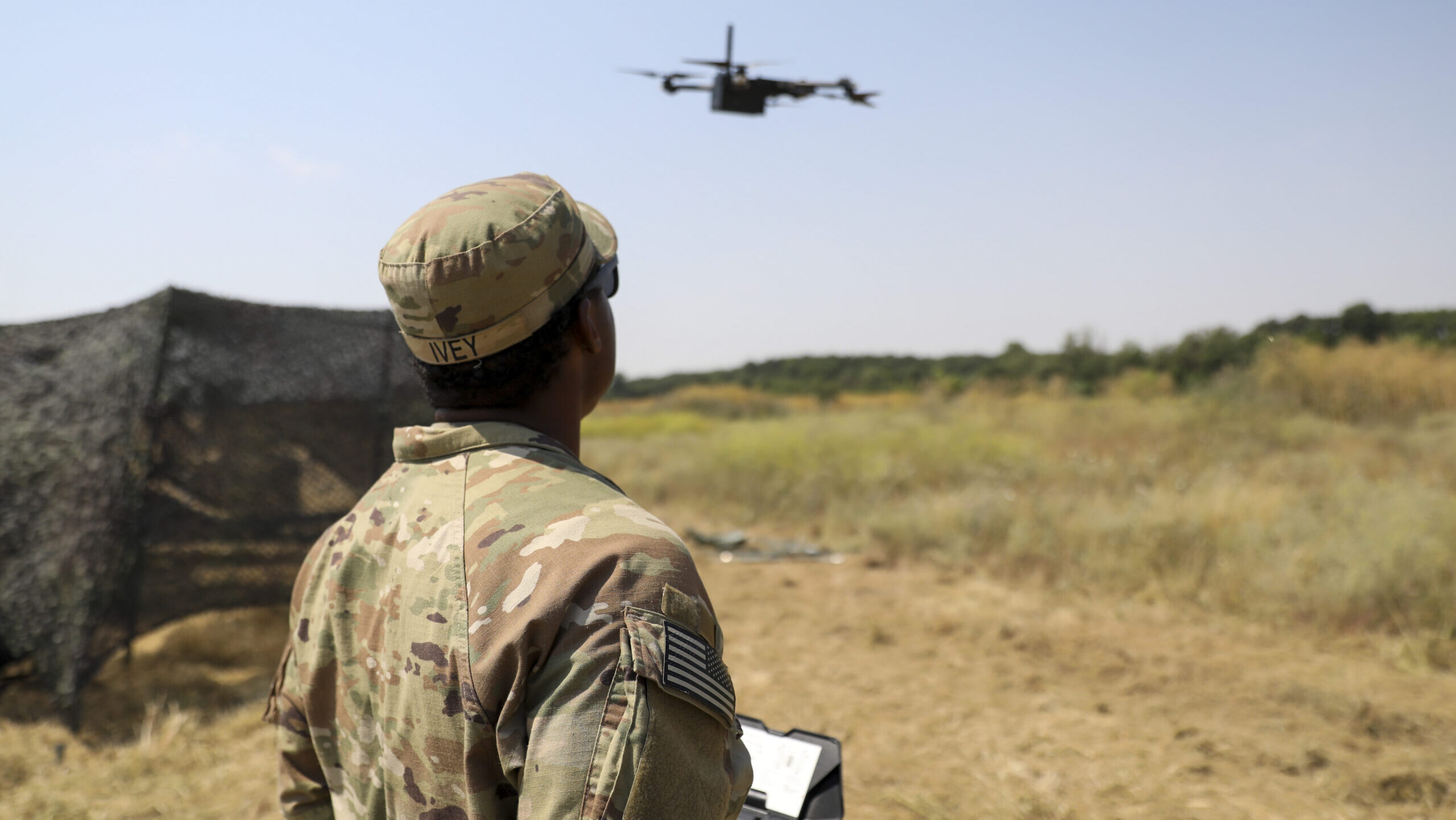
“Drones help us generate tempo by sensing, orienting, and striking faster than the enemy. AI helped us at the staff level plan and sustain it,” he said.
In ten days of operations, drone sensors and reports carried over 25,000 spot reports for the brigade’s intelligence section, all of which was processed using artificial intelligence.
“It helped us make sense for the battlefield and respond faster than Geronimo,” he said.
