

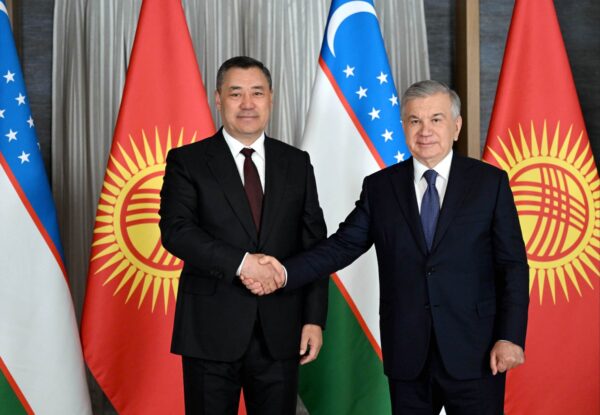
For many years, the Fergana Valley has symbolized border disputes, enclave-related crises, and ethnic tensions in Central Asia. In recent years, however, the region has increasingly been shaped not by border conflicts but by negotiations, land swaps, and greater regional connectivity. The recent transfer of the Chongara and Tash-Tobo enclaves from Uzbekistan to Kyrgyzstan is one of the clearest and most recent examples of this transformation. At first glance, this may appear to be simply a technical border adjustment. In reality, it reflects a new approach to addressing the long-standing border disputes between Tashkent and Bishkek. The real focus should not be on the change in the legal status of the two enclaves, but on the broader transformation that made this agreement possible.
The removal of Chongara and Tash-Tobo from enclave status through a land swap did not emerge in isolation. Rather, it forms part of a broader transformation in the way Uzbekistan and Kyrgyzstan have approached long-standing border issues.
Following the dissolution of the Soviet Union, the administrative boundaries drawn during the Soviet period became international borders, turning the Fergana Valley into one of Central Asia’s most complex border regions, characterized by numerous enclaves and disputed boundary segments. Enclaves, where the territory of one state is entirely surrounded by another, created not only administrative challenges but also recurring tensions between Tashkent and Bishkek over access, security, and interethnic relations. The enclave of Sokh stood out for many years as one of the most prominent examples of this complex border landscape.
This began to change after Shavkat Mirziyoyev came to power in 2016. Repairing relations with neighboring states became one of the key priorities of Uzbekistan’s foreign policy under Mirziyoyev. Political dialogue with Kyrgyzstan was revived, long-closed border crossings were reopened, and long-standing border disputes returned to the negotiating table. Border issues gradually ceased to be viewed solely through a security lens and instead came to be addressed through mutual concessions, land swaps, and regional connectivity.
The comprehensive border agreement signed between Uzbekistan and Kyrgyzstan in November 2022 marked a turning point in a process that had begun back in 2017, when the two countries reached their first comprehensive agreement delimiting most of their nearly 1,400-kilometer shared border. The remaining disputed sections were left for subsequent negotiations. Following nearly five years of talks, the 2022 agreement eliminated most of the remaining uncertainties surrounding the border. It also produced mutually acceptable compromises on long-standing disputes, including the Kempir-Abad Reservoir.
The agreement went well beyond a technical exercise in border delimitation. Provisions on land swaps and the management of shared water resources demonstrated that both sides were prepared to resolve long-standing disputes through political will and mutual concessions. Ratification by both countries further underscored Tashkent and Bishkek’s ability to settle issues that had remained unresolved for decades.
Nevertheless, the 2022 agreement did not resolve every issue. Although most uncertainties over the border had been eliminated, the future of the enclaves in the Fergana Valley remained an open question. Whether these enclaves would retain their existing status, whether further land swaps would be pursued, and how they would ultimately be administered all remained uncertain. The distinct demographic, geographic, and administrative characteristics of the various enclaves meant that political agreements reached at the interstate level would not necessarily be easy to implement on the ground. The subsequent cases of Barak, Chongara, and Tash-Tobo demonstrated that Tashkent and Bishkek had begun addressing these thorny questions through negotiation and mutual compromise.
The first concrete application of this new approach following the 2022 border agreement was seen in Barak. For many years, residents of Barak, Kyrgyzstan’s only enclave inside Uzbekistan, faced serious hardships because of its isolation and the difficulty of traveling to mainland Kyrgyzstan. As a result, local residents had long called for relocation. Under a 2024 land swap agreement, control of Barak was transferred to Uzbekistan, while Uzbekistan ceded an equivalent area of land to Kyrgyzstan in return. Barak’s residents were subsequently relocated to the newly built settlement of Jany-Barak in Kyrgyzstan’s Osh Region. In this way, the two countries resolved a long-standing enclave issue through mutual agreement, relocation, and a land swap.
Following Barak, the second major example of this approach emerged in Chongara and Tash-Tobo. The Kyrgyz authorities announced in late June that the two enclaves, previously under Uzbekistan’s administration, had officially come under Kyrgyz jurisdiction. This time, however, the solution did not involve relocation. Instead, the enclaves will be directly integrated into Kyrgyzstan’s administrative system. Once the registration process is completed, the approximately 2,500 ethnic Kyrgyz residents will receive Kyrgyz citizenship. In return, Kyrgyzstan will transfer an equivalent area of land to Uzbekistan.
The agreement extends beyond changing the status of the enclaves themselves. The two sides also agreed to an additional land swap to facilitate the construction of a new transport corridor between the villages of Sai and Tayan. As a result, the distance between settlements in the Batken region will be reduced from approximately 225 kilometers to just 55 kilometers. In this sense, the Chongara and Tash-Tobo agreement reflects not simply the redrawing of borders, but a new approach aimed at improving everyday life in border regions and strengthening regional connectivity.
At the same time, larger Uzbek enclaves such as Sokh and Shakhimardan have different dynamics because of their population size, geography, and strategic significance. For that reason, it is difficult to assume that the solutions applied in Barak or Chongara and Tash-Tobo can be replicated there in the same way.
Nevertheless, a region once associated with security crises, mined frontiers, and closed border crossings in the early 2000s is increasingly characterized by negotiation, pragmatic compromise, and regional connectivity. The map has largely remained the same; what has changed is the way Tashkent and Bishkek approach this complex borderland.
