

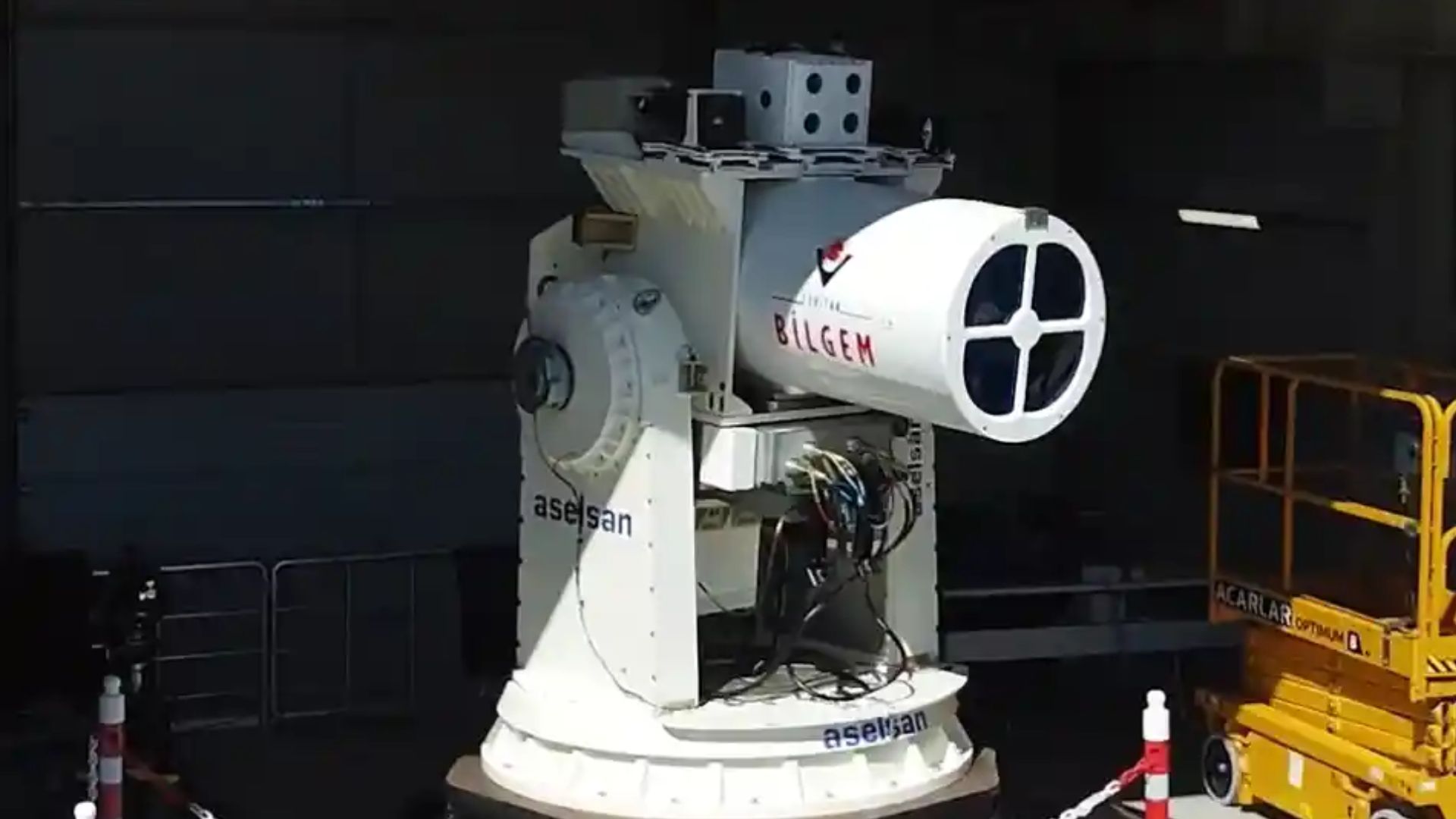
Poland’s Armament Agency (Agencja Uzbrojenia) has confirmed that 20 potential contractors registered for its preliminary market consultations on a laser directed-energy weapon, in a late-June response to the Polish defence press. The consultations, which the agency announced at the end of March, concern a system it designates the Laserowy System Broni Skierowanej Energii (LSBSE), or laser directed-energy weapon, sought in two distinct range variants.
The agency is examining two configurations – one built to engage targets at a minimum range of one kilometre, the other at a minimum of three kilometres. The requirement frames the weapons primarily as a counter-unmanned-aircraft capability, though the published documents also reference artillery and rocket munitions, pointing to a counter-rocket-artillery-and-mortar role. Polish coverage situates the laser as the innermost layer of short-range air defence, sitting behind the Wisła, Narew and Pilica systems and complementing the SAN counter-drone effort.
Track Where EMEA Defence Markets Are Moving
Follow what vendors are doing, what militaries are prioritizing, and where decision-makers are placing their bets through independent reporting, analysis, and briefings built for serious defence readers.
On scale, the agency asked respondents to estimate the cost of procuring up to 150 systems across both variants, together with repair kits covering 10 years of service. The consultation reaches well beyond unit price, seeking data on lifecycle and withdrawal costs, security of supply, training, technology readiness level, technology transfer, component ownership and export restrictions. The agency has also left the acquisition route open, permitting either a government-to-government or a business-to-business arrangement.
The field is unusually broad. It spans global primes – Kongsberg, RTX, MBDA, Rafael Advanced Defense Systems, Rheinmetall Polska, Hanwha Aerospace Europe, AeroVironment, EOS Defence Systems, Roketsan and Türkiye’s Tübitak Bilgem – alongside Polish suppliers, the Air Force Institute of Technology (ITWL) and a number of small engineering firms. One of the latter, Zabrze-based Adapt-E, describes its core business as simulation software and training systems rather than directed-energy hardware.
Unlike the position in 2019, several respondents already field maturing systems. Rafael’s Iron Beam is a 100-kilowatt-class laser developed to counter drones, rockets and mortars, while EOS secured a €70 million order in 2024 to supply a counter-drone laser to a European NATO member, since identified as the Netherlands.
The interest tracks the cost arithmetic that the war in Ukraine has made hard to ignore, where a drone costing a few thousand dollars can compel a defender to spend far more on the interceptor used to stop it. A laser’s appeal lies in that imbalance, since once the system is fielded the per-shot cost can fall below the value of the target destroyed, with no magazine of missiles to stockpile or move forward.
Submissions were due by 30 April, with the non-binding consultations intended to precede a later, formal procurement shaped by the market responses. The agency reserved the option to extend that window should its analytical goals not be fully met.
It is not Poland’s first approach to the technology, as the Armament Inspectorate – the agency’s predecessor – issued a 2019 request for information for a counter-drone laser codenamed LASER. That effort, like earlier domestic directed-energy projects, never produced an in-service weapon. In formal terms, the current round is the first step toward a purchase and the system’s eventual introduction into service with the Polish Armed Forces.
Quwa Pro
Track Where EMEA Defence Markets Are Moving
Follow what vendors are doing, what militaries are prioritizing, and where decision-makers are placing their bets through independent reporting, analysis, and briefings built for serious defence readers.
Featured & Trusted By
