

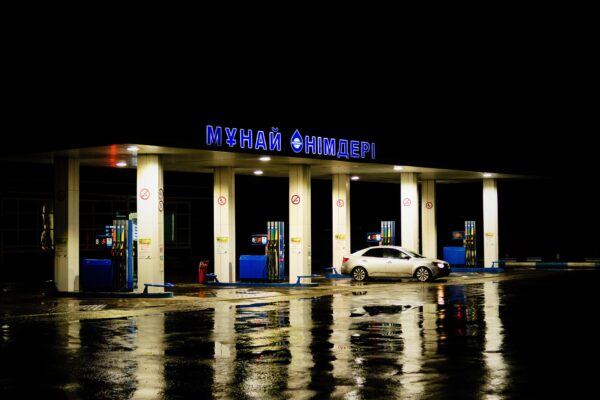
Kazakhstan could be ready to make an exception to its ban on fuel exports, if Russia asks for emergency supplies. This is what emerged last week, when Reuters reported sources as saying that Russia had requested a one-off shipment of petroleum products from Kazakhstan. Astana has curtailed exports in an effort to meet domestic demand.
But with Ukraine’s attacks on Russia’s refineries, in response to Moscow’s war of aggression, now in its fifth year, the Russian fuel market is in trouble.
On June 24, according to Reuters, Russia asked Kazakhstan for 50,000 tons of AI-92 fuel, the most common type of gasoline in the region, to make up with the current shortages. That’s around 25 percent of the country’s total output.
Kazakhstan’s government did not immediately comment, with the energy ministry noting that it did not receive an official request from the Russian side. Deputy Minister of Economy Azamat Amrin told the press, “When there is a concrete decision, we will let you know.”
On June 28, Russian President Vladimir Putin admitted that the country is facing a gasoline deficit, due to ongoing repairs at key refining facilities hit by Ukraine’s drones.
“Obviously, these attacks on our infrastructure create problems. That’s obvious. As of now, we are observing a certain deficit, which is not critical,” Putin said.
For the first time in years, in the past few months the Russian government has partially banned the export of certain petroleum products, some of which it used to sell also to Kazakhstan.
Kazakhstan has long experienced an unstable balance when it comes to petroleum products, such as gasoline, kerosene, and jet fuel.
The country’s three refineries date back to the Soviet era, though they have undergone significant repair works. The Atyrau refinery, located in Kazakhstan’s so-called “oil capital,” is the latest to shut down for scheduled maintenance. The repair work, which began on June 26, will halt output until July 15.
Kazakhstan’s quest for self-sufficiency has repeatedly been tested over the years, with the government and experts taking turns in advocating for the construction of a fourth refinery. While rumors to that effect have spread for around two decades, a final decision has not been made. Instead, the oil sector’s press is being polluted with announcements of a “10 million tons, $10 billion refinery to be commissioned by 2033,” without there being a concrete location or a contractor for such a large project.
The result is uncertainty. The administration of the international airport in Astana said that they hold enough fuel reserves on hand for two weeks, a statement that dismisses any reason for panic, but is far from a long-term reassurance.
In response to a potential jet fuel shortage, Zhanel Kushukova, deputy minister of trade, said on June 25 that Kazakhstan could reduce customs duties on imported fuel, lubricants, and jet fuel from China for one year.
“We don’t have full self-sufficiency in jet fuel,” Kushukova said.
And if Russia comes calling, there is no guarantee that Kazakhstan will be in a position to answer.
Senator Suyindik Aldashev told Azattyq Asia that Kazakhstan should first consider its own needs.
“Nobody can force us to give to this country or that country. And it is not only about gasoline. It also concerns diesel fuel and kerosene. Even aviation kerosene is currently in short supply for us,” Aldashev said.
In May, Kazakhstan’s government had once again renewed its export ban for petroleum products for six months.
In response to rumors of a possible transfer to Russia, the energy ministry reassured the local population that they would not encounter a shortage of gasoline at the pump because Kazakhstan still holds around 1.1 million tons in fuel reserves.
While a request of 50,000 tons could seem just a drop in the ocean compared to 1.1 million tons, Kazakhstan is still struggling with self-sufficiency and cannot afford to affect its own energy security.
“Russia is a major provider for Central Asia. We import gas, electricity, and petroleum products from Russia,” Olzhas Baidildinov, an oil and gas pundit, told BES.media. “About 40 percent of our domestic consumption of jet fuel comes from Russia.”
A decade ago, during a particularly sharp depreciation of the tenge and amid capped fuel prices in Kazakhstan, motorists from Russia crossed the border to refuel, while the residents of northern Kazakhstan crossed in the opposite direction with the hope to sell a full tank in the Russian market, given the significant gasoline price differential.
As a consequence, tougher border controls and export bans were established. Now, there is a chance that small-scale smuggling may resume, as Russia’s demand for fuel stays high.
