

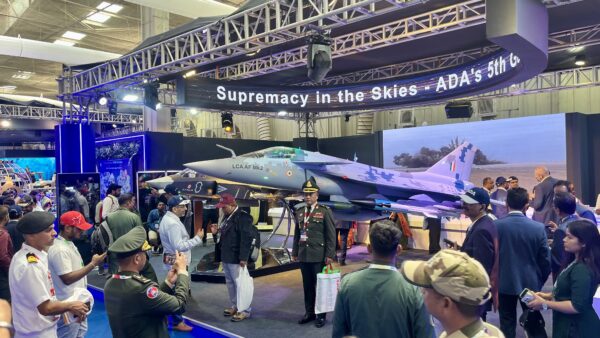
The jet engine remains the biggest stumbling block in India’s bid to achieve military modernization through self-reliance. India is in talks with U.S. engine manufacturer General Electric for its F414 jet engine to power the five prototypes of India’s fifth-generation fighter jet under development, the Advanced Medium Combat Aircraft (AMCA). Several reports indicate that the ongoing negotiations have hit a roadblock as the cost per engine has tripled. This comes amid already delayed development and deliveries of fighter jets.
The F414 engine has also been chosen to power the Mk2 variant of the indigenous single-engine Light Combat Aircraft (LCA) and the twin-engine AMCA-Mk1. Given the confusion due to this, officials in the know clarified that the larger deal under negotiation between GE and Hindustan Aeronautics Limited (HAL) for the Mk2 program remains in the commercial stage. The cost escalation is with respect to the 15 engines that the Aeronautical Development Agency (ADA), designing the AMCA, is looking to purchase off-the-shelf to power the prototypes.
The whole episode has nonetheless put the spotlight on a deal that has now been in the works for over three years.
The cost of the larger deal too is expected to go up significantly, given the steep devaluation of the rupee in the last few years, disruption in supply chains, and increase in input and raw material costs due to major conflicts – the war in Ukraine and more recently, the war in West Asia.
The LCA-Mk2 is being manufactured by HAL, while the AMCA design development is by ADA, under the Defense Research and Development Organization (DRDO). AMCA is planned to be produced by the private industry, for which the selection of partners is underway, with HAL completely out of the program. The engines for AMCA-Mk1 are a separate deal to be taken up in the near future.
In June 2023, India’s Prime Minister Narendra Modi and then-U.S. President Joe Biden announced a landmark agreement for the manufacture of GE F414 jet engines in India by state-owned HAL to power the LCA-Mk2. Negotiations for a deal commenced soon after. However, what was an “almost” done deal, as officials claimed in 2023, with a list of technologies to be transferred having been identified, is still in the works.
Technical negotiations are now complete and commercial talks are underway. According to Indian Defense Ministry officials, the deal would facilitate 80 percent technology transfer by GE to HAL for the manufacturing process. In comparison, a 2012 Engine Development Agreement had stipulated 58 percent technology transfer. It is pertinent to note that the F414 is a mature engine, and the technology transfer is for the manufacturing processes.
The F414 was also chosen for the AMCA prototypes during development and the initial Mk1 variant. A lower-powered engine of the F-series, the F404, already powers the LCA-Mk1 variants — the Mk1 and the yet to be delivered Mk1A. The LCA Mk2 was designed around the F414 engine, and eight F414 engines have been delivered for development and testing.
The fifth-generation AMCA has just gotten into the development phase, with 2035 the current timeline for induction. On the contrary, the fourth-generation LCA, already behind schedule, is the present, adding much-needed numbers to the fighter squadrons that are down to 29 against the 42 squadrons sanctioned. The LCA variants — Mk1, Mk1A, and Mk2 — are supposed to arrest a shortfall in the Indian Air Force’s fighter squadrons till the AMCA variants are inducted in enough numbers. However, each of them is delayed.
The combined delays collectively crystallized the decision to procure 114 Rafales post-Operation Sindoor through the Medium Role Fighter Aircraft tender that was issued in 2018 but hadn’t made any progress.
This collectively underscores the criticality of the GE engines as they power the heart of India’s domestic fighter jet ecosystem. Collectively, the F404 and F414 engines represent the present and future, in the near and medium term. The IAF operates 40 LCA-Mk1 and 180 Mk1A on order, while at least 120 LCA-Mk2 are expected to be procured. This itself makes 340 LCA variants in addition to five AMCA prototypes and at least two squadrons of the AMCA-Mk1 jets that could go up. A squadron typically consists of 16 fighters and two trainers. That’s over 380 jets or roughly about half of the IAF’s sanctioned fighter strength.
Negotiations with Safran of France are in an advanced stage for the co-development of a new, more powerful 120 kN engine for the AMCA-Mk2. Development is expected to take a decade. In short, the heart of India’s indigenous fighter ecosystem will be American for several decades to come.
The LCA-Mk2, a medium-weight, single-engine jet compared to the smaller Mk1, is meant to be a replacement for the Mirage 2000s in service due to its higher power engine. Three squadrons of the French Mirages have played a critical role in the IAF’s operations during the Kargil conflict of 1999 and, more recently, the air strike on terrorist camps at Balakot in Pakistan in response to the Pulwama terror attack in February 2019. The Mirages, as well as the Anglo-French Jaguars’ deep-penetration strike fighters, are aging, and their phasing out is likely by the end of this decade. The LCA-Mk2, which became a bigger and more potent platform from the original concept, is seen as the replacement for both, thus the urgency in getting the production of the Mk2 going.
However, the Mk2 development, like the LCA-Mk1A deliveries, has seen some delays. The maiden flight is now expected by year-end or early next year. Concluding the engine deal at the earliest is essential to align it with the Mk2 manufacturing process.
Together, the LCA and AMCA programs will be the mainstay of the IAF’s fighter numbers well into the remainder of the century, with 150 Rafale multi-role jets, 114 to be procured, holding the fort at the upper end till the AMCA Mk2 is available in enough numbers.
