

Instability and volatility are the defining conditions that investors in aerospace & defense (A&D) must manage in 2026. They are also, for those who read them correctly, a source of opportunity.
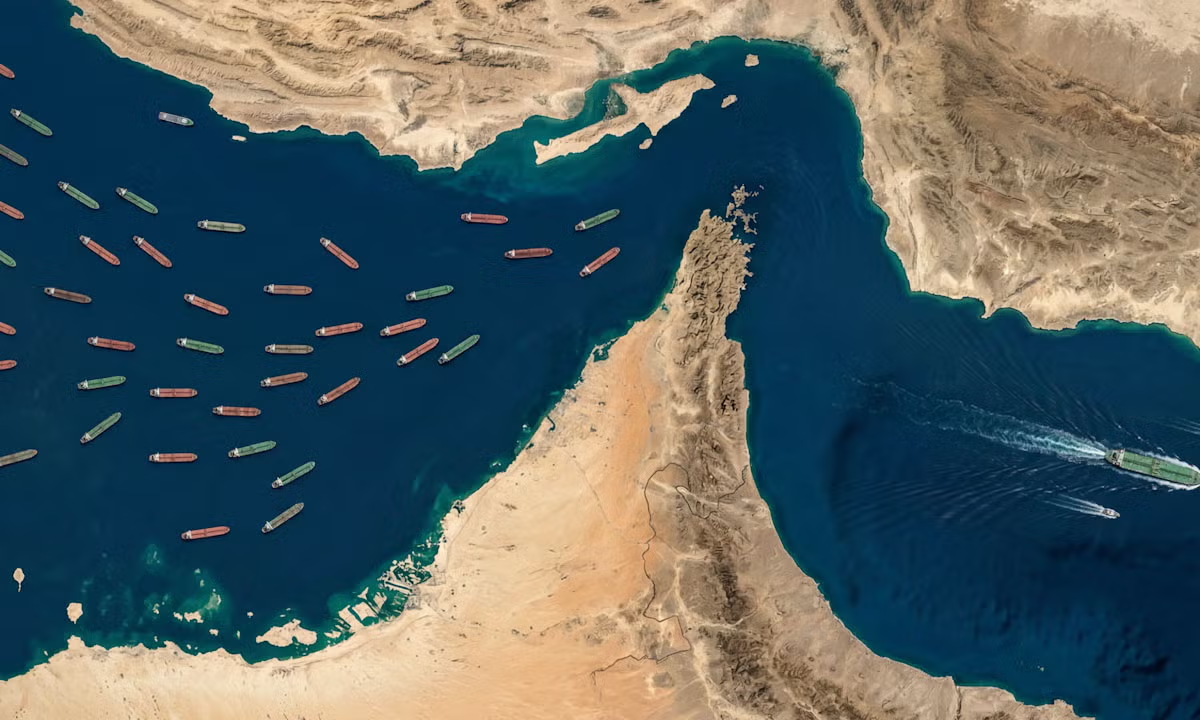
The unpredictability of the second Trump administration has sent economic ripples across much of the world – whether through tariffs, or through the supply chain disruption and oil-price spikes triggered by the American and Israeli war with Iran and the near-standstill in the Strait of Hormuz.
Europe, for now, looks steadier. But the prospect of political change at elections over the next few years could upend the continent’s hard-won consensus on defense spending – notably among the Nato heavyweights of France, Germany and the UK. Such a shift could tip the scales in Russia’s favor, even as Putin tightens his personal security against deepening Ukrainian attacks.
Tariffs and turbulence
The macroeconomic conditions facing aerospace and defense investors are the most complex since the end of the Cold War.
Tariffs have been a leitmotif of the second Trump administration, levied on the majority of countries – historic allies included – as part of a protectionist agenda and a drive to reshore American industry. Their effect on defense supply chains has been significant, pushing up the cost of equipment and materials.
In 2025, America and China traded blows. At the height of the dispute America imposed a 145% tariff on Chinese goods, with China retaliating at 125% on American goods. What President Trump billed as a “total reset” of trade relations arrived in May 2025, when the two sides cut tariffs to 30% and 10% respectively. Yet the tension has not dissipated, and the prospect of fresh escalation lingers at the back of investors’ minds. When America’s Supreme Court ruled against Trump’s tariffs in early 2026, any hope that markets would settle proved short-lived: in March, America and Israel launched a military campaign against Iran that, nearly four months on, continues to rumble.
A central consequence has been the near-standstill of traffic through the Strait of Hormuz, sending oil prices higher, lifting inflation and denting consumer spending across several countries. Iran, for its part, has launched retaliatory strikes against perceived American allies in the Gulf, among them the United Arab Emirates, Saudi Arabia, Kuwait and Qatar.
For dealmakers, all of this translates into a growing premium on businesses able to localize production. The cost of materials and equipment has become a strategic variable in its own right, and one that increasingly separates the assets worth chasing from those best left alone.
Supply chains, reconfigured
For A&D investors, the tariff regime means higher costs – but also fresh opportunities. Supply chains are being recalibrated to fit the new landscape. European powers, in particular, have seized the initiative amid the uncertainty, moving to shore up continental supply chains through the Readiness 2030 scheme, which aims to strengthen defense capabilities across EU members as the bloc loosens state-aid rules to unlock funding.
As European nations look for new suppliers away from traditional vendors elsewhere in the world, the investors who can pinpoint the companies capable of filling the gaps stand to gain considerably. At the same time, international suppliers are establishing manufacturing facilities in America to sidestep tariffs. The investment thesis is straightforward enough: as procurement is repatriated on both sides of the Atlantic, the suppliers able to scale inside friendly borders will command a premium, while those exposed to the wrong jurisdiction face a slow squeeze.
China watch
China, keen to avoid direct military engagement, continues to pour money into its defense capabilities while building economic partnerships that hand it leverage over developing countries. It operates on far longer timelines than almost any democracy, unencumbered by the short-termism that electoral cycles impose on Western decision-making.
With expansionist ambitions of its own – Taiwan chief among them – the actions of the global superpower warrant close attention. Yet cooperation carries advantages too, not least a Chinese supply chain renowned for high volumes at low cost.
There have also been reports that China has supplied dual-use items such as electronics and semiconductors to Russia, allegedly used in weapons deployed in Ukraine. It is, moreover, a critical supplier of components and materials to Germany – a dependency that has bred tension within the EU. For investors, then, China is best treated less as a single wager than as a variable threaded through almost every A&D thesis: a source of cheap, high-volume supply on one side, and of strategic and regulatory risk on the other.
What next for Russia?
Russia’s war in Ukraine entered its fifth year in February, far outlasting the matter of days originally anticipated. Despite a faltering campaign, Putin remains undeterred, and is widely regarded as a persistent threat to Western democracies – deploying everything from AI propaganda and cyber-attacks to hypersonic weapons and nuclear threats.
The ailing Russian economy has enjoyed some respite this year. In March, America announced a temporary easing of sanctions on Russian and Iranian oil, prompted by the supply disruption from the American and Israeli campaign in the Middle East. What was meant to be a 30-day reprieve has stretched to almost three months. The UK, too, has relaxed sanctions on Russian oil processed by third-party countries, to secure supplies of kerosene for commercial aircraft. The upshot, according to Russia’s finance ministry, has been a windfall of $11.4bn.
The relief may prove fleeting. Ukraine is striking oil refineries ever deeper inside Russian territory, and the economy continues to stagnate. Recent polling by the NEST Centre suggests that a third of Russians now take a dim view of how Putin’s policies are affecting the economy, with just 15% believing his actions are doing any good. For investors, the point is less the daily fluctuation than the direction of travel: each twist in Moscow’s fortunes feeds directly into the demand outlook for European defense spending, and with it the procurement pipeline that capital is now being asked to underwrite.
Europe’s political risk
Since Russia invaded Ukraine in 2022, the assumption has been that time favors Putin: the longer the war drags on, the better his odds. The elections looming over the next few years in the Nato lynchpins of France, Germany and the UK could compound that advantage. Populist right-wing and far-right parties with reported Kremlin links are polling strongly and making gains in local elections.
Such parties may not openly champion the Russian president for now, but they may prove reluctant to stand in the way of his future military objectives, and could pare back support for Ukraine should they reach the levers of power. That prospect casts a shadow over the EU’s Readiness 2030 initiative. GlobalData senior defense analyst Fox Walker, however, reckons defense funding will prove resilient whatever the political weather.
“I think Readiness 2030 and European defense spending more broadly can outlast the rise of the far-right within Germany, the UK, and France. The more important question is whether or not Europe will be more united within the next five years or more divided. I think what you’ll see is that if the far right comes to power in these countries, you wouldn’t see a decrease in defense budgets. This is good for the economy. It makes these leaders look strong. It lets them say that their countries are tough and resilient,” says Walker in a forthcoming podcast.
“I wouldn’t worry about the defense spending so much, but I would worry about whether they’re actually willing to deploy that to help Ukraine,” he adds.
Whatever happens, the lesson for investors is the same: prudent long-term planning and diversification. The sensible response is to stress-test exposure against a populist-government scenario rather than assume that today’s spending trajectory is a straight line. And one thing is clear – Ukraine has no intention of surrendering. Its world-leading expertise in drones, honed on the battlefield over recent years, is proving formidable, and its battle-tested solutions are in high demand.
Discover further insights
To learn more, download The future of aerospace & defense: insights for investors & M&A dealmakers, published in association with Sterling Technology – the provider of premium virtual data room solutions for secure sharing of content and collaboration for the investment banking, private equity, corporate development, capital markets and legal communities engaged in aerospace & defense M&A dealmaking and capital raising.

