

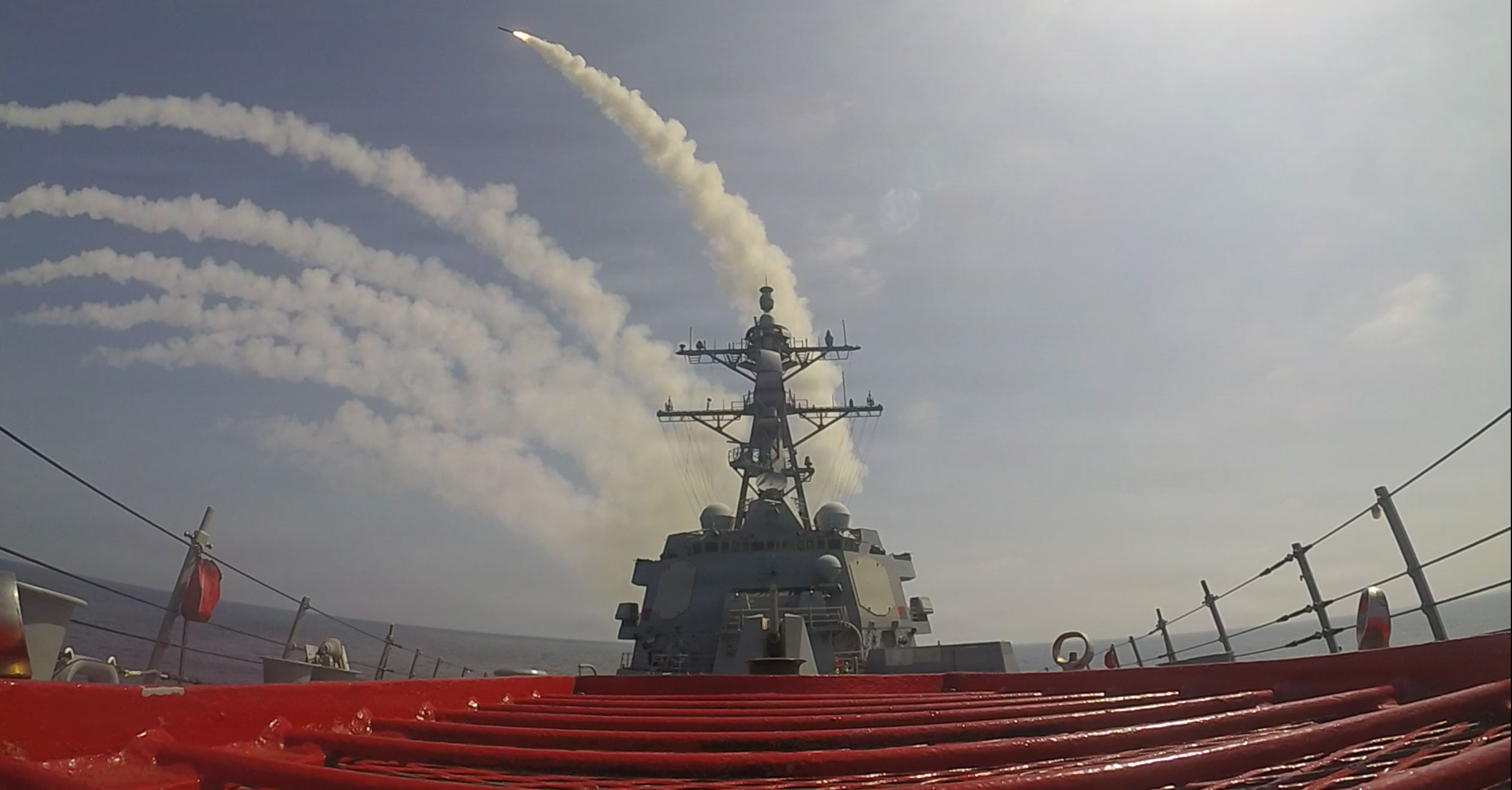
Nestled inside the four months since the United States launched attacks on Iran was six weeks of the most intensive air campaign since the “shock and awe” opening of the Iraq invasion. Yet the deal it produced, while still in final negotiations, seems to be a draw at best and, in many ways, favors Iran. Threatening to resume the bombing, as President Donald Trump has done several times, misunderstands why.
The US was engaged in two air wars simultaneously — one of destruction, and one of disruption. It lost the one that mattered most.
The first — the air war of destruction — centered on the US and Israel seizing the airspace high above Iran and exploiting it to strike at scale. Above 20,000 feet, where stealth and precision-guided munitions decide outcomes, the US military performed exactly as designed. It achieved air superiority over large swaths of southern and western Iran, degraded air defenses, sank much of Iran’s traditional navy, and damaged elements of its missile and drone capabilities. The war of destruction was measured in targets (DMPIs, or “desired mean points of impact” in military parlance) hit and capabilities destroyed. By those metrics, the US won.
Yet Iran managed to keep the Strait of Hormuz effectively closed. A second air war — a war not of destruction but of disruption, imposing psychological and economic costs until the fighting became politically unbearable — decided that.
From the first day of this conflict, Iran’s drones and missiles were aimed not at preventing American air superiority over Tehran, but at making it beside the point. Having largely ceded the higher altitudes, Tehran shifted its military effort downward, to the air littoral — the low-altitude airspace — over and around the Strait of Hormuz, where inexpensive drones and missiles proved sufficient to make the world’s most important energy chokepoint too costly and dangerous to transit, for commercial vessels and the US Navy alike.
Put another way: Iran did not need to win the war of destruction. It needed to make winning it not feel worth it to the US.
Tehran’s strategy rested on a simple asymmetry: Populations tolerate acute devastation better than chronic and increasing inconvenience. For Iran, fighting an existential war, devastation was something to be endured — martyred leaders and generals, bombed airfields, and sunk ships only hardened regime resolve. For the US, with more limited interests at stake, inconvenience became something to escape.
When American airpower failed to open the chokepoint closed by Iranian airpower, the US expanded to a broader campaign of economic pressure. The naval blockade on Iranian oil exports sought to impose reciprocal pressure on Tehran’s economy and achieve leverage the air war of destruction had not. But the blockade became a time horizon contest, and the US was not positioned to win it. Intelligence assessments concluded Iran could endure the blockade for at least 90 to 120 days, if not longer, while political and economic pressures — from American consumers watching gas prices rise, European and Asian governments calculating the cost to their economies, and Gulf states quietly asking Washington how long this would go on — continued to accumulate.
Iran’s primary weapon of disruption was the Shahed drone. By American standards, it hardly rates; it’s slow, low-flying, easy to shoot down, and costs tens of thousands of dollars rather than hundreds of millions. Yet these drones destroyed much more expensive radar and command and control facilities, disrupted oil production, and struck ports and airfields across the region.
Iran did not stumble into this. It tested and refined the approach for years through Houthi attacks in the Red Sea and militia operations in Iraq — learning how cheap, expendable systems could impose disproportionate costs. It watched $20,000 drones prove their value when it supplied them to Russia. By the time this conflict began, Iran already knew what worked.
The threat forced American forces back — and that itself was a measure of Iran’s success. In 2003, the bulk of US combat and support aircraft were forward deployed in Kuwait, Qatar, UAE, Bahrain, and Saudi Arabia, while carriers operated from the Mediterranean and Persian Gulf. That has changed with this war against Iran. The threat of Iranian strikes shifted command of operations away from the Combined Air Operations Center at Al Udeid, while carriers, stealth fighters, and tankers were increasingly pushed back to Israel, Jordan, and the Arabian Sea.
The US could still strike targets across Iran from those distances. What it could not do from those distances was police a 21-mile strait. Keeping shipping lanes open requires persistent, close-in coverage — forces positioned near enough to detect and respond before a threat arrives. A drone launched from the Iranian coast can reach an oil tanker in minutes. The US military is not postured for the war of disruption.
Closing that gap would require capabilities the US has systematically deemphasized or never developed, such as aircraft with large magazines that loiter for long periods at relatively low altitudes, mobile air defenses, and mass-produced weapons to defend ships against incoming drones and missiles. These are precisely the capabilities Iran’s war of disruption demanded. They are precisely what the US could not bring to bear at scale.
Every day the strait remained closed strengthened Iran’s argument about which air war mattered. War-risk insurance for transits effectively collapsed, leaving hundreds of ships stranded in the Gulf. The world’s most powerful military could strike targets across Iran but could not guarantee the safety of one of the world’s most important waterways. Iran had found a way to achieve global impact with local weapons.
That is the central lesson of this conflict. Decades of procurement choices optimized for the war of destruction — long-range precision strikes, stealth, and the ability to dismantle integrated air defenses from a distance — have left a gap in the US ability to wage the close-in, attritional fight. What the US lacks is the ability to produce large numbers of inexpensive systems near the surface, where persistence and mass matter more than survivability and range. LUCAS — a copy of Iran’s own Shahed design — points in the right direction, but a $30 million contract producing hundreds of drones still leaves the US outmatched against adversaries like Iran producing tens of thousands.
Fixing that means prioritizing procurement choices the Pentagon has resisted: drones with long on-station times, platforms with deep magazines, mobile air defenses, and mass-produced interceptors cheap enough to field at scale.
But the deeper problem is conceptual. The US entered this conflict with a detailed plan for the war of destruction and no serious plan for the war of disruption. It approached Iranian missiles and drones as a nuisance to be managed while the real campaign proceeded overhead. That miscalculation created air superiority over Tehran but failed to defeat the adversary where it actually mattered. The next time it will be no different unless fighting the war of disruption becomes part of the primary planning scenario, not an afterthought to the one the Pentagon prefers to fight.
The framework agreement now being worked out is a measure of which air war mattered more. Trump’s threat to hit Iran “very hard again, only harder” misses the point. The US air campaign did not fail because it was not intense enough. It failed because it prioritized the air war that did not decide the outcome. More bombs will not win the war that mattered.
The question was never who controls the skies over Tehran. It was always who wins the war of disruption below them.
Maximilian K. Bremer, a retired U.S. Air Force colonel, is a nonresident fellow with the Reimagining US Grand Strategy Program at the Stimson Center and head of Mission Engineering and Strategy for Atropos Group.
Kelly A. Grieco is a senior fellow with the Reimagining US Grand Strategy Program at the Stimson Center and adjunct professor in the Center for Security Studies at Georgetown University.
