

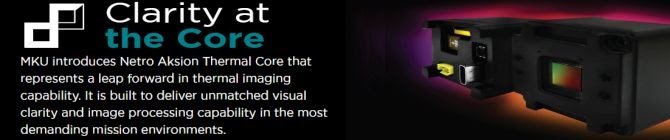
This next-generation thermal imaging engine is designed to provide militaries with zero-latency visual clarity, faster target detection, and extended situational awareness in low-light and complex battlefield environments.
By positioning the Aksion Thermal Core as the “brain” behind modern optronics systems, weapon sights, uncrewed vehicles, and surveillance equipment, MKU has reinforced its commitment to strengthening intellectual property ownership and ensuring supply-chain security for defence forces.
The Aksion Thermal Core is built around a 12-micron sensor, which delivers higher pixel density and advanced image processing capabilities. These include contrast optimisation, denoising, and edge enhancement, all of which contribute to sharper and more reliable visuals in demanding operational conditions.
The system’s engineering ensures zero-latency responses, enabling soldiers and operators to act instantly even in the harshest environments. This rapid detection capability is critical for modern warfare, where milliseconds can determine mission success.
Platform integration has been a key focus of MKU’s design. The Aksion Thermal Core offers digital zoom up to 8x and supports multiple video output formats such as USB, HDMI, RGB24, and MIPI-DSI.
This versatility allows seamless integration across a wide range of platforms, from handheld weapon sights to advanced surveillance systems and autonomous vehicles. Such adaptability ensures that the technology can be deployed across diverse mission profiles without compromising performance.
Durability has also been prioritised. The ruggedized design of the Aksion Thermal Core meets stringent environmental and electromagnetic standards, including MIL-STD-810G and MIL-STD-461F. This certification guarantees resilience against extreme temperatures, vibrations, shocks, and electromagnetic interference, making the system reliable in both conventional and unconventional theatres of operation.
The launch of the Aksion Thermal Core is part of MKU’s broader Netro Optronics initiative, which seeks to collaborate with global manufacturers through co-engineering and build-to-spec models.
This initiative not only enhances India’s indigenous defence capabilities but also positions MKU as a competitive player in the global defence technology market.
By offering cutting-edge solutions that combine innovation with rugged reliability, MKU is contributing to the vision of self-reliance in defence manufacturing while simultaneously opening avenues for international partnerships.
This development underscores India’s growing emphasis on indigenous innovation in defence technology. With the Aksion Thermal Core, MKU has demonstrated its ability to deliver advanced solutions that meet the evolving needs of modern militaries worldwide.
The system’s combination of high-performance imaging, rapid detection, versatile integration, and rugged design makes it a formidable asset in the global defence landscape.
Agencies
