

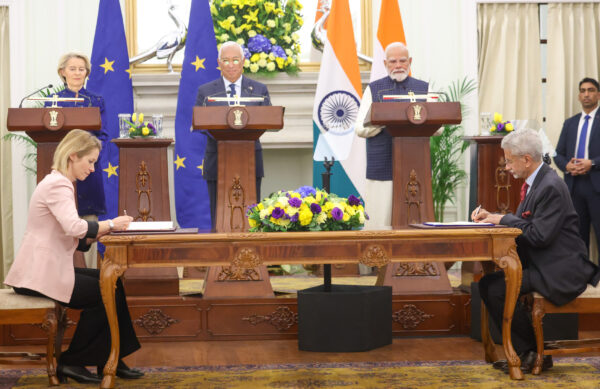
India and the European Union finally shook hands and signed the landmark Free Trade Agreement on January 27, 2026. This deal was widely described as the “mother of all deals” because it took nearly two decades of stalled negotiations to complete. A formal detente in 2022 and a relaunch led to a comprehensive package of 23 chapters covering goods, services, digital trade, and sustainability.
For those who lived through the negotiation of India’s first major trade agreement, the ASEAN-India Trade in Goods Agreement (AITIGA) of 2009, this stirred up memories. The ASEAN-India deal marked a pivotal shift: India, for the first time since liberalization in 1991, opened up its markets to a multi-country regional bloc, fundamentally moving away from its protectionist trade policies.
The AITIGA came into force in January 2010. The services agreement followed in November 2014 – after ASEAN had already secured full access to India’s large domestic market for goods. The goods sector was of interest to ASEAN at that time, while India had an established services sector. By agreeing to sequence them back then, India surrendered its primary bargaining leverage. New Delhi then waited in vain for services reciprocity that never fully materialized.
Using its new market access, ASEAN drove India’s trade deficit from approximately $7.5 billion per year before the FTA to over $44 billion after. Even though India’s exports to ASEAN grew 65 percent in the decade after the FTA, its imports surged 186 percent over the same period. The services agreement finally arrived well over four years later, but it offered a weak and tardy means to balance the already ballooned equation.
As one of the negotiators on the Indian side during that period, the lesson learned was clear and hard: Do not conclude a deal until all parties are on board.
Other failures made a bad deal worse: weak rules of origin, tariff asymmetry, and institutional gaps. The India-EU free trade agreement tries to address these flaws and offers a template for the AITIGA review.
Under the AITIGA, a product could qualify as “ASEAN-origin” with just 35 percent value addition in an ASEAN country. In other words, up to 65 percent of its value could still come from non‑ASEAN sources – like China. To address this, the India-EU FTA employs a dual-criteria rule: goods must be substantially transformed (i.e., a change in customs category) and may not use too high a share of parts from outside countries.
The deal was also asymmetrical from the start. India opened around 74 percent of its tariff lines while Indonesia, New Delhi’s largest trading partner within the ASEAN region committed to only about 50 percent. By contrast, the EU agreed to liberalize about 97 percent of its tariff lines, while India reciprocated by about 92 percent.
Regarding institutional gaps, the AITIGA omits investment protection, geographical indications, digital trade, and sustainability. In contrast, the India-EU FTA covers these areas and includes separate negotiations for investment protection and a separate geographical indications agreement. In the India-EU case, parties agreed on nothing until they agreed on everything.
India is now in the middle of an official review of the AITIGA, which began in 2020 at the 17th ASEAN Economic Ministers India Consultations. It was tentatively expected to end in 2025; it is already 2026 and the review is still underway.
The process represents both an opportunity and a risk for India. The opportunity is to apply the EU model’s core lesson: to insist that any renegotiation of goods schedules be co-conditioned on simultaneous binding upgrades in services access.
However, the risk is if India repeats the original mistake in reverse. It may negotiate goods improvements in isolation or accept services pledges that are again deferred to a future instrument. As happened with the original FTA, ASEAN might not have any incentive to honor these promises once the gains are secured.
The “mother of all deals” with the EU matters not only for its impact on trade in goods. It removes duties on Indian textiles, pharmaceuticals, marine products, and IT services entering the European market, resulting in a genuine transformation of the trade relationship. The EU-India FTA also matters because it shows that India now uses issue linkage as a structural tool rather than just a procedural preference.
Southeast Asia and India share too many strategic interests to stay locked in a one-sided FTA. The ASEAN review gives both parties a second chance, and the EU deal has set the example.
