

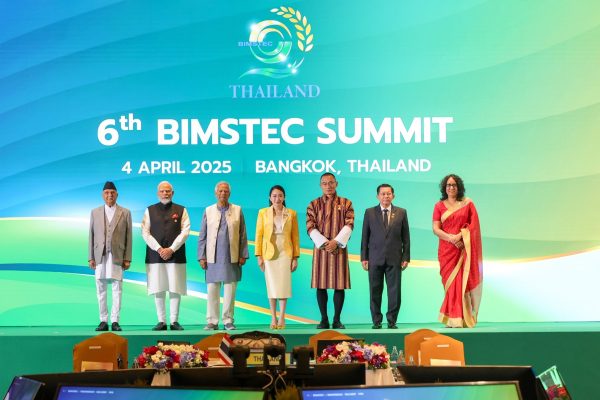
It made headlines when Prime Minister Narendra Modi announced a 21-point action plan at the 6th BIMSTEC Summit in Bangkok on April 4, 2025.
Two memoranda of understanding signed on the sidelines of the summit – one between India’s Ministry of Development of North Eastern Region (MDoNER) and Thailand’s Ministry of Foreign Affairs and another between India’s North Eastern Handicrafts Development Corporation (NEHDC) and the Creative Economy Agency of Thailand (CCAT) – drew far less attention. These were low-key pledges with a strong message: The Northeast is not only a highway between BIMSTEC nations, but a key to the region.
Policy-wise, Northeast India is still under-represented in India’s BIMSTEC engagement. The region’s development, as well as that of BIMSTEC as a viable strategic grouping, cannot be achieved without redressing this imbalance.
Trade among the BIMSTEC member countries has not increased significantly since the Bangkok Declaration of 1997. The share of intra-regional trade remains small, around 7 percent of total trade, despite the grouping comprising nearly 25 percent of the world’s population and $5.2 trillion in combined GDP. More than 20 years after the BIMSTEC Free Trade Agreement (FTA) was agreed in principle in 2004, it has not yet been implemented.
The missing link is a functional land-based connectivity spine – each route of which would necessarily pass through India’s Northeast region. The region has an international boundary with five countries, 4,500 km of border in total, with India’s sole land connectivity with Southeast Asia being the Moreh-Tamu crossing with Myanmar and Mizoram-Chin State border with Myanmar. Yet infrastructure projects to physical link India and Southeast Asia remain stalled.
The Trilateral Highway between India, Myanmar and Thailand is said to be 70 percent finished, but successive deadlines have been delayed and security concerns in Myanmar following the February 2021 coup have contributed to long delays. The Kaladan Multi-Modal Transit Transport Project to connect Kolkata with Mizoram through Sittwe Port is also yet to meet successive deadlines, with the much awaited Paletwa-Zorinpui road section stuck in the middle of the conflict in Rakhine State of Myanmar. These aren’t just engineering postponements but rather illustrate the strategic, and tumultuous, position of Northeast India.
The implementation of the “Look East” policy from 1991 – renamed the “Act East” policy in 2014 – has helped in enhancing the strategic profile of the Northeast region and has led to a boom in investments. Despite its almost 8 percent landmass share, the region is responsible for less than 3 percent of India’s GDP. Progress has been made in some areas, such as the Trans-Arunachal Highway, building up integrated check posts, and air connectivity via UDAN. However, the implementation architecture is fragmented, with infrastructure ministries making the roads, the Ministry of External Affairs making the diplomacy, and the Ministry for Development of North Eastern Region (MDoNER) managing the development funds, without sufficient coordination between them. This silo mentality is particularly strong in the case of trade facilitation.
Land customs stations on the Myanmar border are only open a few hours a day, and process little of the cross-border trade that was originally intended in bilateral trade agreements. The Moreh-Tamu Integrated Check Post, in spite of being improved, transports considerably less goods than other posts from the western borders in India. The informal trade taking place at these borders is several times that of the formal trade, but it does not produce the revenues that formal trade does, nor does it instill the trust that formal trade does.
The Sixth BIMSTEC Summit in 2025 was a turning point – the BIMSTEC 2030 Vision was endorsed as the first strategic roadmap for BIMSTEC, rules of procedure were established and the Agreement on Maritime Transport Cooperation was signed.
The report issued by BIMSTEC’s Eminent Persons’ Group had some suggestions to make with regard to trade and connectivity. Four BIMSTEC Centers of Excellence (COE) on Disaster Management, Maritime Transport, Traditional Medicine and Agricultural Research were launched in India. The Maritime Transport Agreement is useful but also highlights a paradox. The sea corridors between Chennai in India, Chittagong in Bangladesh, and Bangkok in Thailand are much more developed than the land corridors. The region’s land connectivity lags behind its maritime systems, and continues to fall behind. This runs the risk of further embedding the existing imbalance into the base of BIMSTEC’s original connectivity concept – which included coastal and peninsular connectivity.
If India wishes to turn the strategic edge of the Northeast into diplomatic and economic leverage in BIMSTEC, it needs to take action. The Trilateral Highway should be viewed as national security infrastructure, not just a road deal or a transit route. It needs to be funded, cross-ministerial delivery authority must be granted, and contingency routing plans made through other corridors. India also needs to give special attention to the SEZs in the Northeast region to optimize the area for BIMSTEC value chain linkages.
From bamboo to horticulture, and from handicrafts to digital services, the MDoNER-Thailand MoU signed in Bangkok is just beginning to acknowledge of the unique opportunities that the states of India’s Northeast have. The region borders Myanmar’s Chin State, Bangladesh, and the Brahmaputra-Mekong corridor.
Furthermore, communities of the Northeast region should be given due consideration in people-to-people programs under BIMSTEC, such as the BIMSTEC Young leaders’ Summit, the BIMSTEC Traditional Music Festival, and so on. Ethnic, linguistic and cultural linkages with Myanmar, Thailand and Bangladesh are a source of strength for the region, but these are virtually untapped assets in Indian soft diplomacy.
There is also a Commonwealth aspect not often brought to the fore to consider. Three BIMSTEC countries are members of the Commonwealth: Bangladesh, India, and Sri Lanka. The Commonwealth has focused on good governance, rule of law, and trade facilitation. That provides the Commonwealth with a normative background that is missing from BIMSTEC, a younger and institutionally less developed organization. As the biggest economy in BIMSTEC and a member of the Commonwealth, India is in a unique position to bring into BIMSTEC’s fledgling institutional framework the elements gleaned from Commonwealth membership, such as a dispute settlement mechanism, customs harmonization and small-business cross-border trade. The Bangkok Vision 2030’s theme, “Prosperous, Resilient and Open,” is a line that is all too recognizable from the Commonwealth development frameworks. An institutional cross-pollination possibility is here that has not been seriously examined.
BIMSTEC is experiencing an acceleration from the slow-bowling of its institutionalization over the years. But it will be incomplete without the recognition of Northeast India as the center, a key pivot point for the grouping, rather than just a beneficiary. India’s Northeast has the largest number of neighboring countries among the BIMSTEC members, with which it has cultural connections and ethnic bonds. This is not connectivity manufactured by a summit declaration, but an asset to be realized and operationalized through infrastructure.
India has been implementing the Act East Policy for the past 40 years. Its maturity should be judged by its ability to change from articulating strategy to putting that strategy into practice. That implementation ought to focus on the Northeast. It will ultimately be the infrastructure that will decide whether the Bay of Bengal is a region of true integration or merely islands of bilateral diplomacy.
