

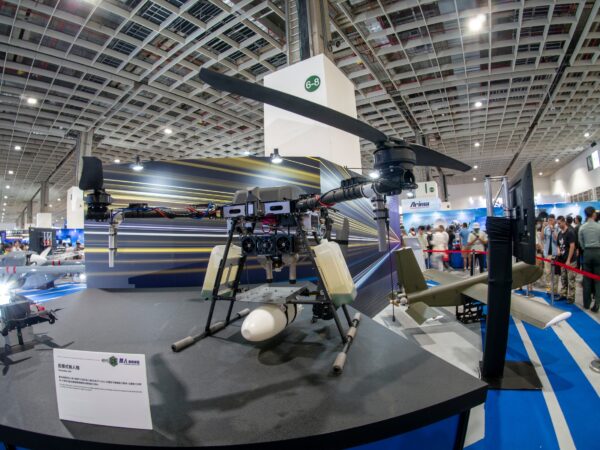
Defense spending has become a contentious issue in Taiwan. The Kuomintang (KMT) and Taiwan People’s Party (TPP), which together control the legislature, continue to be at odds with the ruling Democratic Progressive Party (DPP) over the issue. In particular, the pan-Blue and pan-Green camps are now in conflict over a NT$210 million (US$6.6 million) special budget for drones that President Lai Ching-te hopes to pass.
The Lai administration had hoped to purchase 208,200 coastal attack drones, 1,446 coastal reconnaissance drones, and 1,320 uncrewed surface vessels using the special budget. This seems to indicate rising interest in maritime drones; there was relatively more discussion of unmanned aerial vehicles in the past. This proposal, however, was blocked by the KMT and TPP. Their legislators did not allow the bill to proceed to committee review.
Instead, the KMT and TPP eventually produced their own version of bills that would provide spending on drones. The KMT’s version of the bill would divide NT$240 million in spending over six years, while requiring any procurement above NT$100 million to include a written report to the legislature with details on progress and implementation. The bill also specified local content for drones at 50 percent in two years and 80 percent in four years. The TPP’s version of the bill, on the other hand, puts drone funding under the annual budget but does not have any overall cap. Both versions of the bill have supply chain checks, as well as other oversight measures.
The Lai administration has criticized both bills reducing funding for drones, in that the KMT and TPP’s bills are subject to the annual budget process and therefore also subject to the national debt ceiling. It has also suggested that funding drone procurement through the annual budget would result in less money for education, welfare, and other social services. Instead, the Lai administration has instead argued that special budgets would provide for more flexibility in developing Taiwan’s capacity in a rapidly changing field.
More broadly, the Lai administration has criticized the KMT and TPP for again attempting to claim powers over budgeting from the Executive Yuan, Taiwan’s executive branch of government. Indeed, both the TPP’s and the KMT’s bills would subject further spending to approval by the legislature, as has also occurred with other defense spending passed by the legislature.
For its part, the KMT has argued that funding the drone industry through the legislature indicates commitment to long-term development, while asserting that the Lai administration’s use of special budgets is only a temporary fix.
The Taiwan Unmanned Vehicle Alliance has been among the industry groups to voice support for the Lai administration’s special budget. In an event in Taipei at the end of June, the organization suggested that funding drone development through the legislature would lead to competing funding streams from the government, constraints on funding, and less spending overall.
Partisan fighting between the pan-Blue and pan-Green camps over drones is the latest version of Taiwan’s ongoing debate about defense. Funding for drones became much more hotly discussed in the wake of KMT chair Cheng Li-wun’s trip to the United States last month.
Together, the KMT and its ally, the TPP, blocked defense spending for over six months – until May. That month, the two parties passed a budget greenlighting NT$780 billion out of the NT$1.25 trillion special defense budget originally sought by the Lai administration. It is probable that the KMT passed this spending with an eye to Cheng’s U.S. trip. Cheng wanted to depict her party as not opposed to defense spending but instead concerned about what that spending would consist of, and wanting oversight over the DPP.
Indeed, Cheng’s trip was largely a charm offensive aimed at mediating her pro-China image. She has stoked controversy in Taiwan many times, including by suggesting that she one day hoped to see Taiwanese proud to call themselves Chinese, and through controversial comments during her meeting with Chinese President Xi Jinping in Beijing in April. Cheng has also suggested Ukraine provoked Russia’s invasion by getting too close to NATO – and that Taiwan could suffer a similar fate by becoming too close with the United States.
Against that backdrop, Cheng was hoping to tone down the perception in the United States that the KMT has become overly skeptical of relations with the U.S. in recent years. Passing a special budget for defense – albeit on much reduce from the Lai administration’s request – was a bid to help counter criticisms that Cheng and the KMT are tilting too far toward China.
However, the DPP said that the KMT-TPP version of the special budget effectively cut domestic defense capabilities, such as drones, while putting most of the funding toward arms purchases from the United States. The criticism was that this ran counter to the KMT’s previous claims that arms purchases from the U.S. should be evaluated with greater oversight. It has become a recurring refrain of KMT politicians that Washington simply foists useless weapons onto Taiwan through arms sales in order to financially profit.
The Lai administration indicated that it would continue to pursue measures aimed at securing funding for what was cut – apart from drones, that also includes the Lai administration’s “T-Dome” missile defense system.
This was not the first time that drone funding had been cut by the KMT and TPP either. The budget passed by the two parties in 2025 amounted to the largest set of budget cuts in Taiwanese history, slashing one-third of the government’s operational budget. Among the casualties was funding to a drone industry cluster in Chiayi.
It is notable, then, that both the KMT and the TPP were rather quick to propose their own version of spending on drones – especially when the two parties delayed for over half a year on the Lai administration’s previous special defense budget. As both the KMT’s and TPP’s proposed versions of the drone bill contain measures aimed at boosting local content, it may be that both parties are wary of criticism from the DPP that they have simply signed off on arms purchases from the United States while not benefiting local manufacturers.
Jaw Shaw-kong, the KMT’s vice presidential candidate in 2024 – usually considered a hardliner, if an astute political analyst and media commentator – has suggested in comments that opposing drone spending would be “political suicide” for any KMT politician.
Drones are increasingly in focus not only within the legislature, but among civil defense groups. The Kuma Academy, founded by DPP legislator Puma Shen, now offers drone practice courses, and discussion of drone supply chains and the domestic drone industry is increasingly common at civil society and civic tech events.
This is a large shift from even just a few years back, when UMC founder Robert Tsao publicly pledged to purchase 1 million drones as a means of pushing the Lai administration to be more proactive on drone development. This is in large part driven by fears of a Chinese invasion, as well as reflections on Ukraine’s successes in fending off a much larger enemy using drones. But there’s another driver: concerns about China-dominated supply chains in the West are creating a market opportunity for Taiwan’s domestic drone industry to position itself as a leader in “non-red supply chains.”
