

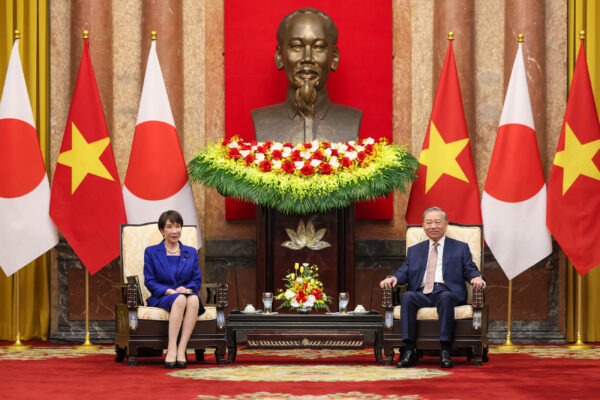
On May 1, 2026, Japanese Prime Minister Sanae Takaichi began a three-day visit to Vietnam, meeting with all major political leaders, including To Lam, General Secretary of the Communist Party of Vietnam and President, Prime Minister Le Minh Hung, and National Assembly Chairman Tran Thanh Man. In her meeting with Lam, Takaichi reaffirmed the continued development of the Japan-Vietnam Comprehensive Strategic Partnership (CSP), agreed to advance cooperation on rare earths for economic security, and indicated that her government would promote Official Security Assistance (OSA).
Vietnam occupies a central place in Japan’s foreign relations, serving as a gateway to Southeast Asia and as a leading investment destination for Japanese companies pursuing a China Plus One strategy. Japan has long prioritized this relationship, including through plans to offer Official Development Assistance (ODA) in the aftermath of the Vietnam War.
Vietnam’s importance to Japan has grown in recent years, spanning economics, politics, and security. As Vietnam grows its regional influence within ASEAN, closer ties are central to Japan’s Southeast Asian strategy. Both countries also face Chinese maritime pressure — Japan in the East China Sea, Vietnam in the South China Sea — and that shared strategic outlook reinforces the partnership. Since Abe Shinzo took office for the second time in 2012, every Japanese prime minister has visited Vietnam early in their tenure, underlining that Tokyo’s interest in Hanoi is driven substantially by its broader focus on China.
Japan has been Vietnam’s largest ODA provider for 20 years, and that economic importance remains undiminished. In his meeting with Takaichi, Lam identified six areas for enhanced strategic cooperation: strengthening political trust among the Party, government, and local authorities; deepening defense and security cooperation; and advancing economic collaboration while addressing security concerns. He also called for expanding cooperation into digitalization, energy transition, and AI; stressed scientific and technological collaboration through human resource development and joint research; and encouraged broader people-to-people exchanges across labor, education, culture, and tourism.
Takaichi was also invited to deliver a foreign policy speech at Vietnam National University in Hanoi, where she outlined the updated Free and Open Indo-Pacific (FOIP) vision. She spoke of developing FOIP further to strengthen the autonomy and resilience of Indo-Pacific nations, and identified three areas of focus: building economic infrastructure for the age of AI and data, including strengthening supply chain resilience for energy and critical materials; co-creating economic growth opportunities through public-private collaboration and rule-sharing; and deepening security cooperation to ensure regional peace and stability.
Relations with Japan clearly matter to Vietnam. But for a country pursuing a multi-directional foreign policy, Japan is only one piece of a larger picture. Vietnam has established CSPs, its highest level of bilateral relations, with 15 partners. Five years ago, it was just three.
Vietnam’s relationship with China, however, is in a league of its own. Since Xi Jinping’s 2023 visit, the China-Vietnam CSP has carried the formulation “Building a China-Vietnam community with a shared future that carries strategic significance.” Lam, focused on economic growth, is closely attentive to stabilizing ties with Beijing. Cultivating strong relations with other partners, including Japan, is how Hanoi manages that relationship on its own terms; this is the essence of Vietnam’s multi-directional diplomacy since it first proposed its Doi Moi policy.
Vietnam is carefully navigating its security relationship with China, avoiding undue attention to the tensions between them. Unlike the Philippines, it has not experienced major confrontations with China in the South China Sea in recent years. Its defense policy is anchored in the “Four No’s” (no military alliances, no foreign military bases, no siding with one country against another, and no use of force in international relations). During Takaichi’s visit, both sides agreed to promote security cooperation, but the specifics — including OSA — remain modest. Practical cooperation has not advanced significantly, especially compared to defense equipment cooperation with the Philippines. This reflects Vietnam’s characteristic caution.
In her talks with Lam, Takaichi extended a formal invitation to visit Japan, and both sides agreed to target a visit within the year. Lam, who also serves as president, has been considerably more active internationally than his predecessors, and his movements attract growing attention as Vietnam’s global profile rises. A visit to Japan before year’s end seems likely.
