

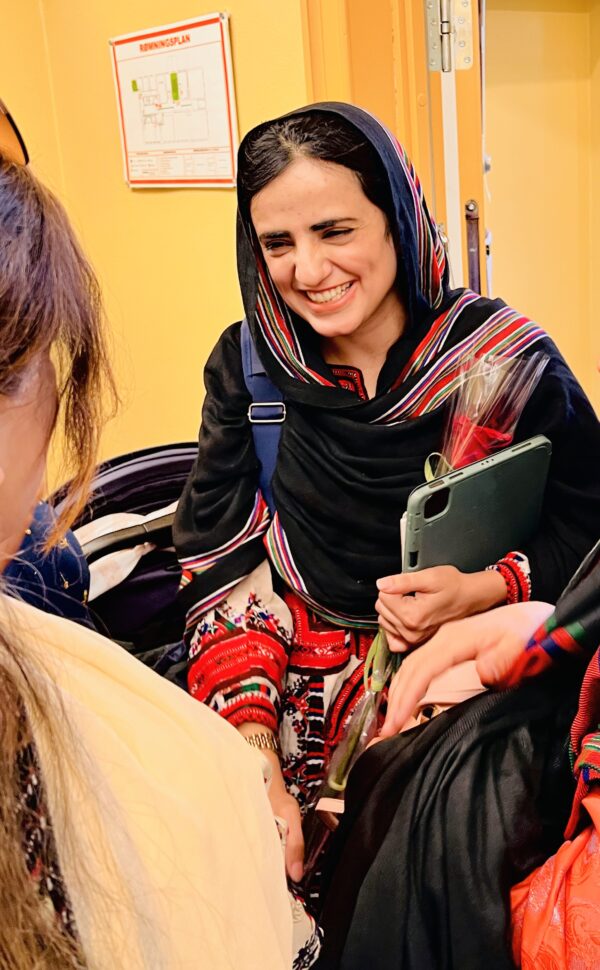
On June 25, an Anti-Terrorism Court (ATC) sentenced Dr. Mahrang Baloch, a Baloch rights activist and the founder of the Baloch Yakjehti Committee (BYC), to life imprisonment over the killing of a paramilitary soldier during the July 2024 protest in Gwadar. She and another BYC activist, Sibghatullah Shahji, have been convicted of murder and terrorism. Both Baloch and Shahji boycotted the trial, which was moved from an open court to Quetta’s Huda Central Jail, and was conducted via video link.
Both denied the charges against them. Their lawyers will challenge the ATC’s verdict in the Balochistan High Court (BHC).
Although the Balochistan government upholds that the trial was fair and the prosecution furnished sufficient evidence to prove the charges against Mahrang, legal and rights bodies, including Amnesty International, have called it a sham for the in-camera proceedings.
Nevertheless, Mahrang’s conviction marks an inflection point in Balochistan’s troubled relationship with Islamabad, with far-reaching implications for the restive province’s fractured politics and security. This decision vindicates three fundamental realities confronting the Pakistani state in Balochistan.
First, as much as the state wants to downplay it, enforced disappearances remain the single most critical issue of the Baloch conflict. No amount of obfuscation, media censorship, legal intimidation and accompanying propaganda of terming the BYC as a foreign-sponsored entity will change the ground facts. In fact, such verdicts will make these troubling realities even more prominent. Instead of weakening the BYC’s movement, such counterproductive steps will further increase public anger in Balochistan.
Such verdicts, rather than acting as a deterrent, provoke a generation that consumes social media, thinks outside the traditional social frameworks and carries no tribal baggage. Balochistan’s Gen-Z and Gen-Alpha have grown up in a political environment where they have been directly or indirectly affected by the issue of enforced disappearances. Either their relatives, friends or someone they know has been forcibly disappeared, and this issue has scarred their collective memory. Against this backdrop, the state’s high-handed tactics taken from the old playbook, which pre-dates the advent of social media, are counterproductive. The more the state tries to suppress the issue of enforced disappearances, the more prominent it will become due to the decentralized flow of information through various digital and social media platforms.
Second, when a state has a hammer as the only tool, it tends to see every problem as a nail. Mahrang’s conviction, which is a desperate attempt to criminalize political dissent and rights protests, exposes the state’s narrow security-centric view of Balochistan’s political challenges. By prosecuting rights protests under the anti-terrorism laws, the state is inadvertently blurring the line between peaceful dissent and insurgency. When the BYC gained traction in Balochistan and the masses joined its rallies in large numbers, it strengthened the impression that a vast majority in the restive province was still invested in the constitutional framework and wanted to address the issue of enforced disappearances through peaceful means. Furthermore, the Baloch people’s overwhelming response to the BYC’s rights activism underscored the fact that Balochistan’s vast majority did not buy into the Baloch Liberation Army (BLA)’s violent approach and separatist narrative. It was assumed that if the state sincerely addressed the genuine grievances of the Baloch people, a peaceful settlement through a concerted political approach was still achievable. However, by sentencing Mahrang to life imprisonment and criminalizing peaceful dissent, the state is blurring the line between protesters and insurgents. It is pushing the former into the latter’s orbit.
Third, this verdict is a resounding victory for BLA’s separatist narrative and violent approach and a defeat for the politics of pro-federation Baloch nationalist parties. For years, in Balochistan’s regional political space, a fierce narrative battle has raged between pro-federation nationalists and the separatists. The former have opposed the recourse to violence and advocated in favor of a peaceful approach within Pakistan’s constitutional framework. On the contrary, the latter have called such an approach futile and labeled its proponents as traitors. The separatists even killed some pro-federation Baloch nationalist leaders. The National Party’s Maula Buksh Dashti, for example, was murdered by separatists in Turbat in 2010, after coming under pressure to abandon using political means to address Balochistan’s problems.
In recent years, pro-federation Baloch nationalist figures like Sardar Akhtar Mengal and the National Party’s Chief Dr Abdul Malik Baloch have withdrawn from mainstream politics due to the Pakistani state’s repeated rigging of elections and imposition of hand-picked figures and parties to rule Balochistan. In 2018, Mengal’s Balochistan National Party Mengal (BNPM) participated in elections and, despite reservations over electoral fraud, joined the Pakistan Tehreek-e-Insaf (PTI)-led coalition government in the hope of finding a solution to enforced disappearances. However, the commitments made to him were not honored. In 2024, notwithstanding massive rigging, Mengal joined the national assembly but resigned in September over the deteriorating security situation in Balochistan. Against this backdrop, Mahrang’s conviction and sentencing will strengthen the separatist narrative that demanding rights through peaceful protests results in life imprisonment instead of drawing sympathetic attention to genuine grievances.
Balochistan’s population is overwhelmingly under the age of 30. The court verdict against Mahrang is going to deepen the frustration of this alienated demographic. It will ease the job of separatist groups to lure their vulnerable segments into their fold. In recent years, the participation of educated youth from middle-class backgrounds, including women, in insurgency points to creeping frustration among Baloch youth. The verdict against Mahrang will further strengthen that trend and contribute to separatist violence.
