

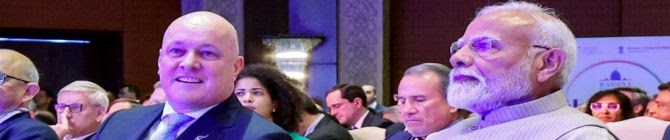
Prime Minister Narendra Modi will make his first official visit to New Zealand on 10–11 July 2026, marking the first trip by an Indian leader to the country in 40 years.
The visit will centre on Auckland, with a packed programme highlighting the recently signed New Zealand–India Free Trade Agreement and deepening ties across trade, investment, and community relations.
Prime Minister Christopher Luxon announced the visit on 3 July, describing it as a historic milestone in bilateral relations. He emphasised that India, as one of the world’s largest and fastest-growing economies, is of enormous importance to New Zealand’s prosperity.
Luxon stated that the leaders will take the relationship to the next level through the Free Trade Agreement signed in April, which is expected to deliver more jobs, higher exports, and stronger economic growth for New Zealand.
Luxon explained that the agreement will unlock new opportunities to grow goods and services exports into India’s vast market of 1.4 billion people. He noted that this will bring more money into Kiwi communities, create jobs, and lift wages. The visit is therefore seen as a catalyst for accelerating the benefits of the FTA.
Earlier, on 6 May, New Zealand Trade and Investment Minister Todd McClay highlighted that two-way trade between India and New Zealand is poised to double within a few years under the high-quality FTA. He explained that the agreement caters to New Zealand’s consumers who seek high-quality goods and services, readily available in the Indian market. McClay confirmed that the New Zealand government is committed to promoting up to USD 20 billion in investment into India over the next 15 years.
To facilitate this capital flow, the Indian government agreed to establish a special New Zealand “single desk” to streamline and accelerate investment clearances. McClay said this mechanism will make it easier for New Zealanders to invest in India, ensuring quicker approvals and smoother processes.
The Free Trade Agreement itself is a comprehensive framework encompassing market access, agricultural productivity, investment, talent mobility, collaboration in sports, tourism, and people-to-people ties.
It is designed to benefit manufacturers, farmers, MSMEs, women entrepreneurs, students, and skilled professionals across both nations. For New Zealand, the deal eliminates tariffs on 95 per cent of its exports to India, while India gains duty-free access to New Zealand’s market and expertise in agri-tech and food production.
Modi’s visit will be concentrated in Auckland, reflecting the city’s role as home to a large share of New Zealand’s Indian-origin population. He will arrive late on 10 July and depart the following evening. The programme includes a formal welcome at Government House Auckland, a bilateral meeting with Luxon, and a New Zealand–India business leaders’ event. A cultural showcase under the theme “A Winning Partnership” will highlight sporting and community ties. A major public reception is planned at Spark Arena, where thousands of members of the Indian diaspora are expected to attend, with registrations already exceeding expectations.
Community organisations across New Zealand have been preparing traditional performances and welcome presentations to showcase India’s cultural heritage. The excitement among the diaspora is palpable, with many travelling long distances to Auckland to witness the historic occasion. Labour leader Chris Hipkins is also expected to meet Modi during the visit, underlining the bipartisan support for strengthening ties with India.
This visit is not only symbolic but also strategic. It comes just months after the signing of the FTA and amid growing Indo-Pacific cooperation. For New Zealand, it represents a major diplomatic opportunity to deepen ties with India, while for the Indian community in New Zealand, it carries immense cultural and emotional significance.
ANI
