

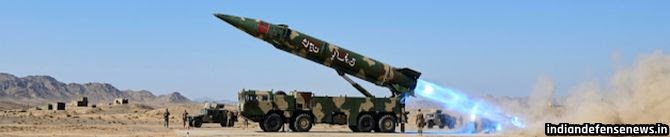
Within months of its inability to counter India during the 88‑hour conflict in May 2025, Pakistan announced the creation of the Army Rocket Force Command (ARFC).
This decision reflected Islamabad’s recognition of a new reality in which India’s armed forces are likely to respond to terror strikes with calibrated conventional operations that remain below the nuclear threshold. Such actions deny Pakistan the ability to invoke nuclear rhetoric and erode the sense of security it has traditionally derived from its strategic arsenal.
Pakistan’s failure to inflict significant damage on India during the conflict, despite deploying its air force, drones and Fatah‑series rockets, was a major factor behind the establishment of the ARFC. Indian air defences, centred on the S‑400 surface‑to‑air missile system, proved highly effective in blunting Pakistani attacks.
Islamabad attempted to claim that it had destroyed the S‑400 system, but this was quickly disproven when Prime Minister Narendra Modi visited the unit days after the fighting ended.
In his Independence Day address in 2025, Prime Minister Shehbaz Sharif explained that the ARFC was intended to strengthen Pakistan’s conventional strike capability.
The force was explicitly designed as a non‑nuclear entity, with nuclear‑capable missiles retained under a separate command structure. This marked a significant doctrinal shift, signalling Pakistan’s intent to consolidate its conventional rocket and missile assets under a unified command.
Operation Sindoor itself showcased India’s growing proficiency in non‑contact warfare. This approach seeks to minimise casualties by avoiding direct physical engagement and instead relies on cyber operations, unmanned systems, precision strikes, missile warfare, directed‑energy weapons, space capabilities and robotics.
It is heavily dependent on network‑centric warfare, battlefield transparency and advanced C4I2SR systems — command, control, communications, computers, information, intelligence, surveillance and reconnaissance — to deliver cohesive, technology‑driven military power. The United States and Israel have also demonstrated such methods in their strikes on Iran, while Iran itself has employed drones and ballistic missiles extensively in regional conflicts.
India began Operation Sindoor with missile, artillery and drone strikes across the Line of Control and the international border, describing them as attacks on terror infrastructure. Pakistan retaliated with drones, artillery, rockets and missiles against both civilian and military sites, but Indian defences blunted these assaults.
More than a year later, Pakistan has yet to provide credible evidence of successful strikes on Indian targets. India’s counter‑offensive destroyed gaps in Pakistan’s air defence radar coverage and struck 11 airbases critical for offensive air operations, forcing Islamabad to sue for peace.
Both nations drew lessons from the confrontation but pursued different priorities. India focused on strengthening its air defence network and enhancing strike capabilities, as highlighted by Prime Minister Modi in his Red Fort address.
Pakistan, meanwhile, announced the ARFC to bolster its conventional strike power and began exploring the acquisition of the Chinese J‑35 fifth‑generation fighter aircraft. The ARFC, modelled on China’s rocket force, is tasked with doctrine planning, procurement and sustenance, consolidating Pakistan’s conventional rocket and missile assets under one command.
The ARFC’s arsenal includes the Fatah‑1 rocket system with a range of 140 kilometres, the Fatah‑II with a reported range of 400 kilometres, and the A‑100 system, a Chinese design based on the Russian Smerch with a range of 100 kilometres.
The Fatah‑II was used during Operation Sindoor but was shot down near Sirsa, according to reports. The force is expected to integrate these systems into a cohesive conventional strike capability.
In his annual press conference earlier this year, General Upendra Dwivedi, who has since retired, revealed that the Indian Army is also considering raising a similar rocket force. If established, it would likely be equipped with conventionally armed Pinaka, Smerch, BrahMos, Suryastra and Pralay systems, thereby mirroring Pakistan’s move and further intensifying the conventional missile competition in South Asia.
ANI
