

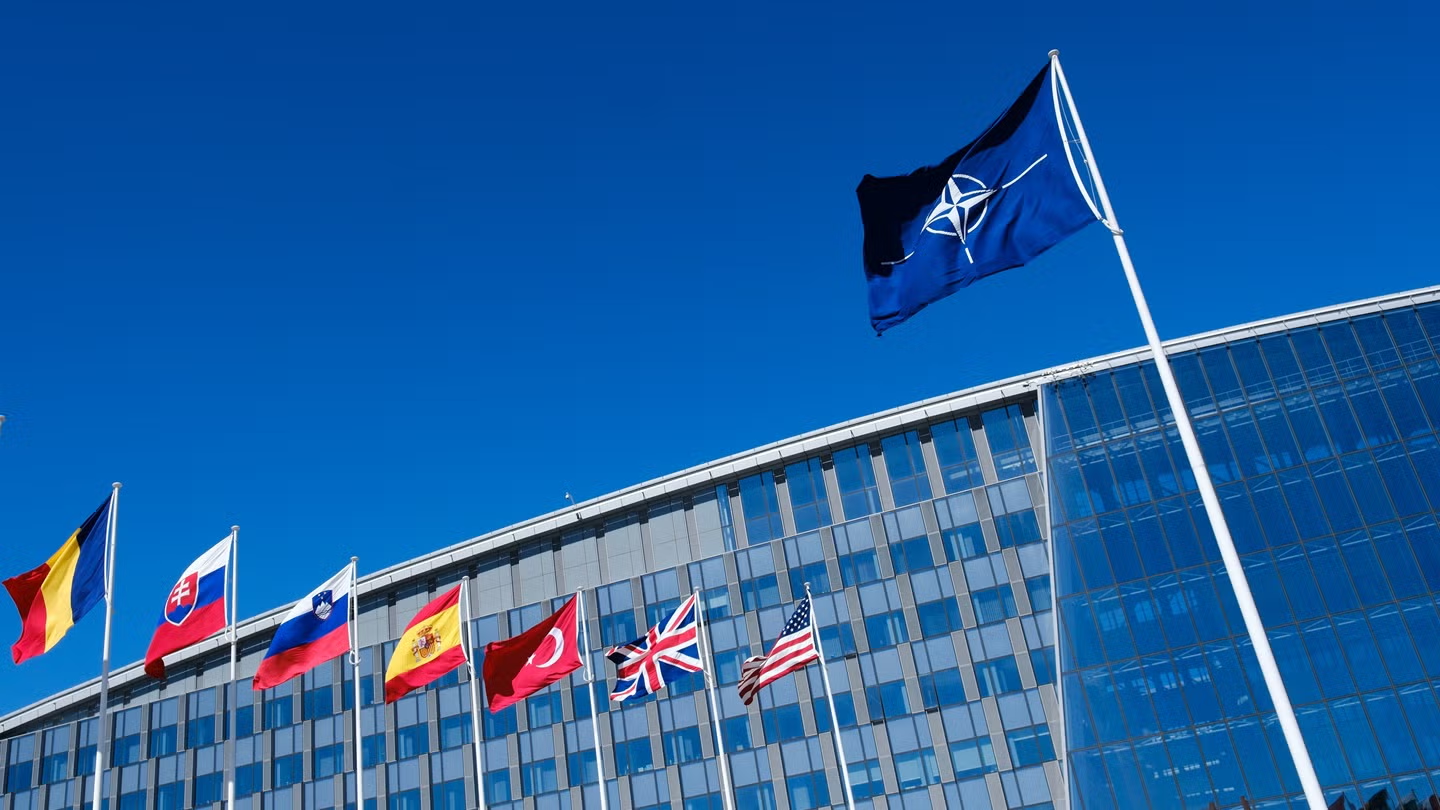
- The Belgian Minister of Defence points to transatlantic distrust ahead of the Nato Summit in Ankara
- Meanwhile, UK Prime Minister Keir Starmer insists Europe must fill the US vacuum
- Stepping up to Nato leadership, Europe will need to confront some existential questions about industrial capacity and C-UAS capabilities
Over a week ago, in Brussels, Belgium’s Minister of Defence Theo Francken reflected on the tribulations at the heart of the Nato alliance.
“We need to have trust,” he counselled as he unpicked the transatlantic divide, which he ascribed to America’s indefensible policies toward Europe and the resultant backlash among countries on the continent.
The US administration under President Donald Trump is seen to be weakening the military alliance through isolationism, trade war, undermining Ukraine and threats against allied territory, forcing Europe to retreat from its enduring reliance on the country’s military and technology.
“Every empire falls when you don’t have allies,” Francken warned as the superpower turns its back on the European theatre.
Other European leaders have similarly envisaged a Nato structure without the United States in some form. In his speech unveiling the overdue Defence Investment Plan (DIP), the UK Prime Minister Keir Starmer acceded to the US pivot, stating:
“While the US remains our key ally, I have been clear that in order to sustain Nato…. European nations must take primary responsibility for their own defence.”
During the Ankara Summit, which begins tomorrow (7 July), Europe will be hard pressed to confront existential questions about what form European leadership in Nato will take. But an answer can be found in Europe’s military commitment financially and the strategic direction of its defence market focus now and in the coming years.
Europe’s defence spending
Of course, Nato spending provides a sense of the wherewithal states are willing to expend for collective defence and security.
In this case, the Nato Secretary General’s Annual Report for 2025 shows a gradually increasing trend. Defence spending as a percentage of GDP for Canada and Europe (collectively) has risen noticeably from 1.62% in 2022 to 2.33% last year.
However, some countries, such as the UK, register a reduced commitment according to alliance figures.
But top-line percentages do not fully capture leadership potential. Other tangible factors such as industrial strength and defence market focus help to determine true military and strategic readiness.
Industrial capacity
There a different forms of deterrence. Foremost among them is a commitment to industrial capacity. The ability to sustain the production of defence systems at the point of need projects a strong defence posture to adversaries.
The consumption of advanced stand-off missiles during the US and Israeli war against Iran demonstrated this clearly after only seven days of the conflict.
Nato Secretary General Mark Rutte reiterated the same point on 10 June, commenting: “when you, all of you, produce more, our deterrence and defence posture is stronger, and we are all safer.”
While last year’s summit in The Hague concerned cash – where allies agreed to spend 3.5% of GDP on core defence by 2035 – Ankara will focus on scaling Europe’s defence industry.
One of the few clear commitments in the DIP that the UK will likely emphasise in Ankara is its ambition to build six new energetics factories by 2030 despite having no roadmap for delivering this objective.
Responding to trends
Another effective form of deterrence is shutting down any opportunity for adversaries to exploit weaknesses.
In this regard, Russia is probing Europe’s civil infrastructure in every domain, from subsea internet cables to satellites for banking transactions. Yet Europe has been slow to deploy a credible response to these so-called “grey-zone” attacks.
Some emerging technologies such as directed energy laser weapons are effective and cheap counter-uncrewed aerial system (C-UAS) systems but these have yet to be rolled out at mass. In the meantime, however, there have been glimmers of hope.
Although the UK was slow to respond to Iranian strikes against RAF Akrotiri in Cyprus earlier this year, the solutions it deployed have proven relatively successful. First among them was the use of Thales’ Martlet missiles from Wildcat helicopters.
This prompted the UK Government to finance the production of hundreds more low-cost missiles.
A more innovative solution is the development of Rapid Sentry, a short-range air defence system with a range of up to eight kilometres. The system combines Saab’s Giraffe 1X radar with a launcher for Martlet missiles.
Elsewhere, European defence companies are undertaking fast development cycles for interceptors, from Frankenburg’s Mark I mini missile (~2km range) to Cambridge Aerospace’s Skyhammer drone interceptor (~30km).

