

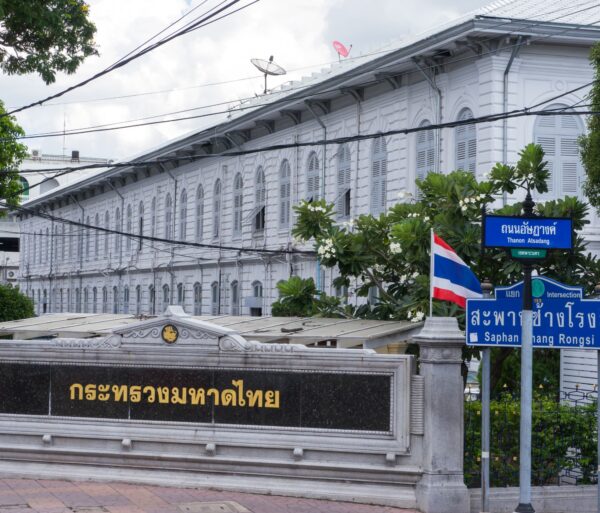
To many, suggestions for bureaucratic reform in Thailand are hollow slogans rather than viable policy undertakings. It is one thing to restructure government agencies, as Thailand is doing in real time by splitting its Tourism and Sports Ministry to merge tourism functions with the Culture Ministry. It is another thing entirely to tackle corruption and patronage networks, which has not been done in the eyes of the public. Worse still, a series of developments last month surrounding the Interior Ministry, the centralized body overseeing local administration and internal security, put alarming tendencies on display.
The first problem arose in mid-June at the level of the provincial leadership appointed by the Interior Ministry. Word spread online that the governor of Phuket, following his crackdown on illegal beach businesses operated under the protection of influential officials, was threatened with being booted out by one of his own deputies.
While the alleged source of discord is a familiar one in Phuket, a tourism and development powerhouse defined by varied and competing interests, the province’s growing notoriety as a hub for foreign nominee businesses, coupled with the publicized flaunting of powerful backing by a certain high-ranking member of the public service to bypass formal structures, prompted Prime Minister Anutin Charnvirakul to intervene directly in his concurrent capacity as Interior Minister. He swiftly approved the reshuffle of Phuket’s two deputy governors, Teerapong Chuaychu and Adul Chuthong, to the same positions in Nakhon Si Thammarat and Songkhla provinces, respectively. The accompanying expectation was that Nirat Pongsitthaworn, governor of Phuket since November 2025, would carry on with his duties. Yet he, too, was subsequently transferred to Bangkok as deputy permanent secretary of the Ministry.
As much as the sweeping turnover was probably intended to create a clean slate and improve governance efficiency, the narrowing of the space to pursue self-interest is what matters most. Besides, it is only when the public thinks the disputing parties are subject to unbiased treatment that there is an appreciation for leadership turnover. Because Nirat had already been deputy permanent secretary from 2020 to 2022, his reassignment to the same role naturally struck observers as a demotion, regardless of it being technically equivalent in rank to that of the governor. That Nirat’s former deputies found themselves in populous administrative centers hardly considered a “downgrade” further fed into the premise that whoever leverages stronger backing prevails in Thailand’s bureaucratic system.
The second problem centering around aspiring bureaucrats exploded in late June. Thailand’s Central Investigation Bureau uncovered an illicit network helping applicants cheat their way through the entry-level local government examinations in an exceptionally sophisticated manner, employing a hybridized method to alter physical answer sheets and manipulate digital records.
The scale was likewise unprecedented. In 2025, there were 6,669 vacancies under the Interior Ministry’s Department of Local Administration. Out of over 400,000 competing candidates, 9,000 utilized the cheating service to ensure success, paying between 150,000 baht ($4,503) and 900,000 baht ($27,019) individually depending on the intensity of competition in different local arenas. It is impossible for corruption at this level to take root without the complicity or direct orchestration of the moles already embedded within the bureaucracy. This is indicated in an awareness-raising publication by the Thammasat Testing Center – one of Thailand’s biggest examination conductors – which has been shared by the National Intelligence Agency.
The third problem is brewing in the realm of subnational electoral politics, involving the provincial administrative organizations (PAOs), municipalities, and subdistrict administrative organizations (SAOs). At the end of June, the Thai Senate passed an amendment bill to lift the eight-year cap on term limits and lower the minimum age from 35 to 25 for candidates running for PAO presidents, mayors, and SAO chiefs.
Arguments for these changes are soundly grounded in the logic of continuity and democratic freedom, encouraging citizens to keep choosing politicians who actually do their jobs – in turn incentivizing those politicians to continue running – and attracting greater participation from younger generations. But these qualities are not automatically produced. Even if politicians – especially the baan yai (local political dynasties literally dubbed “big houses”) – may not necessarily abuse the changes to entrench their power as skeptics would assert, the mere anxiety about this being the case already acts as a barrier deterring “clean” people from seeking public office.
The pervasive disfigurement of Thailand’s internal governance bodes poorly for the ruling Bhumjaithai Party, which has controlled the Interior Ministry since 2023 and increasingly holds sway over the Senate. Concerning the Interior Ministry, there was only a few-month-long transfer of power to the Pheu Thai Party in 2025. So, any mixed signals from the Interior Ministry, as demonstrated in the Phuket drama, are easily taken as reflecting internal tensions within Bhumjaithai’s leadership, and by extension the longevity of the government it leads. Curiously watched right now is the relationship between Bhumjaithai’s official leader and its founder who prefers to avoid the limelight, namely Anutin himself and Newin Chidchob.
One broader, longer-term implication of Thailand’s current predicament is whether local-level authorities can reliably address fluid security concerns. With reference to the National Security Policy (2023–2027), Thailand’s security apparatus has prioritized modernizing its gathering and evaluation of actionable intelligence while promoting area-based security for greater resilience, laying the foundation for the whole-of-society approach to protecting national interests. The Interior Ministry’s recruitment of questionable human capital directly subverts this effort, and its effects will gradually be felt.
The situation as it stands need not be viewed straightforwardly as a threat. Its high-profile exposure could be framed as a pretext to correct the flaws and rebuild public trust. One can only hope those in positions of power will choose to act rightly.
