

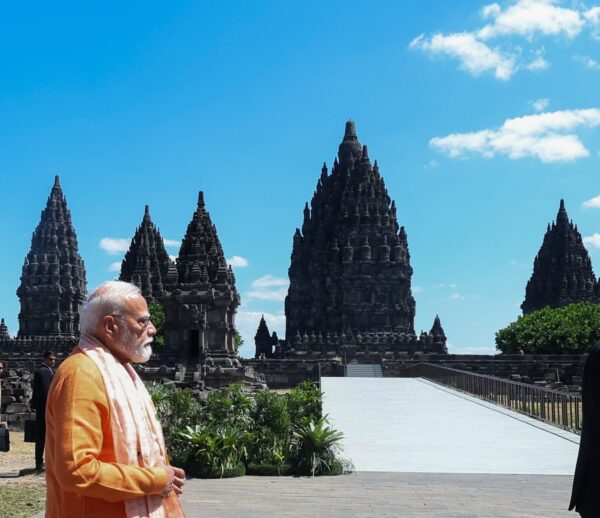
On July 6, Prime Minister Narendra Modi arrived in Jakarta for a two-day state visit. Indonesia was the first leg of Modi’s three-nation tour, which also includes official visits to Australia and New Zealand. This visit, which was Modi’s first standalone bilateral visit to Indonesia since both sides elevated their partnership to a Comprehensive Strategic Partnership in 2018, resulted in the two sides signing 20 memorandums of understanding (MoUs) or agreements, with substantive cooperation in areas including critical minerals, digital cooperation, maritime security, healthcare, agriculture, disaster management. India and Indonesia also agreed to continue work on the Sabang port project in Aceh.
However, it was the finalization of the long-pending agreement on cooperation in the field of defense, including the BrahMos missile system and Astra air-to-air missiles, that was the highlight of the visit. Although commercial details have not been disclosed, BrahMos Aerospace, an India-Russia joint venture missile manufacturer, reportedly signed a contract with Indonesia’s Defense Ministry to supply the BrahMos missile system, covering supporting infrastructure, operator training, and maintenance services. The estimated cost is $630 million.
Separately, Republikorp, Indonesia’s largest privately owned defense industrial holding company, signed an agreement with India’s Bharat Dynamics on air-to-air missiles, paving the way for Jakarta to induct India’s indigenous Astra beyond-visual-range missile.
Speaking to The Diplomat, Dinakar Peri, a fellow in the Security Studies program at Carnegie India, explained how the Astra sale could boost “Made in India” weapons. “Securing Indonesia as the first export market for Astra marks a breakthrough for India in a highly competitive, niche area, allowing New Delhi to position itself as a serious defense exporter and effectively opening the door for future defense sales to the wider ASEAN market,” Peri said.
What makes these defense deals different from a simple one-off procurement sale is the underlying commitment to build a durable defense partnership, highlighted in India’s commitment to support Jakarta’s ongoing defense modernization program through “experience and expertise sharing.”
At the third India-Indonesia Defense Ministers’ Dialogue last year, India proposed a Joint Defense Industry Cooperation Committee to strengthen collaboration in areas such as technology transfer, joint R&D, certification harmonization, and supply-chain linkages. As Indonesia looks to modernize its armed forces, officials in Jakarta view India as a “natural partner” due to its “growing defense-industrial base.” Indonesia has expressed interest in building a partnership with India through “genuine cooperation, technology transfer, and co-production rather than transactions alone.”
While the specifics around the broader issue of sharing advanced missile technologies remain undisclosed to the public, in May this year, during his visit to Singapore, Indian Defense Secretary Rajesh Kumar Singh said India has a strong commitment to “friendly foreign countries” (referring to the 11 ASEAN member states) with whom India “can share advanced defense technologies.”
On the question of introducing Indian military hardware into Indonesia’s notoriously fragmented defense inventory, Peri pointed out that Jakarta’s turning to New Delhi represents a streamlining of logistics, rather than adding a layer of complexity. Integration of the Astra missile adds another layer of cooperation to India and Indonesia’s existing partnership on Sukhoi maintenance and training.
Additionally, turning to New Delhi fits well with Indonesian President Prabowo Subianto’s own foreign policy approach, which is premised on diversification and independence and the “Good Neighbor Policy,” and seeks to maintain positive bilateral relations with major regional and global powers.
The road ahead for India’s defense sales will not be easy. India’s defense export ecosystem is still a “work in progress” with significant hurdles vis-à-vis overseas maintenance hubs, spare parts inventories, and what Lieutenant General D.S. Hooda described as the necessary “institutional culture of long-term customer support.”
Nevertheless, Modi’s visit to Indonesia highlighted how the defense relationship is evolving from military engagements to deeper cooperation in defense manufacturing, heralding a new era of cooperation and defense diplomacy between two key regional actors in the Indo-Pacific.
Despite being maritime neighbors, the pace of maritime security cooperation between New Delhi and Jakarta has been relatively slow, largely due to historic baggage and differing perceptions of the Indo-Pacific strategic geography.
Beyond periodic exercises and coordinated patrols, lack of real-time operational links has impeded cooperation in the maritime domain. Together with the decision to renew the coast guard maritime security arrangement, the posting of an Indonesian liaison officer at the Information Fusion Center-Indian Ocean Region (IFC-IOR) based in Gurugram in India is expected to not only significantly improve real-time maritime information-sharing but also enhance mutual trust between maritime security agencies of both countries and significantly contribute to collective domain awareness efforts.
Beyond defense and security, major outcomes on the economic side included cooperation on strengthening supply chains in critical minerals, rare earths, and steel, which included Indian investment in processing steel, nickel, and rare earth magnets in Indonesia.
During the visit, an MoU was signed between India-based private company Midwest Ltd, Indonesia’s state-run PT Perusahaan Mineral Nasional (PERMINAS), and the Non-Ferrous Materials Technology Development Center (NFTDC), marking the first time that a private Indian enterprise has secured overseas rare earth assets to build global supply chains. Under the agreement, Midwest Energy and NFTDC will contribute technology and operational expertise in establishing the rare earth magnet manufacturing plant, while PERMINAS will provide critical mineral resources for joint development.
A separate MoU was signed between Steel Authority of India Limited (SAIL) and PT Krakatau Steel to set up a steel manufacturing facility in Indonesia. Both sides also agreed to accelerate preferential trade agreement talks.
Overall, the visit paved the way for greater economic integration and deeper security cooperation between Delhi and Jakarta, with the potential to move the relationship beyond symbolism to deeper operational cooperation. However, to achieve this, it will be necessary to keep up the political tempo of bilateral relations. For now, it seems that New Delhi and Jakarta are seizing the moment to shape an Indo-Pacific security architecture that favors regional agency, which is arguably the key outcome of this visit.
