

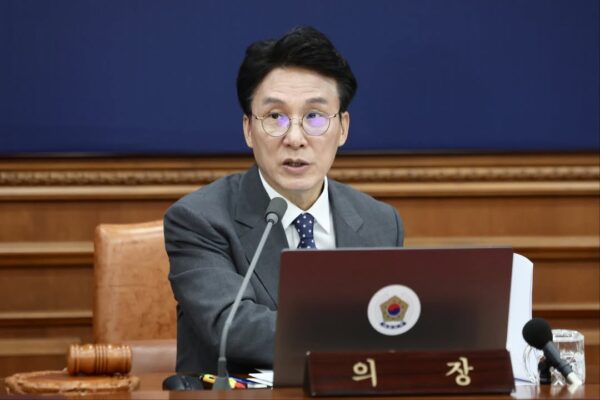
On July 7, former South Korean Prime Minister Kim Min-seok declared his candidacy in the upcoming election to determine the next chair of the ruling Democratic Party. In doing so, Kim accused Jung Chung-rae, a former leader of the DP, of self-serving politics that kept the party from converting President Lee Jae-myung’s approval ratings into legislative wins.
The race will likely be intense. Jung is expected to formally announce his candidacy in the coming days; he resigned his post last month to run for the election. Son Yong-gil, a six-term lawmaker who returned to the National Assembly after winning a June 3 by-election, and Ko Min-jung, a National Assembly member and former TV and radio host, also joined the race on July 8.
According to a local pollster, Kim leads Jung by 21 percentage points among DP supporters, with 45 percent support compared to Jung’s 24 percent. However, it is still unclear who will win the race since the DP, for the first time, will weigh votes from ordinary dues-paying members equally with those of convention delegates. The previous party leadership election system gave a delegate’s vote roughly 17 times the weight of a rank-and-file member’s. Jung pushed the change through as his signature reform earlier this year, arguing it would strengthen party sovereignty.
President Lee is a DP member, and the party also controls 161 of the National Assembly’s 300 seats, along with the speakership and the chairmanship of the Legislation and Judiciary Committee, which vets every bill before a final vote. There is no excuse for gridlock, yet complaints have persisted inside and outside the presidential Blue House that the DP is not moving fast enough. Lee himself has voiced frustration at Cabinet meetings over the pace of legislation and the party’s failure to translate its legislative majority into passed bills.
That backdrop puts Jung in an awkward position. His year as party leader coincided with the complaints about the DP’s strategy, which has made many pro-Lee members of the party hold Jung personally responsible for the sluggish pace of legislation. His campaign thus reads less as a bid to serve Lee’s agenda than as an effort to protect his own bloc’s standing within the party. Stepping aside would likely cost Jung’s faction control over DP nominations for the next general elections in 2028.
Meanwhile, Kim and Song are functioning as something close to a single ticket. Both have targeted Jung directly, and Song has said he would drop out if his campaign risks splitting the anti-Jung vote. Ko’s entry complicates that calculus. A former spokesperson for previous President Moon Jae-in, Ko is campaigning on generational change and the retirement of the party’s senior cohort. She draws from a pro-Moon base close to Jung’s own, and it remains unclear whether her candidacy will pull votes from Jung or simply give younger members somewhere else to go. Given her reputation as “anti-Lee” – a label she denies – and the baggage that entails in today’s DP, many expect Ko to drop out of the race in the coming weeks.
While the DP’s chair race is shaping up to be a fierce competition, the opposition People Power Party offers a striking contrast in how it has handled its own leadership crisis. Even after the PPP’s devastating defeat in the June 3 local elections, party leader Jang Dong-hyuk has refused to resign. Instead, he has threatened disciplinary action against members who criticized his leadership. Where the DP has turned accountability for a mixed result in the June elections into the entire premise of its leadership race, the PPP has shown little internal appetite to force out a leader who presided over defeat.
