

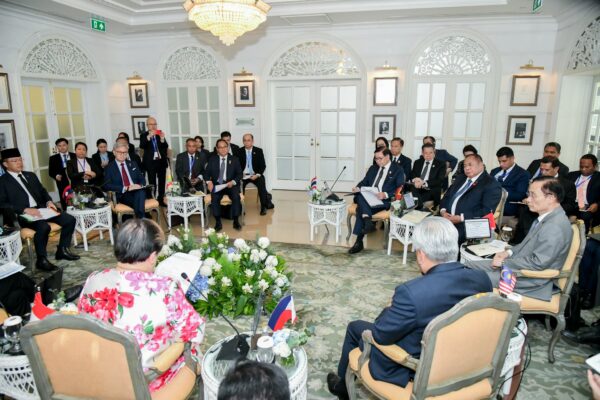
Myanmar’s foreign minister yesterday met with his counterparts from the Association of Southeast Asian Nations (ASEAN) for the first time in five years, in an effort to revive a regional peace initiative intended to resolve the country’s civil war.
At a summit in May, the 11-nation bloc agreed to an informal meeting with Tin Maung Swe, the foreign minister of Myanmar’s new military-backed civilian government, which took office in April. Since then, the new government has launched a campaign to normalize its relationships with its major neighbors, including ASEAN.
The bloc has excluded Myanmar from the bloc’s summits since late 2021, due to its lack of implementation of the Five-Point Consensus, ASEAN’s roadmap for the management of the country’s conflict. The Consensus, which was agreed at a special ASEAN meeting in April 2021, calls for an immediate cessation of violence and inclusive dialogue involving “all parties” to the conflict.
Yesterday’s meeting involved both an informal meeting between Tin Maung Swe and his ASEAN counterparts, the first to take place since the 2021 coup, and a second session involving just the latter. The meeting was attended by foreign ministers from every member state except Cambodia and Malaysia, which was represented by Foreign Ministry Secretary-General Tan Sri Amran Mohamed Zin.
Speaking to reporters after the meetings, Philippine Foreign Secretary Ma. Theresa Lazaro said that Tin Maung Swe had given the meeting a “comprehensive briefing” covering the Myanmar military’s peace efforts, the status of ousted civilian leader Aung San Suu Kyi, and cooperation against cross-border scam operations, trafficking and drug trafficking.
Thai Foreign Minister Sihasak Phuangketkaew, whose government brokered yesterday’s meeting and has led the push to bring Myanmar back into the “ASEAN family,” said that Bangkok supported an approach of “calibrated engagement” with Naypyidaw. Sihasak said that ASEAN’s member states reaffirmed their commitment to the bloc’s Five-Point Consensus, but added that “the key issue here is what is the strategy to implement it.”
He added that engagement was a “two-way street,” and said that the Myanmar side “has to reach out as well to address the concerns of ASEAN and the concerns of the international community.” In a separate press interview, he described the meeting as an “icebreaker.”
One of the main issues during the discussions was the status of Aung San Suu Kyi, the elected civilian leader who has removed in the 2021 coup and has been in custody ever since. In May, the new military-backed government announced Suu Kyi’s relocation from prison to house arrest, but it has since rebuffed a request by Lazaro, ASEAN current special envoy on Myanmar, to be granted a meeting with the 81-year-old.
Tin Maung Swe said that the ousted leader was in good health and would be looked after, Lazaro told yesterday’s press conference.
“The premise of how he said is that she is a relative, she is a sister, and therefore, we will take care of her,” Lazaro said, as per Inquirer.net.
Sihasak added that his ASEAN counterparts “clearly spelled out our expectations” of progress, and called for access to Suu Kyi “so that we can be able to verify the claims” that she was in good health.
However, there remains a wide gap between ASEAN’s avowed expectations and the views that prevail in Naypyidaw. Since agreeing to the Five-Point Consensus in April 2021, Myanmar’s military has done little to implement its most important goals, instead focusing its attention on defeating its opponents by force of arms. Last week, the military-dominated Myanmar parliament passed a motion rejecting the Consensus as a form of interference by ASEAN that was inconsistent with the country’s “political reality.”
Myanmar’s new government is clearly hoping to achieve a full normalization with ASEAN while maintaining a free hand to deal with its enemies as it sees fit. In a statement, Myanmar’s Foreign Ministry said that yesterday’s meeting discussed enhancing relations and “constructive cooperation for the restoration of Myanmar’s full and equal participation in ASEAN.”
For this reason, human rights organizations and armed groups have criticized the meeting.
In a statement, ASEAN Parliamentarians for Human Rights (APHR) said that the bloc’s member states should reject any “steps toward legitimizing Myanmar’s military junta.”
“ASEAN must not fall into the junta’s trap,” Mercy Chriesty Barends, an Indonesian MP who serves as the chair of APHR, said in a statement. “Time and again, ASEAN has rewarded the junta’s non-compliance instead of holding it accountable for its crimes against the people of Myanmar.” The Special Advisory Council for Myanmar, which is made up of former and current U.N. experts, said that meeting with Tin Maung Swe “would undermine ASEAN’s own Five-Point Consensus (5PC) and reward the junta’s bloodshed and recalcitrance.”
Lazaro defended the decision to meet with Myanmar Foreign Minister Tin Maung Swe and said the bloc was already seeing progress on humanitarian access, one of the goals of the Five-Point Consensus.
“It can’t be done in one stroke,” she said. “It’s evolving and I think all of these engagements are very important.”
Lazaro said that she planned to make a second trip to Myanmar later this year, while Thailand is working to facilitate talks between Myanmar and ethnic armed groups along the two countries’ border. The progress will then be reviewed at the next ASEAN Summit at the end of the year.
