

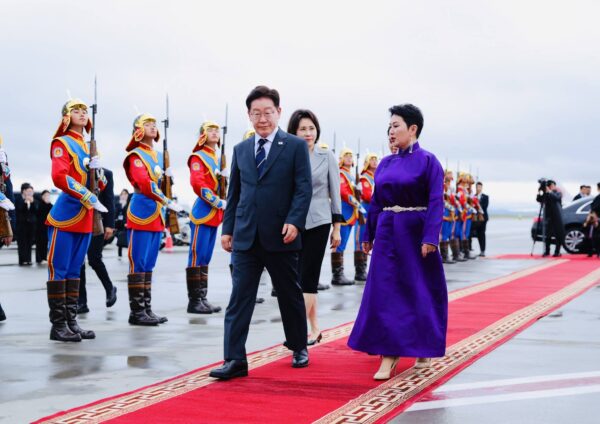
South Korea’s President Lee Jae-myung paid a state visit to Mongolia from July 9-11, following his attendance at the NATO Summit in Turkiye. Lee’s trip marked the first visit to Mongolia by a South Korean head of state in 15 years, and underscored a major boost in the two countries’ strategic partnership, particularly cooperation in critical minerals, health, education, and Northeast Asia’s peace and security environment.
Lee’s visit emphasized a new level of Mongolia-South Korea partnership in a changing regional geopolitical environment. Ahead of the state visit, in an interview with Mongolia’s state news agency, Montsame, Lee stated: “I hope this visit will be a step toward opening a ‘New Golden Era’ of Mongolia-Korea relations together.”
The state visit indeed concluded with Mongolia and South Korea announcing a “Golden Era of Korea-Mongolia Relations.” The two countries signed 21 cooperation agreements, including a landmark Comprehensive Economic Partnership Agreement (CEPA), effectively serving as a free trade agreement between the two economies. In early June, trade ministers from both sides met in Ulaanbaatar to push the CEPA, and they reached a “principle agreement” during Lee’s state visit. Among the commitments, South Korea will eliminate tariffs of 2 to 5 percent on imports of Mongolian minerals, including copper and molybdenum. Mongolia will reduce or eliminate tariffs on cosmetics, trucks, and construction equipment from South Korea.
South Korea’s interest in the deal is clear: finding new sources of raw materials for its technology industry. Given South Korea’s advanced manufacturing industries in steel, automotives, and semiconductor, the country consumes roughly $120 million high-purity molybdenum powder.
Additionally, South Korea’s interest in becoming more active in the defense industry and manufacturing makes Mongolia’s natural resources a strategic asset. For Mongolia, South Korea’s investments are crucial to ongoing diversification efforts – even though the funds are still being channeled into the mining sector.
The economic side of the relationship was on display. Lee was accompanied by a large delegation of business leaders, and around 300 business representatives from 40 entities participated in the Mongolia-South Korea Business Forum during him time in Mongolia. Participants included POSCO Holdings chair Jang In-hwa, Kakao Bank CEO Yoon Ho-young, and Jang Byung-ho of Hanwha Investments and Securities.
The forum served as a platform for business leaders and interested parties to discuss future opportunities in critical minerals, supply chain, logistics, and investments. From the Mongolian side, conglomerates such as MAK, MCS Group, and Tavan Bogd Group participated, and 40 others attended the Special Export Consultation Session.
In his opening remarks at the Business Forum, Mongolian President Khurelsukh Ukhnaa recognized the two countries’ strategic partnership and again noted the Golden Era of Mongolia-South Korea relations. Khurelsukh also welcomed Mongolia-South Korea joint ventures as growing strategic partners.
In the last ten years, South Korean chaebol have increased their footprints in Mongolia. According to South Korea’s Ministry of Trade, Industry, and Energy, and the Korea Trade Association, South Korea has invested over $1.1 billion in Mongolia, around 1.6 trillion Korean won.
South Korea’s retail and digital services have been successful in Mongolia, making Ulaanbaatar a major consumer market. Retail and quick stop shops such as GS25 and CU Mongolia can be found on every corner in Ulaanbaatar, making it one of the most lucrative South Korean business ventures in the country.
Attracting FDI is an ongoing focus for Mongolia. Mongolia’s new Prime Minister Uchral Nyam-Osor, who has been in office for 100 days now, unleashed several pro-business initiatives such as Unlock Mongolia, with the hope to attract diverse investments by reducing regulatory risks and bureaucracy. Mongolia remains hopeful for diverse investment flows from South Korea.
Beyond the economic sphere, Mongolia and South Korea signed cooperation agreements between government agencies ranging from healthcare, education, agriculture, critical minerals, and clean energy transition. South Korea pledged to establish Mongolia’s second national cancer center, and the two sides will deepen cooperation in scientific, technological, and digital development. Considering the high number of cultural exchanges between Mongolia and South Korea, and the number of Mongolians living in Korea, the two countries agreed to mutual recognition of driver’s licenses.
Mongolia and South Korea’s diplomatic relations and their strategic partnership is also crucial in the context of Northeast Asia’s geopolitics. Both Seoul and Ulaanbaatar share a peaceful vision for the region and seek cooperation with other states in the region, like Russia, China, and Japan. Despite North Korea’s nuclearization and intermittent hostility toward South Korea, as Pyongyang becomes more open for diplomacy and economic engagements, Seoul remains hopeful about Mongolia’s active participation in mitigating inter-Korean tensions.
These converging interests were illustrated by South Korea’s Unification Minister Chung Dong-young during the 2026 Ulaanbaatar Dialogue on Northeast Asian Security, which took place in early June in Mongolia. Lee reiterated this position during his state visit. “Mongolia, as a trusted partner for peace that also maintains dialogue with North Korea, can play a significant role built on the trust it has accumulated in the region,” he told Montsame.
With Lee’s successful state visit to Mongolia, the Mongolia-South Korea “Golden-Era” partnership has a new to-do list. The two countries must close the trade imbalance by increasing Korean investments into Mongolia’s infrastructure, clean energy, and development projects as opposed to keeping Mongolia as a consumer hub. As Mongolia’s Uchral administration looks to create a more business-friendly environment, Mongolia hopes to continue to attract South Korean investments in diverse sectors of the country.
